
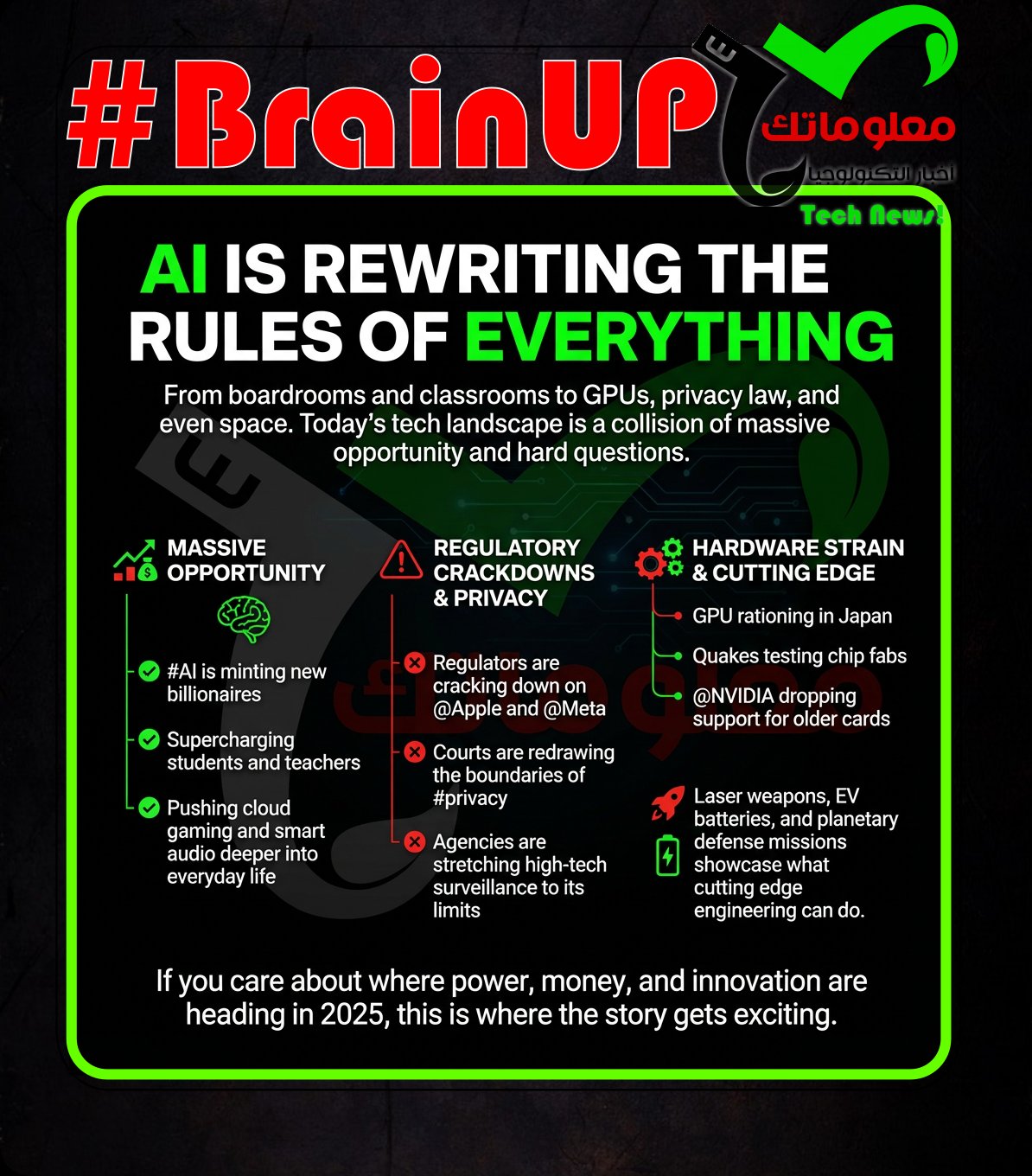
#BrainUp Daily Tech News – (Sunday, December 28ᵗʰ)
Welcome to today’s curated collection of interesting links and insights for 2025/12/28. Our Hand-picked, AI-optimized system has processed and summarized 20 articles from all over the internet to bring you the latest technology news.
As previously aired🔴LIVE on Clubhouse, Chatter Social, Instagram, Twitch, X, YouTube, and TikTok.
Also available as a #Podcast on Apple 📻, Spotify🛜, Anghami, and Amazon🎧 or anywhere else you listen to podcasts.
1. Apple seeks to appeal £1.5bn ruling it overcharged UK customers
Apple is pursuing an appeal against a £1.5bn ruling accusing it of overcharging UK customers by inflating prices on its devices through restrictive contract terms. The ruling found that Apple imposed unfair terms that limited retailers’ ability to discount products, resulting in higher prices for consumers. This legal battle highlights ongoing tensions about #consumerprotection and #digitalmarketregulation in the tech industry. Apple’s appeal aims to overturn the decision, which could set a significant precedent for how technology companies manage pricing strategies and contractual conditions in the UK. The case underscores the scrutiny Apple faces from regulators and courts about its market conduct and pricing policies.
2. ICE Expands Use of High-Tech Surveillance Amid Reduced Privacy Regulations
ICE has increased its deployment of #high-tech surveillance tools while privacy guardrails protecting U.S. residents have been reduced. Reports reveal the agency’s growing reliance on facial recognition, cellphone tracking, and artificial intelligence to monitor and apprehend individuals. This expansion raises significant civil liberties concerns as it often targets marginalized communities with minimal oversight. Privacy advocates warn the diminished regulations diminish accountability and risk broad abuses. The development highlights a tension between technological enforcement advances and the need to safeguard constitutional rights.
3. Salesforce Executives Say Trust in Generative AI Has Declined
Salesforce executives report a decline in trust towards generative AI due to increased misinformation and ethical concerns. The company has noted challenges in managing the balance between innovation and user confidence as #AI technologies rapidly evolve. This shift impacts how Salesforce integrates generative AI into its products and the cautious approach towards deployment. The trend reflects broader industry skepticism as users and companies reassess the implications of #generativeAI on security and reliability. Salesforce’s experience underscores the need for transparent AI development and stringent safeguards to restore and maintain trust.
4. Google’s privacy policy: The fine print that waives your rights to scrutiny
@PennsylvaniaSupremeCourt ruled that police may access a person’s Google search history without a warrant, arguing that users consent to surveillance through @Google’s privacy policy. The court cited that websites, internet-based applications, and providers collect and sell user data, and that @Google expressly informed users they should not expect privacy when using its services, a claim tied to #privacyPolicy. It authorized a ‘reverse keyword search warrant’ to obtain the IP address of users who googled the victim’s name or address, with the IP traced to the defendant’s residence. The justices noted that while the data trail is created by internet use, it is not involuntary in the same way as carrying a cell phone, highlighting a privacy trade-off between public safety and rights. The decision raises ongoing questions about #FourthAmendment protections in the digital age and whether consent via privacy policy sufficiently preserves individual privacy.
The global memory crunch is tightening the supply of high-capacity GPUs in Japan, with retailers rationing cards with 16GB VRAM and up. ITmedia reports that Akihabara shop Tsukumo eX is limiting purchases to one GeForce RTX 5060 Ti 16GB or higher, or a Radeon RX 9000 series or higher, and other shops say GPUs with 8GB VRAM or more are becoming harder to restock. The shortage is driven by AI data-center demand and a shift by memory makers away from consumer GPU output, with @Nvidia reportedly no longer supplying VRAM to board partners, constraining supply further and leaving @AMD and others to fill the gap #memorycrunch #VRAM. Even if production expands, it will take years to normalize, so the situation in Japan reflects a broader, long-running memory crunch that could keep prices elevated for memory-heavy GPUs.
6. OpenAI’s ChatGPT ads will allegedly prioritize sponsored content in answers
OpenAI plans to introduce ads in ChatGPT, which will prioritize sponsored content in responses as part of a monetization strategy. According to reports, the ads could influence the AI-generated answers by promoting certain brands or products, raising concerns about the impartiality of information provided. This approach suggests a shift in how AI models like #ChatGPT balance user trust against commercial interests, potentially affecting user experience and perception. Critics argue that blending advertising with AI responses may compromise content authenticity and ethical standards in AI deployment. As OpenAI explores revenue generation, the impact of integrating sponsored content within AI interactions highlights ongoing tensions between innovation, user trust, and monetization.
7. Why do airline computer systems fail? What the industry can learn from meltdowns
Airline operations depend on a #fragile, interconnected suite of systems built from multiple vendors, and outages can ground flights. Alaska Airlines grounded planes in July after an unexpected failure in hardware at a data center, followed by a later outage that canceled more than 100 flights and left staff overwhelmed. Experts like @Eash Sundaram warn that there is little commercially available software for core airline functions, so systems are cobbled together; when one piece falters, cascading outages can shut down the network. @Tony Scott, former CIO of Microsoft, describes the architecture as a ‘spider’s web’ of technology built over time by different hands, a design you wouldn’t choose if you started from scratch. The industry can learn from these disruptions about the need for more cohesive design, resilience, standardized tools where possible, and stronger incident recovery to prevent future meltdowns.
8. Zuckerberg settles $8 billion lawsuit over Cambridge Analytica scandal, avoids testifying
@Mark Zuckerberg and current and former Meta executives agreed to settle an $8 billion shareholder lawsuit alleging privacy violations tied to #CambridgeAnalytica, avoiding testimony in the Delaware Court of Chancery. Judge Kathaleen McCormick adjourned the trial just as it was to enter its second day, with plaintiffs’ lawyer saying the agreement came together quickly, and the case was to feature testimony from former board members such as @Peter Thiel and @Reed Hastings. The plaintiffs argued that Zuckerberg and other directors failed to oversee compliance with the 2012 FTC order after the regulator fined Facebook $5 billion in 2019 for data harvesting and privacy violations, underscoring ongoing #privacy and #FTC concerns. Some observers, including @Jason Kint, said the settlement provides relief but amounts to a missed opportunity for public accountability and corporate governance oversight. The case notes that Facebook changed its name to Meta in 2021 and that Meta itself was not a defendant, highlighting continuing questions about responsibility for user data.
9. Father tracks kidnapped daughter using phone’s parental controls, authorities say
A 15-year-old girl kidnapped on Christmas Day from the Houston suburb of Porter, Texas, was located by her father using the phone’s #parental_controls. That tracking led to a secluded, partially wooded area in Harris County about two miles from Porter, where the girl and her dog were found inside a maroon pickup truck with a partially nude 23-year-old man. The father helped his daughter escape and called authorities; the man, Giovanni Rosales Espinoza, was arrested without incident and charged with #aggravated_kidnapping and #indecency_with_a_child after allegedly threatening the girl with a knife. Espinoza remains in the Montgomery County Jail with no bond, and authorities said there was no immediate information on his legal representation. Sheriff Wesley Doolittle praised deputies and detectives for swiftly apprehending the suspect and stressed ongoing vigilance to keep families safe.
10. AI has become the norm for students. Teachers are playing catch-up.
AI has become a norm in classrooms, with teachers negotiating how to use it effectively while grappling with policy and privacy questions. At a NYC training organized by the National Academy for AI Instruction—a collaboration of @American Federation of Teachers, its NYC affiliate @United Federation of Teachers, and private-sector AI firms including @OpenAI and @Anthropic—about 50 teachers tested AI tools for lesson planning, student engagement, and even water consumption, receiving detailed answers from chatbots. The tools are already reshaping work: a geometry teacher said AI can cut PowerPoint prep from 15 minutes to two to three minutes. National data backs the trend: 84 percent of high school students use #generativeAI for schoolwork, and more than half of grade-school teachers use AI for their work. In NYC, the district briefly banned ChatGPT in 2023 over concerns that it does not build critical-thinking and problem-solving skills, then reversed course in late 2024 as schools experiment with AI in varying degrees, while April Rose, a teacher at Public School 132 in Queens, remains cautious but wants to learn more.
11. The rise of prediction markets and why they matter
The article explores how prediction markets have grown in popularity as tools for aggregating collective expectations about future events, ranging from elections and economic indicators to sports outcomes and even geopolitical risks. These markets work by letting participants buy and sell contracts that pay out based on the outcome of a specific event, with prices reflecting the probability that the community assigns to that outcome. Proponents argue that these markets can outperform traditional polling and expert forecasts because they harness diverse viewpoints and financial incentives, forcing traders to put real money behind their beliefs. Critics raise concerns about legal and ethical boundaries, especially where markets touch on sensitive areas or could be manipulated by insiders with privileged information. The piece also explains how technological innovations and regulatory shifts are making prediction markets more accessible and how they could reshape how we anticipate and respond to uncertainty across society.
Definition: Prediction market
A prediction market is a speculative exchange where individuals trade contracts whose payoff depends on the outcome of future events. The price of each contract is interpreted as the collective market probability of the event happening, allowing aggregated crowd wisdom to form a real-time, data-driven forecast that can often rival or surpass traditional expert predictions in accuracy.
12. TSMC says some facilities evacuated after quake
TSMC reported evacuations at some of its facilities following an earthquake in Taiwan, a region known for its significant role in the global semiconductor supply chain. The company promptly initiated safety protocols to ensure employee safety and assess any potential damage to its operations. Although some disruption occurred, TSMC emphasized that production has not been severely impacted at this stage. This incident highlights the vulnerability of critical technology infrastructure to natural disasters and the importance of resilient contingency measures. TSMC’s quick response aims to minimize impact on its manufacturing output and uphold its critical position in the semiconductor industry.
13. Austria’s top court rules Meta’s ad model illegal, orders overhaul of user data
Austria’s Supreme Court declared Meta’s targeted advertising model illegal due to inadequate user consent, requiring the company to overhaul its data processing practices by 2025. The court found Meta’s current system fails to comply with the EU’s General Data Protection Regulation, noting that users are not clearly informed or given a genuine choice regarding personal data use. This ruling challenges the foundation of Meta’s ad-driven business by emphasizing stronger privacy defenses and transparency. It may set a precedent for stricter regulatory scrutiny of digital advertising practices across Europe, impacting broader industry standards. The decision underscores the increasing legal pressure on tech giants like Meta to align data usage with user rights and regulatory demands.
A Ford F-150 Lightning owner spent 26 months charging to 100% nightly for 60,000 miles, challenging the usual EV guidance that keeping a battery at full harms longevity. He used an EVIQO charger on a 40-amp circuit, charging at 38A to 100% most nights and letting the pack sit at full for hours, yet a diagnostic after the lease showed the battery retained full health with no degradation. He later turned in the lease and bought a 2025 Lariat ER, planning to drive up to 100,000 miles, with the diagnostic confirming a pristine battery. @ArmenHareyan provides analysis on why the battery may stay intact, in a Torque News YouTube breakdown referenced by the piece. The article also frames the story within the broader context of #FordF150Lightning configurations and capabilities, highlighting how design and usage shape perceptions of #EV battery stress, #EVIQO charging setups, and related considerations.
15. Five of the most insane military lasers that reshaped defense in 2025
The article portrays 2025 as a watershed year when laser weapons graduate from concept to deployable force multipliers, reshaping defense expectations. It notes the introduction of several laser systems that demonstrate the rapid maturation of directed-energy tech and their growing battlefield relevance. This acceleration drives strategic recalibration, pressuring militaries to rethink detection, defense, and engagement timelines as engagements can occur at the speed of light. As #laser_tech and related countermeasures evolve, the balance of power and policy debates surrounding rules of engagement are likely to intensify.
16. AI Could Create 50 New Billionaires by 2025, Startup Investment Surging
Artificial intelligence is projected to create 50 new billionaires by 2025 due to robust startup investment, highlighting AI’s expanding economic influence. Data from a recent report indicates that venture capital funding in AI startups is surging, with significant contributions from major firms and investors eager to capitalize on AI innovation. The rapid growth in AI suggests that entrepreneurs focusing on this technology will have unprecedented opportunities to generate wealth. This trend underscores AI’s transformative impact across industries and emphasizes the potential for continued investment and development in the sector. As AI continues to evolve, its role in shaping new business leaders and billionaires is increasingly evident.
17. Samsung’s two new speakers will deliver crisp audio while blending into your decor
Samsung has introduced two new speakers designed to offer high-quality audio while seamlessly integrating into home aesthetics. The speakers focus on delivering crisp sound with a minimalist design that complements various decor styles, highlighting Samsung’s commitment to both function and form. These devices incorporate advanced #audio technology to ensure clarity and performance that meet consumer expectations for home entertainment. By balancing sound quality with visual appeal, Samsung aims to enhance the listening experience without disrupting the interior ambience. This approach aligns with broader trends in #smart home technology, where devices combine utility with stylish design.
18. Legion Go systems join MSI and ASUS with Xbox full screen experience
Lenovo’s new Legion Go handheld gaming system supports Xbox Cloud Gaming, joining MSI and ASUS in offering a full-screen Xbox experience on portable devices. This integration enables gamers to stream Xbox games directly with native controller support and a dedicated Xbox button for seamless access. The collaboration highlights a growing trend where major PC manufacturers incorporate cloud gaming technologies to enhance portability and gaming flexibility. This development benefits gamers by expanding options for playing Xbox Game Pass titles on diverse hardware platforms beyond traditional consoles. Lenovo’s move aligns with Microsoft’s efforts to broaden Xbox gaming reach through partnerships with established PC brands like MSI and ASUS.
19. NVIDIA Drops Pascal Support On Linux, Causing Chaos On Arch Linux
@NVIDIA is gradually dropping support for older GPUs, with the #Pascal family among the latest to lose official Linux support, which has sparked chaos on @ArchLinux after updates break the driver. On these systems, upgrading with a Pascal or Maxwell GPU can cause the new driver to fail to load and drop users back to the CLI. The Arch Wiki provides a starting point, and the workaround centers on a legacy driver from the #AUR, maintained by @ventureo of the #CachyOS project, which preserves compatibility but feels sketchy. Using this legacy option breaks Steam due to its reliance on official NVIDIA dependencies, requiring a series of hacks to try to restore functionality. Beyond this, the alternative #Nouveau path remains reverse-engineered with its own drawbacks, illustrating how fragile Linux driver support can be for older cards and why the Arch experience matters to users.
20. Asteroid Apophis ESA and JAXA Mission
Asteroid Apophis has become a significant focus for the European Space Agency (ESA) and the Japan Aerospace Exploration Agency (JAXA) due to its close approach to Earth and potential impact risk. The asteroid’s trajectory will bring it near Earth in 2029, prompting joint missions to better understand its composition and path. ESA and JAXA plan to collaborate on advanced spacecraft to gather detailed data, which will improve impact prediction models and develop potential mitigation techniques. This collaboration exemplifies a growing international effort to address planetary defense challenges posed by near-Earth objects. Their mission highlights the importance of scientific cooperation in enhancing Earth’s safety from asteroid threats.
That’s all for today’s digest for 2025/12/28! We picked, and processed 20 Articles. Stay tuned for tomorrow’s collection of insights and discoveries.
Thanks, Patricia Zougheib and Dr Badawi, for curating the links
See you in the next one! 🚀
