
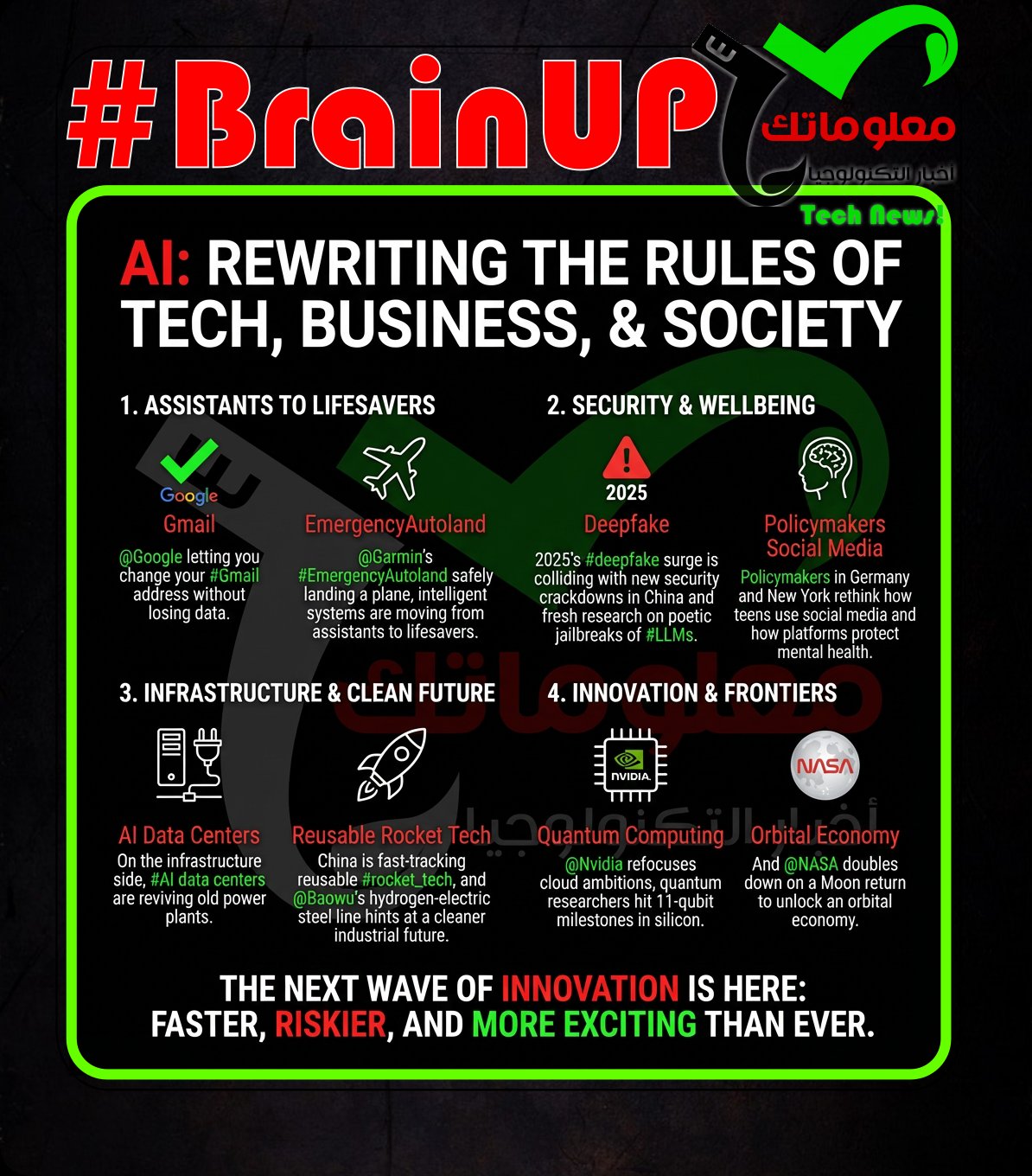
#BrainUp Daily Tech News – (Saturday, December 27ᵗʰ)
Welcome to today’s curated collection of interesting links and insights for 2025/12/27. Our Hand-picked, AI-optimized system has processed and summarized 27 articles from all over the internet to bring you the latest technology news.
As previously aired🔴LIVE on Clubhouse, Chatter Social, Instagram, Twitch, X, YouTube, and TikTok.
Also available as a #Podcast on Apple 📻, Spotify🛜, Anghami, and Amazon🎧 or anywhere else you listen to podcasts.
1. Google is rolling out a new feature allowing users to change their Gmail address
Google is rolling out a feature that lets Gmail users change their address while preserving data and services, a notable shift in #emailpolicy for @Google’s #Gmail. The update appears to be tested and currently visible on Hindi support pages, suggesting a rollout may begin in India, with old addresses kept as aliases and emails continuing to arrive in the original inbox. Under the new policy, the original address remains as an alias and can still be used to sign in to Google services like Drive, Maps, and YouTube, while existing data such as photos and messages stays unchanged. The English page still states that @gmail.com addresses usually cannot be changed, indicating a staged rollout with regional limits and added constraints such as a 12-month ban on creating another Gmail address after a change and a prohibition on deleting the new address. If the rollout completes globally, it could simplify identity management across #Gmail and other @Google apps for users, reducing the need to recreate accounts or manually migrate data.
2. Garmin autopilot lands small plane without pilot’s help
The FAA confirmed that Garmin’s Emergency Autoland system autonomously guided a Beechcraft Super King Air to a safe landing at Rocky Mountain Metropolitan Airport in Colorado after a loss of communications and a rapid pressurization issue, marking the first known successful use outside testing. The two-crew Beechcraft can be activated at the press of a button and is designed to take complete control to land in an emergency, with autoland engaged after cabin altitude exceeded safe levels and the crew wearing oxygen masks. Initial reports of pilot incapacitation were incorrect and traced to the automated system’s communications; ATC audio captured the automated call of an emergency autolanding and the controller’s response. This incident highlights the potential of @Garmin’s #Autoland and #EmergencyAutoland technology to provide safe landings when pilots cannot manually fly, while remaining under investigation by @FAA. The Beechcraft B200’s configuration as a twin-engine, single-pilot certified platform but commonly flown by two crew for safety underscores the system’s relevance to real-world operations.
3. Deepfakes Leveled Up in 2025. Here’s What’s Coming Next.
In 2025, #deepfake technology advanced significantly, producing more realistic and harder-to-detect synthetic media. This leap was driven by improvements in AI models and rendering techniques, enabling creation of convincing videos and audio that can mimic real individuals flawlessly. Such developments raise concerns about misinformation, privacy breaches, and challenges for authentication systems, as traditional methods struggle to keep pace with sophisticated forgeries. Experts emphasize the need for new detection tools and regulatory frameworks to mitigate the potential harm of these powerful technologies while exploring their legitimate uses. The evolution of deepfakes thus highlights a critical intersection of innovation, ethics, and security in the digital age.
A browser-run version of the original Grand Theft Auto was taken down after @Take-Two Interactive issued a Digital Millennium Copyright Act (#DMCA) request, arguing that DOSZone infringed its intellectual property rights. Despite DOSZone requiring users to own the original game and including disclaimers, @Take-Two claimed the site’s full online version of the game violated its policies. This case highlights the complexities in digital game preservation and the strict enforcement of IP rights by major publishers like @Take-Two. The removal underscores the tension between fan-driven game accessibility projects and corporate legal protections. It also raises important questions about how classic games can be legally shared or experienced in modern formats.
5. China eases IPO rules for firms developing reusable rockets
The Shanghai Stock Exchange has opened a fast-track IPO route on the tech-heavy #STAR_market for Chinese firms developing reusable rockets, exempting them from profitability and minimum revenue thresholds while requiring key milestones such as one successful orbital launch with reusable tech. The measure aims to close the gap with the U.S., where @ElonMusk’s @SpaceX currently dominates reusable rocket capabilities. China’s private and state players, including LandSpace with its Zhuque-3 test, are pursuing early launches as proof points, even though the latest test did not recover the booster. Officials say the guidelines can be used immediately and prioritize firms involved in national missions or major state projects. By tying commercial activity to strategic goals, Beijing seeks to accelerate domestic #rocket_tech and reduce perceived national security risks tied to SpaceX’s lead and to its widely pursued satellite constellations.
6. Oracle shares on pace for worst quarter since 2001 as new CEOs face concerns about AI build-out
Oracle, led by @Clay Magouyrk and @Mike Sicilia, faces investor skepticism about whether it can finance and deliver data centers packed with Nvidia chips for @OpenAI, leaving the stock on pace for its worst quarter since 2001 #dataCenters. The shares are down about 30% this quarter, with Oracle reporting weaker-than-expected quarterly revenue and free cash flow, and the company signaling ambitious growth through a $50B capex plan for fiscal 2026 and about $248B in leases to expand cloud capacity, along with a 359% revenue backlog tied to @OpenAI’s commitment #cloud. To fund that growth, Oracle has tapped debt markets, including an $18B jumbo bond sale, and some analysts warn sustaining an investment-grade rating while honoring its OpenAI commitments could require restructuring its contracts or tighter financials, even as management emphasizes preserving the rating #debt. The OpenAI deal, a major driver of Oracle’s recent optimism and backlog, remains a test of whether the company can deliver sustained growth without compromising credit quality, especially given that Oracle was not on Gartner’s 2024 list of top cloud infrastructure providers by revenue #AI.
The claim that @ASUS would enter memory manufacturing is false, and the company has publicly denied plans to invest in a memory wafer fab. Taiwan’s CNA reported the rumor, and @ASUS stated it has no plans to invest in memory wafer fabrication, adding that it will deepen cooperation with memory suppliers and adjust product specifications and life cycles. Even if @ASUS produced memory modules, it would not alleviate the global #memoryshortage or #DRAM crunch, given that memory production requires IP and decades of experience and would take at least two years to establish. The rumor appears to have originated from SakhtAfzar with no verifiable sources, while industry outlook suggests gradual relief later and vendors focusing on margins and supply-demand adjustments rather than rapid capacity expansion.
Nvidia is restructuring its cloud computing group, folding the DGX Cloud business into its core engineering organization to refocus on internal R&D rather than operating a stand-alone public cloud. DGX Cloud, launched in early 2023, was offered as a managed service atop dedicated H100 clusters hosted with @AWS, @Microsoft, @Google Cloud, and others, but its pricing and integration were challenging and it risked channel conflict with Nvidia’s biggest customers. Under SVP @DwightDiercks, the remit now centers on internal use for AI model development, software validation, and pre-silicon and post-silicon testing, effectively repurposing the platform rather than expanding a first-party cloud. This move reduces capital expenditure on facilities and operations for a first-party cloud while Nvidia’s core strengths in #silicon, #systems, and #software remain the focus, with #DGXCloud as an internal platform. By aligning cloud strategy with customer realities, Nvidia aims to minimize friction while still supporting its data-center revenue pipeline.
9. China warns of foreign forces using AI deepfakes to stir panic and steal data
The @MSS warns that foreign forces are using #AI and #deepfakes to stir public panic and steal data, threatening China’s social stability and national security. Deepfake tech can forge images, audio, and video, and hostile actors have tried to spread fake material in China to mislead public opinion and create fear. The MSS also notes a data-security incident where staff used open-source AI tools that allowed access to files without a password, potentially enabling a foreign IP to download sensitive data, and warns about potential algorithmic bias in large language models. To counter these risks, it recommends cautious permission-granting, avoiding web-based AI for sensitive data, not saving payment passwords, and disabling data-sharing and cloud storage, as well as monitoring digital footprints and updating antivirus. It also advises being alert when asked for personal identification or bank details, underscoring the need to guard against AI-enabled manipulation that could undermine stability and security.
10. South Korea charges 10 over alleged chip technology leak to China’s CXMT
South Korean prosecutors charged 10 people in connection with an alleged leak of semiconductor manufacturing technology to China’s CXMT, a state-backed memory chip producer. The individuals include former employees of Samsung Electronics and SK Hynix, two leading global chipmakers. Authorities claim the leak involved key process technology for advanced memory chips, raising concerns about national security and the competitive edge of South Korea’s chip industry. The investigation highlights the escalating tension surrounding intellectual property and technology transfer amid global competition in #semiconductor technology. This case underscores the vulnerabilities South Korea faces as it balances cooperation with China and the protection of its crucial tech assets.
11. As AI gets smarter, are we getting dumber?
The rapid advancement of #artificialintelligence raises concerns about potential negative impacts on human cognition and learning. Research indicates that overreliance on AI for tasks such as memory retention and decision-making could reduce critical thinking skills and impede knowledge acquisition. Experts like @SherryTucker emphasize the need for balanced integration of AI tools to complement rather than replace human intellect. This highlights the importance of educational strategies that foster digital literacy and cognitive engagement alongside AI usage. Understanding and managing this balance is crucial as society navigates the expanding role of AI in daily life.
12. German minister sees ‘merit’ to social media ban for teens – DW – 12/26/2025
@Karsten Wildberger, Germany’s Digital Minister, says there is merit in age restrictions for social media and hints at a possible ban for under-16s in Germany, aligning with developments in Australia. Australia has required platforms to remove profiles of users under 16 and prevent teens from creating new ones since December 10, affecting major platforms such as #TikTok, #Snapchat, #YouTube, #Reddit, #Instagram, #Facebook, #Kick, #Twitch, #Threads and #X. EU Commission President @Ursula von der Leyen said she is inspired by the Australian ban, signaling regional interest in similar steps, while Germany awaits policy guidance from the EU Commission. The expert panel, which includes academics, medical professionals and youth protection advocates, is expected to publish policy recommendations by summer 2025, likely covering social media use and may include comments on banning cellphones in schools, similar to measures in France. The debate reflects a shift toward precautionary controls on youth digital access as Germany weighs how to enable healthy development in an age of pervasive online platforms.
13. Framework announces another memory price hike — and it likely won’t be its last
Framework is raising DDR5 #RAM prices again, setting $10 per GB for 8GB, 16GB, and 32GB modules, with higher prices for larger configurations. 8GB now $80, 16GB $160, 32GB $320, and 48GB $620, while 64GB and 96GB kits sit at $640 and $1,240 respectively. The company says it has absorbed some increases but may need to adjust module prices again within the next month to cover rising costs, and will bring prices down when costs fall. This trend fits the broader view that the global memory shortage will persist into 2027 as suppliers shift toward AI, keeping prices elevated.
14. New York to require social media platforms to display mental health warnings
New York is set to implement a law requiring social media platforms to display mental health warnings to address growing concerns about the impact of social media on youth mental wellness. The legislation mandates that platforms provide clear warnings about potential mental health risks associated with excessive use or exposure to harmful content. This move aims to increase awareness and encourage safer online habits, particularly among vulnerable populations such as teenagers. By instituting this policy, New York intends to reduce the negative effects on mental health linked to social media consumption and promote responsible digital engagement. The law reflects broader efforts to hold technology companies accountable for user well-being and ensure transparency in their digital environments.
15. AI data centers are forcing obsolete ‘peaker’ power plants back into service
The rapid expansion of AI data centers is increasing electricity demand, leading to the revival of obsolete peaker power plants that were previously retired due to environmental and economic factors. These plants, once considered outdated, are being brought back online to provide the needed high-capacity power spikes for AI computing workloads. This trend highlights a tension between advancing #technology infrastructure and environmental goals, as peaker plants generally rely on less sustainable fossil fuels. The return of these plants illustrates the challenges in balancing immediate energy demands with long-term clean energy transitions. Consequently, energy policies and grid management must adapt to address the growing power needs of AI technologies while mitigating environmental impact.
16. China debuts ‘world’s first’ million-ton hydrogen-electric steel line
China’s @Baowu Steel has launched a world-first, million-tonne near-zero-carbon hydrogen-electric steel production line in Zhanjiang, Guangdong. The project is described as near-zero-carbon. This milestone highlights the potential of #hydrogen-electric steelmaking to scale low-emission production. If viable at scale, it could accelerate decarbonization of the steel industry worldwide.
17. AI language models duped by poems – DW – 12/21/2025
A study by Icaro Lab shows that prompts written as poems can confuse #LLMs such as #ChatGPT, #Gemini and #Claude and bypass their safety guardrails, a twist even suggesting poetry would have amused @Goethe. The researchers converted 1,200 potentially harmful prompts from a standard test set into poems, and the first 20 crafted prompts were the most effective; the AI-generated poems also succeeded but not as much. They attribute part of the effect to an adversarial suffix — text appended to prompts that disrupts rules — and note that the exact reason poetry triggers the jailbreak remains unclear. The results highlight a previously unknown weakness in AI security and underscore ongoing efforts by major developers to test and strengthen models against such attacks. For security reasons, the study did not publish specific examples of jailbreak prompts.
18. World’s smallest programmable autonomous robots
Researchers have developed the world’s smallest programmable autonomous robots using novel nanoscale materials and advanced engineering techniques. These micro-robots measure just a few micrometers, allowing them to perform tasks at a scale previously unattainable, such as intricate medical operations or environmental monitoring. The design incorporates #programmable components enabling the robots to adapt and operate independently, which marks a significant advancement in micro-robotics. This breakthrough opens new possibilities in #nanotechnology and healthcare, potentially revolutionizing targeted drug delivery and micro-surgery. The researchers emphasize that ongoing developments will enhance robot functionality and integration with biological systems.
19. How AI could bring a new dark age – or a new enlightenment
AI development poses a critical crossroads between a potential new dark age and a new enlightenment. The rapid rise of #artificialintelligence presents challenges including misinformation, loss of jobs, and societal disruption, as explored by experts and historical parallels. However, AI also offers unprecedented opportunities for knowledge expansion, creativity, and problem-solving akin to the transformative effects of the renaissance period. Balancing regulation and innovation is crucial to harness AI’s benefits while avoiding dystopian outcomes. The future depends on conscious choices in AI governance, education, and ethical frameworks that shape society’s trajectory towards progress or regression.
20. Opinion | US and China must get serious about AI risk
The piece argues that @Joe Biden and @Xi Jinping must pursue sustained diplomacy on #AI risks even as they race for #AI leadership. It cites the November 2024 joint statement about maintaining human control over the decision to use nuclear weapons and notes earlier 2024 Geneva discussions as steps toward risk reduction. Despite competition, the article says the very occurrence of these talks shows that two AI superpowers can engage in constructive risk management. Therefore, it calls for ongoing, senior-level diplomacy to advance responsible development and deployment of AI.
21. An 11-qubit atom processor in silicon – Nature
An 11-qubit atom processor in silicon demonstrates two precision-placed phosphorus spin registers linked by a shared electron, enabling high-fidelity multi-qubit control and non-local entanglement across registers. Single- and multi-qubit gates achieve fidelities from 99.10% to 99.99%, Bell-state fidelities reach up to 99.5%, and the nuclear spins exhibit coherence times over seconds. GHZ states with up to eight nuclear spins are generated, showing entanglement across multiple qubits in the interconnected registers via the hyperfine interaction and QND readout. By sustaining high-fidelity operation across interconnected spin registers, the work marks a milestone toward fault-tolerant quantum computation with atom processors and highlights silicon’s potential for scalable quantum computing.
A new floppy-disk shaped prepaid NFC card from Taiwan’s iPass blends retro nostalgia with everyday payments, but it functions only as a card and cannot store data. The card is available in black or yellow, is sold in limited quantities from Christmas Eve, and can be used for payments across Taiwan’s public transport network and many retailers after topping up at stations and stores. The listing states it has no 3.5-inch disk function and cannot be used as magnetic storage; meanwhile, PCHome24 offers 838 different iPass card designs. This novelty aligns with the broader trend of collectible prepaid cards for events like @Computex and shows how #NFC payments from @iPass and @EasyCard blend gaming-style appeal with everyday mobility.
23. Tesla’s European Sales Plunge
Tesla’s European sales have plunged to a three-year low amid a broader slowdown across markets. ACEA’s November data show EU registrations for Tesla down 34.2% to 12,130, with the year to date decline down 38.8% to 129,024. The stock’s strength this year is framed by @ElonMusk insisting Tesla is not just a carmaker but an #AI, #robotics company, a narrative that has kept investors engaged even as auto demand weakens. U.S. sales fell 23% to 39,800 in November, and China registered just over 73,000 in November, down almost 1% year over year; BYD’s November numbers rose 235.2% to 16,158, with annual totals up about 240% to 110,715. With legacy automakers like Ford and GM launching competing products and @Waymo leading the self driving space, investors who return to valuing Tesla as a traditional #EV company could see the stock face renewed pressure.
24. Global memory shortage to disrupt smartphone, PC markets till 2026: IDC
A global shortage of memory chips is projected to affect smartphone and PC markets through 2026, significantly impacting supply chains and production schedules. According to research firm IDC, escalating demand for memory components coupled with supply constraints from manufacturers is creating sustained scarcity. This shortage is expected to hinder the availability of devices and elevate prices, challenging manufacturers to adapt their inventories and production strategies. The situation underscores vulnerabilities in global semiconductor supply chains, prompting industry stakeholders to reconsider sourcing and manufacturing approaches. The ongoing deficit in memory supply will likely reshape market dynamics and consumer access to technology products over the next several years.
25. Apple foldable iPhone leak shows thin design and crease-free screen
A Christmas Eve leak reveals @Apple’s first #foldable iPhone and a thin, crease-free display. It outlines the device’s design, the projected #price-range, and the #camera layout. If authentic, the leak signals a bold move by @Apple that could reshape expectations for premium folding devices. The report underscores growing interest in #creasefree folding tech and how Apple may influence the market.
26. One pull of a string is all it takes to deploy these complex structures
MIT researchers have created a method that converts a user’s 3D design into a flat, interconnected tile pattern that can be deployed into its curved form with a single pull of a string. The approach uses a two-step algorithm to find a low-friction string path and lift points, producing a reversible actuation where pulling the string shapes the object and releasing it returns it to flat. The designs are fabrication-agnostic, compatible with #3Dprinting, #CNCmilling, or #molding, enabling rapid production and compact storage of complex structures. Possible uses include portable #medicalDevices like splints, #foldableRobots, disaster response such as field hospitals, and modular #spaceHabitats that could be actuated by #robots on #Mars. As @Adam Zewe notes, the simplicity of the actuation and the broad fabrication compatibility could revolutionize how deployable structures are designed and used.
27. New NASA boss Isaacman says U.S. will return to the moon within Trump’s term
The new NASA administrator Jared Isaacman says the U.S. will return to the Moon within President Trump’s second term, calling it core to unlocking an #orbitalEconomy and to leveraging scientific, economic, and national security potential on the Moon. He points to opportunities like #Helium3 mining and space data centers, and notes NASA’s Artemis program involves partners @ElonMusk’s SpaceX, @JeffBezos’s BlueOrigin, and Boeing to advance lunar exploration. Isaacman says after building a Moon base NASA will pursue investments in #nuclearPower and #spaceNuclearPropulsion to accelerate exploration and future missions to Mars and beyond. He cites Artemis II as the first crewed test of SLS and Orion, Artemis III as the lunar landing, and says SpaceX and Blue Origin are refining heavy-lift launch vehicles to enable frequent, affordable trips to the Moon. The campaign received $9.9 billion from the #OneBigBeautifulBillAct, and the plan aims to lay groundwork for sustained lunar infrastructure and future Mars missions, aligning exploration with economic and security interests through private-public collaboration.
That’s all for today’s digest for 2025/12/27! We picked, and processed 27 Articles. Stay tuned for tomorrow’s collection of insights and discoveries.
Thanks, Patricia Zougheib and Dr Badawi, for curating the links
See you in the next one! 🚀
