
#BrainUp Daily Tech News – (Monday, December 22ⁿᵈ)
Welcome to today’s curated collection of interesting links and insights for 2025/12/22. Our Hand-picked, AI-optimized system has processed and summarized 20 articles from all over the internet to bring you the latest technology news.
As previously aired🔴LIVE on Clubhouse, Chatter Social, Instagram, Twitch, X, YouTube, and TikTok.
Also available as a #Podcast on Apple 📻, Spotify🛜, Anghami, and Amazon🎧 or anywhere else you listen to podcasts.
1. Korea develops core tech for world’s 2nd-fastest 370 kph high-speed train – The Korea Times
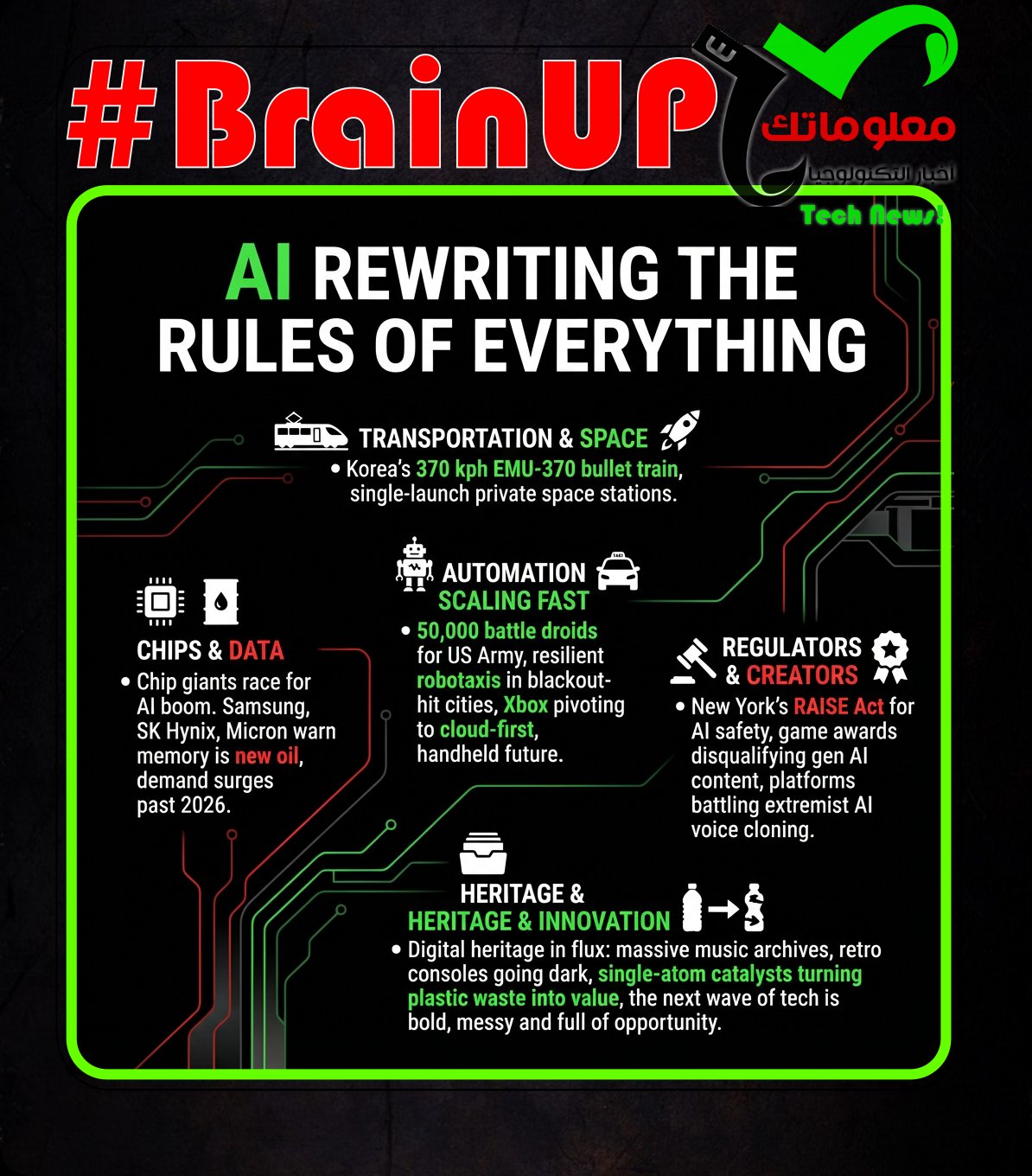
The government has completed core technologies for a next-generation high-speed train, the #EMU-370, capable of 370 kph operation and ranking as the world’s second-fastest by operating speed. The technologies have a designed maximum speed of 407 kph and were developed under a national R&D program led by the Korea Railroad Research Institute, with seven public and private partners and a total investment of 22.5 billion won (18 billion from the government and 4.5 billion from the private sector). Manufacturing of the first vehicles is planned for next year, with test operations starting in 2030 and commercialization after 2031, and the EMU-370 would be second globally in commercial speed behind China’s #CR450, which is currently testing at 400 kph ahead of a 2027 service start. The project, run from 2022 to 2025, also notes that major players such as France, Germany and Japan typically operate high-speed trains at around 320 kph, illustrating Korea’s drive to close the gap.
2. US firm’s space station could be deployed by a single Falcon 9 rocket
The Thunderbird space station could be deployed with a single @Falcon 9 rocket rather than requiring multiple launches to be fully operational in Earth orbit. The article states that the Thunderbird does not require multiple launches to be fully operational. This #single-launch deployment approach points to a more streamlined path for orbital infrastructure, potentially simplifying mission logistics. The report frames this as a notable shift in how space stations could be deployed in the future.
Google pulled the compatibility window for the Dreamcast’s built-in PlanetWeb 3.0 browser, shutting a 25-year era of web access for @Dreamcast users. The move disables support for the console’s obsolete SSL/TLS stack and JavaScript engine, with older ciphers no longer functioning, while fan-made search engines and online gaming servers remain available. PlanetWeb 3.0 dates to 2001 (PlanetWeb 1.0 in 1999, 2.0 in 2000), making the official browser lineage span about 26 years and now largely a relic used mainly as a memento. Some online communities persevere: #PhantasyStarOnline and #QuakeIIIArena servers still run, and portals like frogfind.de are used for web search via @Google, @Brave, and @DuckDuckGo, though mirrors may be down. The piece notes that Dreamcast homebrew participants look for workarounds, keeping a small but dedicated ecosystem alive even as mainstream web access fades.
4. CISA Acting Director Madhu Gottumukkala Faces Polygraph Investigation
Madhu Gottumukkala, acting director of the Cybersecurity and Infrastructure Security Agency (#CISA), is currently under investigation regarding a polygraph examination. The inquiry has raised concerns about internal security protocols and the integrity of leadership within #CISA. This situation highlights potential vulnerabilities in federal cybersecurity oversight, emphasizing the need for strict vetting processes for critical positions. The investigation’s outcome could impact CISA’s operational stability and public trust in government cybersecurity defense. Ongoing scrutiny reflects the importance of maintaining transparent and secure leadership in safeguarding national infrastructure.
5. Samsung, SK Hynix to beat TSMC in gross profit margin for memory business – KED Global
@Samsung Electronics Co. and @SK Hynix Inc., the world’s two largest memory chipmakers, are expected to surpass @TSMC in gross profit margin for memory, signaling resilience as the market shows an early thaw. The piece notes potential deepening chip technology cooperation with @ASML, highlighting ASML’s high NA EUV machine as a basis for stronger joint capabilities. South Korea’s DRAM exports have risen for four straight months, and Samsung plans to unveil a 400-layer vertical NAND for AI servers by 2026 to lead the data storage market. Analysts point to rapid AI growth driving DRAM and #NAND innovations such as 3D DRAM in 2025 and #400-layer vertical NAND, helping memory players improve profitability despite earlier inventories. The push includes expansion like the @Samsung complex in Pyeongtaek and a broader drive to win AI workloads, reinforcing the main claim that memory leaders are edging ahead of @TSMC in profitability.
6. Xbox is losing the console race by miles. It’s part of Microsoft’s big gaming pivot
Microsoft’s Xbox is losing the console race by miles, as hardware sales slump and the company pivots toward an open, cross‑platform strategy across console, PC and cloud gaming #open-system #cloudgaming. In the past year, Microsoft has cut jobs, raised prices and closed studios, with gaming revenue down 2% year over year and Xbox hardware down 29%, while November hardware spending fell 27% in a market that saw the worst November in two decades. Xbox Series S and X have about 1.7 million units sold, far behind Nintendo’s Switch at 3.4 million this year, while Nintendo’s Switch 2 has sold 10.36 million since June and PS5 reached 9.2 million in 2025. The piece notes Valve’s upcoming Steam Machine and SteamOS, illustrating a push toward PC-first ecosystems that could blur console boundaries. Even so, @Phil Spencer has said Microsoft is not ‘in the business of out-consoling Sony or out-consoling Nintendo’ but aims to broaden access across PC, console and handheld devices, underscoring a pivot to cross‑platform play across #open-system and #cloudgaming.
7. In Two Years, 50,000 Battle Droids May Replace Some of US Army Servicemen
The US Army plans to deploy up to 50,000 battle droids within two years to augment and potentially replace some servicemen in combat roles. This initiative focuses on integrating advanced #autonomousrobots and AI-based technologies to reduce human casualties and increase operational efficiency. The battle droids will undertake various battlefield tasks, including reconnaissance, logistics, and frontline engagement, enhancing force multiplication. Experts suggest that this shift could transform warfare by blending human decision-making with machine precision, though ethical and tactical challenges remain. This development aligns with broader military trends prioritizing #automation and technology to maintain strategic superiority.
8. Amazon, Microsoft and more cite AI for 2025 layoffs
Major tech companies like Amazon and Microsoft are planning layoffs in 2025, attributing job cuts to the impact of #artificialintelligence advancements. These firms are restructuring to integrate AI technologies more deeply, aiming to optimize operations and reduce costs. The layoffs reflect a broader industry trend where AI adoption leads to workforce adjustments and shifts in job roles. Experts note that while AI increases efficiency, it also disrupts traditional employment patterns, necessitating workforce adaptation. This reshaping highlights the balance companies must strike between innovation through AI and managing its effects on employees.
9. PHOTO ESSAY: Invisible infrared surveillance technology and those caught in its digital cage
The photo essay examines how invisible infrared surveillance quietly tracks people in everyday life. It notes that when you unlock a phone, step into view of a security camera, or drive past a license plate reader at night, beams of infrared light shine onto the unique contours of your face, body, and license plate lettering. Because the beams are invisible, this surveillance operates largely out of sight, creating a pervasive digital cage around individuals. By foregrounding these mundane moments, the piece invites readers to consider the reach of #infrared #surveillance technology and its impact on privacy in a connected world.
10. Waymo suspends service in San Francisco after causing traffic jams during blackout
In the wake of a citywide power outage, @Waymo suspended its ride-hailing services in the San Francisco Bay Area after its driverless cars contributed to major #traffic jams. With traffic lights down, several Waymo vehicles reportedly halted at intersections, and riders and pedestrians shared photos and videos of congested lanes, illustrating the disruption caused by automation during outages. The outage affected about 125,000 homes and businesses; by 11:30 p.m. about 95,000 customers had power restored, leaving roughly 35,000 still offline. Waymo said it is monitoring infrastructure stability in coordination with city officials and hopes to bring services back online soon, noting that there were no injuries. The incident highlights the vulnerability of autonomous #poweroutage #autonomous #traffic systems when critical infrastructure fails and raises questions about future urban deployments of @Waymo during outages.
11. Waymo resumes service in San Francisco after robotaxis stall during blackout | TechCrunch
@Waymo resumed its San Francisco robotaxi service after a citywide blackout left many vehicles stalled and disrupted city streets. The outage, linked to a fire at a @PG&E substation, knocked out traffic signals and affected around 120,000 customers, with photos and videos showing robotaxis stationary at intersections as human drivers navigated around them. Although @Waymo said its self-driving systems treat non-functioning lights as four-way stops, the scale of the blackout caused some robotaxis to pause longer than normal, but the majority of active trips were completed, and the company pledged to rapidly learn from the event to improve traffic-flow adaptation #robotaxis #poweroutage #trafficlights. The company framed the resumption as a step toward maintaining trust with the communities it serves, focusing on integrating lessons learned and ensuring technology can handle such disruptions.
12. Indie Game Awards Disqualifies Clair Obscur: Expedition 33 Due To Gen AI Usage
@Six One Indie announced that Clair Obscur: Expedition 33 is disqualified from its nominations and wins due to #genAI usage, discovered after voting and the ceremony had been recorded. The move follows a hard stance on gen AI throughout the nomination process, with Sandfall Interactive initially denying AI use but later confirming it on the day of the Indie Game Awards 2025 premiere, which led to the disqualification. As a result, the runner-ups receive the awards: Sorry We’re Closed for Debut Game and Blue Prince for Game of the Year. The decision underscores the organization’s commitment to its policy and invites community feedback as the ceremony looks ahead to 2026.
13. NOAA rolls out AI weather models, promise faster and more accurate forecasts
The National Oceanic and Atmospheric Administration (NOAA) has introduced AI-based weather models to improve forecast speed and accuracy. These models leverage machine learning techniques to process vast amounts of meteorological data efficiently, enabling quicker predictions compared to traditional physics-based models. By integrating AI, NOAA aims to enhance severe weather forecasting, reducing response times and potentially saving lives and property. Early deployments have shown promising results, confirming AI’s role in modernizing weather prediction. NOAA’s initiative represents a significant advancement in the application of #artificialintelligence in public safety and environmental monitoring.
14. New York Governor Kathy Hochul signs RAISE Act to regulate AI safety
New York Governor Kathy Hochul signed the RAISE Act, a law aimed at regulating AI safety to mitigate risks associated with artificial intelligence technologies. The act requires companies developing AI systems to implement risk assessments and safety protocols to prevent harm and ensure accountability. This regulatory move addresses growing concerns about AI’s societal impact, including bias, privacy violations, and misinformation. By introducing clear standards, the RAISE Act sets a precedent for responsible AI development and safeguards public interests. It illustrates New York’s proactive approach in shaping ethical AI governance amid rapid technological advancement.
15. Micron warns ram shortages will last beyond 2026 as AI demand surges – Dexerto
RAM and storage shortages are expected to persist beyond 2026 as #AI demand surges, according to Micron’s CEO @Sanjay Mehrotra. He said the supply-demand imbalance will last for years rather than months, with accelerating #AI data center buildouts driving a sharp upward revision in memory demand forecasts. He noted that both #DRAM and #NAND are affected and that aggregate industry supply will remain substantially short of demand in the foreseeable future. The warnings from Micron, along with similar cautions from Samsung and SK Hynix about long timelines to bring new facilities online, suggest persistent capacity constraints could pressure prices and force customers to adjust their portfolios. The article frames memory availability as a core bottleneck for the tech sector as AI adoption expands.
Extremist movements are leveraging #AI #voicecloning to amplify propaganda by recreating the voices and speeches of influential figures across languages. Experts say AI-enabled translation now produces seamless, contextually accurate translations that preserve tone, emotion, and ideological intensity, expanding reach beyond language barriers, according to @Lucas_Webber, a senior threat intelligence analyst at Tech Against Terrorism and a research fellow at the Soufan Center. On the neo-Nazi far-right, English-language versions of @Adolf_Hitler speeches have racked up millions of streams on X, Instagram, and TikTok, produced by feeding archival speeches from the era of the Third Reich into #ElevenLabs to mimic Hitler in English. A neo-Nazi influencer described making an audiobook of Siege by @James_Mason with a custom voice model, turning newsletters and clippings into an AI-generated read that deepens ideological impact. The Base’s book club in 2020 and a subsequent FBI counterterrorism probe illustrate how AI voice content can fuel recruitment and planning, signaling a shift in digital propaganda strategies and creating new challenges for platforms and security.
17. The internet just made a 300TB copy of Spotify!
Anna’s Archive claims to have scraped almost all of @Spotify, assembling a nearly 300TB archive that includes metadata for 256 million tracks and audio for 86 million songs, as a #preservation project. The archive is being distributed via bulk torrents and organized by popularity, with metadata fully available now and audio files released gradually starting with the most popular tracks #torrent. The project argues it could safeguard music history if licenses change or platforms shut down, but it clashes with Spotify’s terms and with copyright law in many countries. With potential takedown requests or legal threats looming from Spotify and major labels, the archive’s ultimate fate remains uncertain and raises questions about legitimate preservation vs. piracy.
18. Don’t Waste Money On Dual Monitors: Use This Instead – SlashGear
A single ultrawide monitor can replace two traditional displays, delivering more horizontal space and eliminating the bezel gap that breaks immersion. Two monitors also demand more desk space, require two video outputs, and can show subtle color differences unless calibrated, whereas ultrawide options like 21:9 or 32:9 save space and often cost less. The article cites a 29-inch LG ultrawide being wider than a laptop screen and a 34-inch ultrawide potentially cheaper than two 24-inch monitors, illustrating real world gains. The article notes OS window management as key: on @Windows, Windows 11’s Snap Layouts helps organize apps, and you can supplement with PowerToys and its #FancyZones; on @macOS, #Rectangle offers additional layouts. For streaming, a precise 16:9 region on an ultrawide allows the stream and software to run side by side without overlays, reducing neck strain and clutter, making ultrawide a practical #ultrawide alternative to #DualMonitors.
19. Xbox Ally expected as early as December 2025 in ‘Super Saturday’ rumor
The Xbox Ally, a handheld gaming PC from Microsoft, is rumored to launch as early as December 2025 during an event dubbed ‘Super Saturday.’ This device aims to tap into the growing handheld gaming market and compete with products from rivals like Valve’s Steam Deck. Reports highlight features aligned with Xbox’s gaming ecosystem, such as Xbox Game Pass integration and cloud gaming capabilities. The anticipated release could position Xbox Ally as a significant player in portable PC gaming, expanding Microsoft’s hardware portfolio beyond consoles. If accurate, this timeline suggests Microsoft is accelerating efforts to capture a share of the handheld gaming sector.
20. Plastic to valuable chemicals in one atom catalysts
Transforming plastic waste into valuable chemicals is a critical challenge, addressed by researchers using #singleAtomCatalysts. Scientists employed palladium atoms anchored on ultrathin titanium dioxide to efficiently break down polyethylene, a common plastic, into useful chemicals like alcohols and hydrocarbons at low temperature. This innovative approach enhances selectivity and reduces energy consumption compared to traditional methods, showing promise for sustainable plastic recycling. The use of atomically dispersed catalysts creates a pathway to convert abundant plastic waste into high-value products while minimizing environmental impact. These findings contribute to advancing green chemistry solutions for plastic pollution and circular economy goals.
That’s all for today’s digest for 2025/12/22! We picked, and processed 20 Articles. Stay tuned for tomorrow’s collection of insights and discoveries.
Thanks, Patricia Zougheib and Dr Badawi, for curating the links
See you in the next one! 🚀
