
#BrainUp Daily Tech News – (Sunday, December 21ˢᵗ)
Welcome to today’s curated collection of interesting links and insights for 2025/12/21. Our Hand-picked, AI-optimized system has processed and summarized 24 articles from all over the internet to bring you the latest technology news.
As previously aired🔴LIVE on Clubhouse, Chatter Social, Instagram, Twitch, X, YouTube, and TikTok.
Also available as a #Podcast on Apple 📻, Spotify🛜, Anghami, and Amazon🎧 or anywhere else you listen to podcasts.
1. Experts warn AI is making your brain work less
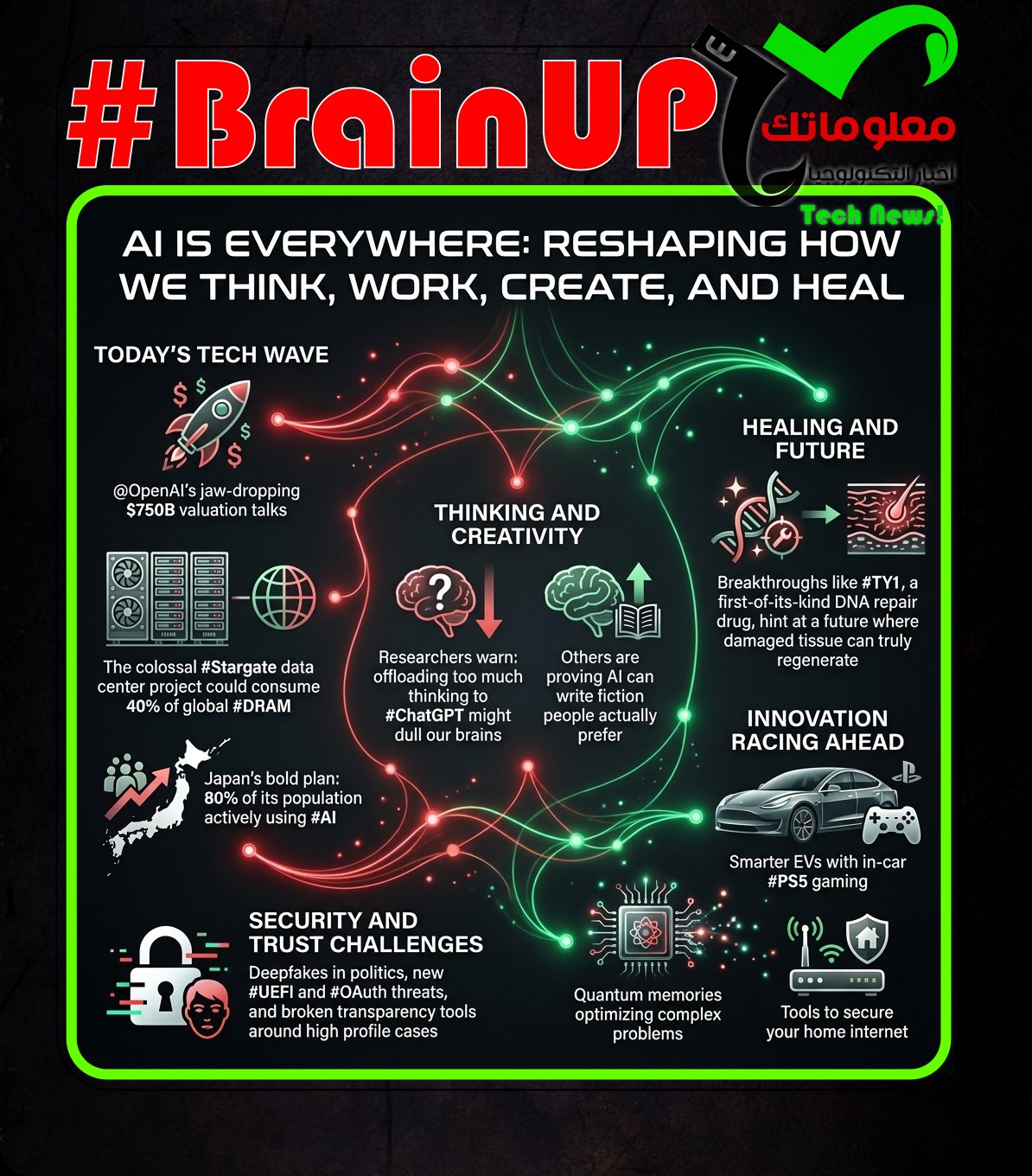
Generative AI tools are hugely popular, but researchers warn that outsourcing thinking tasks to AI may reduce cognitive engagement and harm critical thinking and problem-solving. @MIT’s study with 54 participants using #EEG found that those who used ChatGPT to write essays showed less activity in brain networks tied to cognitive processing and were less able to quote from their own work. Separately, Carnegie Mellon University and Microsoft, which operates #Copilot, surveyed 319 white-collar workers and analyzed 900 AI-assisted tasks, finding that higher confidence in the tool’s ability was linked to less critical thinking effort and potential long-term overreliance. A UK survey by #OUP found six in ten schoolchildren felt AI had negatively impacted their skills, while nine in ten said AI helped develop at least one skill, revealing a nuanced picture; Dr @AlexandraTomescu of @OUP emphasised the need for guidance on how to use AI. With ChatGPT’s 800 million weekly users and a published set of 100 prompts for students, experts like @WayneHolmes of @UCL warn that more work and guidance are needed before drawing broad conclusions.
2. What if Readers Like A.I.-Generated Fiction?
Readers’ taste for AI-generated fiction could reshape the literary landscape, turning machine-made prose into a rival voice authors must reckon with and market forces may reward. In the experiment, computer scientist Tuhin Chakrabarty fed GPT-4o (#GPT-4o) the complete works of @Han Kang, then fine-tuned the model on those authors and others; blind tests showed initial human judges despised AI imitations, but after the fine-tuning the AI version produced an emotionally resonant line, ‘Live, please live. Go on living and become my son,’ which the graduate-student judges then preferred to the human imitations. That shift suggests #AI can generate powerful prose when trained on a single author’s voice, complicating debates about originality and signaling a market-driven reason for authors to adapt rather than resist, a concern echoed by the author-narrator who notes that readers’ preference for AI could pressure authors out of the field. Ultimately, the piece frames this as part of a broader shift in literature’s relationship with #AI and technology, where public taste may decide which voices survive.
@Valve has discontinued its most affordable Steam Deck, the $399 256GB LCD model, elevating the entry point to the $549 512GB OLED version. The Steam Deck page now shows the LCD model as Out of stock and Valve states it is no longer being produced. The move may reflect a #RAMcrisis and rising #NANDcosts that squeeze margins, with industry chatter suggesting Valve is clearing inventory ahead of potential new products, though a second generation has not been announced. For budget gamers, this narrows options and makes the OLED model the default choice, as competing entry points like the Asus ROG Ally at $489.99 and Lenovo Legion Go S at $589.99 illustrate a crowded market. This signals a shift in Valve’s Steam Deck strategy toward higher-margin options and could reshape the accessibility of Steam OS handheld gaming in 2025.
4. One year on, many Android users still can’t use audio in their cars properly
The core idea is that for over a year, owners of several @Pixel and Galaxy devices can’t reliably use Bluetooth audio with car head units, despite @Google acknowledging the problem, #Bluetooth #car. The issue predominantly affects the @Pixel 7, 8, and 9 series in both stable and beta channels, with some Galaxy users affected as well, and it has persisted since at least November 2024 despite monthly updates including the Android 16 release, #Android. Users report that phones do not automatically connect and sometimes require manual pairing, with workarounds such as toggling the car’s Bluetooth media audio setting on and off, as documented on Reddit threads #Reddit. Google’s engineering team has been notified and is working to fix it, but progress is slow and some users saw temporary relief with Android 15 QPR2 only to have the problem return with Android 16 beta. The issue may extend to cars from Japanese brands and highlights broader Android interoperability challenges in in-car Bluetooth, with low chances of a fix before engineers return from the Christmas and New Year breaks.
5. Republicans make deepfake AI video of Democrat giving a kid trans hormone therapy
Republicans have created a deepfake AI video depicting a Democrat allegedly providing hormone therapy to a child, stirring controversy and misinformation. The video utilizes advanced artificial intelligence technology to fabricate events that did not occur, raising concerns about the ethical implications and potential harms of deepfake media in political discourse. Such manipulations threaten to undermine trust in genuine information and exacerbate partisan divides, particularly on sensitive issues like transgender healthcare. This incident highlights the urgent need for strategies to detect and counteract deepfakes to protect democratic processes and public understanding. As digital tools evolve, addressing misinformation through education and regulation becomes critical to maintain informed and respectful political dialogue.
6. Japan aims to raise public AI use to 80%
Japan’s government is drafting a basic program to develop and use #AI, aiming to raise public utilization from 50% to 80% and to build Japan’s own #AI technologies. The plan seeks about ¥1 trillion in private-sector investment to boost #R&D and accelerate AI deployment, with Cabinet approval targeted by year-end. It frames #AI as social infrastructure, an intellectual foundation and an execution platform, and envisions an #AIecosystem where developers, semiconductor makers and cloud providers collaborate to expand overseas markets and reduce Japan’s digital trade deficit. The draft also calls for AI to be used across all ministries and agencies, eventually by all government employees, echoing PM @Sanae_Takaichi’s pledge to make Japan the easiest country in the world to develop and utilize AI, and relying on public-private partnerships to speed up progress.
7. Justice Department’s Release of Epstein Files Comes with Broken Search Tool
The Justice Department released files related to Jeffrey Epstein’s case, but the accompanying search tool provided is dysfunctional and hinders public access. This flawed resource undermines transparency efforts by making it difficult to locate specific documents within the trove. The broken search capability raises concerns about whether the release genuinely facilitates insights into Epstein’s criminal network or deters scrutiny. Despite the intent to increase openness around sensitive #legal and #criminal investigation materials, the poorly implemented technology limits effective public engagement and oversight. The situation reflects broader challenges in managing digital releases of high-profile case files.
8. At least 16 files have disappeared from the DOJ webpage for documents related to Jeffrey Epstein
The DOJ’s webpage for documents related to @Jeffrey Epstein is missing at least 16 files a day after their release. The piece states that those files had just been released prior to their disappearance. The missing items raise questions about the reliability of the release process and page management. The incident underscores concerns about public access to investigative materials on the DOJ site. Overall, the event points to the need for careful hosting and verification of document releases.
9. First-ever drug to repair DNA and regenerate damaged tissue is here
TY1 is the first exomer, a new class of drugs that addresses tissue damage in unexpected ways, and it represents a synthetic RNA drug inspired by heart progenitor cell exosomes studied by @Eduardo Marbán and @Ahmed Ibrahim. Researchers at Cedars-Sinai isolated heart progenitor cells and examined exosomes that carry DNA, RNA and protein to repair tissue, sequencing the exosomal RNA and identifying one molecule that stood out, with animal studies confirming its role in healing. TY1 works by amplifying the activity of the Trex1 gene, which boosts immune cell activity around damaged DNA to clear debris and enable repair and regeneration, a process that can reduce scarring after a heart attack. Beyond the heart, the approach may also address autoimmune diseases and other conditions, offering a new mechanism for tissue healing and broader therapeutic potential #TY1 #exomer #DNArepair.
10. Internet, Inequality, and Regime Stability
This academic study examines how income inequality and internet penetration interact to influence political stability across more than 120 countries over the period from 1996 to 2020. The authors find that in societies with low levels of internet access, greater inequality does not consistently translate into political instability, possibly because limited connectivity reduces collective awareness and coordination. In contrast, in countries where a majority of the population is connected to the internet, high inequality amplifies political tensions and increases the likelihood of unrest, as digital connectivity enhances information flow, mobilization, and public scrutiny of socioeconomic disparities. The findings suggest that the stabilizing or destabilizing impact of inequality is conditioned by the extent of digital inclusion and online communication networks.
Definition: Internet penetration
Internet penetration refers to the proportion of a population that has access to and uses the internet. It is typically expressed as a percentage of the total population and serves as an indicator of digital connectivity, technological infrastructure, and the potential for widespread information exchange. High internet penetration can accelerate the spread of news, ideas and collective action, affecting political, economic and social dynamics.
11. Reddit postponed gag order on user linked to Brown shooting due to surveillance concerns
Reddit delayed enforcing a gag order on user u/garland_valente, who posted about the shooting of #ChristopherBrown, because of concerns that authorities monitored the platform. The user alleged the incident involved police misconduct and sought justice through posting videos and information. Reddit’s initial gag order aimed to comply with legal demands but raised privacy issues when a surveillance firm reportedly tracked discussions on the platform. This incident highlights ongoing tensions between user privacy, free speech, and law enforcement surveillance on social media. The situation underscores the need for clear policies balancing transparency and protection for users discussing sensitive events online.
12. Sam Altman’s OpenAI in talks to raise money at $750B: report
OpenAI is in talks with private investors to raise funds at a $750 billion valuation, a round that could total tens of billions and potentially go as high as $100 billion. The talks are preliminary and would mark a roughly 50% increase from October, when employees could sell $6.6 billion of shares at a $500 billion valuation. Reuters had reported OpenAI was laying groundwork for an IPO with filings possible by the second half of next year that could value the company at $1 trillion, though an OpenAI spokesperson said an IPO is not the focus. Amazon is said to be in talks to invest at least $10 billion and supply chips, while @Sam Altman and @OpenAI face pressure to improve #ChatGPT as it reaches 800 million weekly active users but remains unprofitable, highlighting a broader debate about a potential #IPO and the need to fund data-center and infrastructure growth amid competition from Google #AI.
13. Google and Apple reportedly warn employees on visas to avoid international travel
Google and Apple have reportedly advised employees working in the United States on visas to limit international travel due to concerns over visa and immigration issues. This caution stems from the complicated and often unpredictable nature of obtaining reentry into the U.S., especially given recent tightening of immigration policies and increased scrutiny at borders. The companies are urging their employees to remain cautious because even routine travel can lead to delays or denials that disrupt work and personal plans. These warnings highlight how geopolitical dynamics and immigration regulations are impacting global tech companies’ workforce mobility and operational planning. The travel advisories underscore the broader challenges faced by tech talent on visas trying to navigate international work and travel in a complex legal environment.
14. Sony’s first EV with Honda will let you remotely play PS5 in your car
Sony Honda Mobility’s first EV, the Afeela, will feature @Sony’s PS Remote Play, allowing PS5 and PS4 titles to be played remotely on the car’s integrated display. Passengers can grab their DualSense controllers from home and resume games in the vehicle, with a 5 Mbps connection required and 15 Mbps delivering a smoother experience. This capability echoes earlier CES 2024 demonstrations of remote Play on the Afeela 1 and aligns with broader interest in #gaming within #EV contexts. It also contrasts with Tesla’s past Steam support, which was provided then removed, underscoring how in-car gaming options are still evolving while illustrating @Sony and @Honda’s #EV entertainment strategy.
OpenAI’s Stargate project aims to build multiple massive AI data centers and could consume up to 40% of global DRAM output, with preliminary agreements to supply memory wafers from @Samsung and @SK_hynix to the tune of up to 900,000 wafers per month #DRAM. The deals specify undiced wafers rather than tested and packaged DRAM chips or HBM stacks, and a potential demand of 900,000 DRAM wafers monthly, which could amount to roughly 40% of total DRAM output. Context shows the global 2024 DRAM capacity at about 2.07 million wafer starts per month and a projected 2.25 million in 2025, implying Stargate’s planned consumption of around 40% #DRAM. Stargate is described as being controlled by @OpenAI, Oracle, and SoftBank, and will require massive server fleets with high-end GPUs such as @Nvidia’s Blackwell, with power and cooling infrastructure potentially including dedicated power plants #GPU. Samsung’s broader involvement includes @Samsung SDS partnering on data-center architecture in Korea and reselling OpenAI services there, while Samsung C&T and Samsung Heavy Industries explore floating data centers to improve cooling and reduce emissions.
16. Microsoft 365 accounts targeted in wave of OAuth phishing attacks
A surge in OAuth phishing attacks targeting #Microsoft365 accounts has been detected, exploiting the OAuth authorization protocol to gain access without passwords. Attackers trick users into consenting to malicious apps, granting them permissions to access emails, files, and other sensitive data, bypassing traditional security measures like multi-factor authentication. Researchers highlight that these attacks leverage social engineering to convince victims to authorize access, illustrating the effectiveness of abuse in trusted OAuth flows. This trend underlines the growing risks in cloud environments where attackers exploit authorization systems rather than direct credential theft. Organizations must enhance security awareness and implement monitoring solutions to detect and respond to unusual OAuth token activities, protecting user data in cloud platforms.
17. Texas files antitrust lawsuit against Epic over access to parent’s medical records
Texas Attorney General Ken Paxton has filed an antitrust lawsuit against Epic Systems, alleging the company restricts parent’s access to their children’s medical records. The lawsuit claims Epic’s policies limit interoperability and patient data sharing, violating state antitrust laws by maintaining a monopoly over electronic health records in Texas. Paxton argues that this behavior harms patients and families who need comprehensive access to healthcare information for effective treatment, particularly for minors. The suit highlights a growing concern about the control dominant health IT vendors have over sensitive medical data and the impact on patient rights. This case emphasizes the need for policies ensuring fair access and competition in the digital health records market.
18. New cloaking device concept shields electronics from electromagnetic interference
Researchers have developed a new cloaking device concept that effectively protects electronic equipment from electromagnetic interference (EMI), a growing issue in increasingly electronic-dependent environments. Utilizing advanced metamaterials that steer electromagnetic waves around sensitive components, the device prevents disruption and damage without affecting device functionality. The innovation significantly enhances the reliability and performance of electronics in complex settings such as hospitals, aircraft, and densely packed electronic circuits. This approach marks a promising step towards practical EMI shielding solutions that maintain device transparency to electromagnetic signals. The development could drive safer, more efficient electronic systems critical to modern technology and communication infrastructure.
19. New tech will soon be turning Marine light vehicles into roaming drone- and aircraft-killers
The Marine Corps is fielding MADIS, a mobile air defense system that converts a pair of Joint Light Tactical Vehicles into a counter-drone and anti-aircraft weapon. It includes radars, sensors, and electronic warfare, with one vehicle focused on drones and the other on helicopters and fixed-wing aircraft, and it fires #Stinger missiles and a #30mm cannon while remaining operable on the move. MADIS fills a gap in the air defense arsenal by enabling Marines to locate, identify, and destroy threats within a single system, rather than relying on several separate assets. Its mobility gives forward-deployed forces a new way to defend against drones and other aerial threats, including small UAS and potential adversaries like China, with upgrades planned to address evolving threats. The program, developed by @KongsbergDefense & Aerospace, entered full-rate production after training and live-fire exercises, signaling its role as a key element in the Marine Corps’ plan for the next decade.
20. Quantum memory can optimize complex problems, study finds
Quantum memories, which can store and process quantum information, demonstrate advantages in optimizing complex problems such as graph coloring and number partitioning. Researchers developed a framework that integrates quantum memories into quantum optimization algorithms, leading to improved solution accuracy and efficiency compared to classical optimization techniques. The study highlights how the superposition and entanglement properties within quantum memories enhance computational power, allowing exploration of solution spaces more comprehensively. These results suggest quantum memory-based approaches could significantly advance fields requiring combinatorial problem solving, like logistics and cryptography. Overall, the integration of #quantummemories in optimization opens new pathways for solving traditionally intractable problems with quantum technology.
21. Tool Checks for Compromised Home Internet
Many home internet users face security issues without realizing their connections have been compromised, which can lead to data breaches and privacy concerns. The article highlights tools designed to detect unauthorized access or malware infections on home networks by scanning network traffic and device behavior. Such tools help users identify vulnerabilities, enabling them to take timely action like changing passwords or updating firmware to bolster security. Security expert suggestions emphasize the importance of regular monitoring to prevent persistent cyber threats. Implementing these tools can significantly improve home network safety and protect sensitive information from attackers.
22. NEX Playground boss says the console solves the Wii problem
The NEX Playground console aims to address the shortcomings seen with the Wii by focusing on a better gaming experience that appeals to core and casual gamers alike. According to the NEX Playground’s boss, the Wii’s problem was its broad approach that didn’t fully satisfy either audience, whereas their console emphasizes improved hardware and exclusive games tailored to diverse player preferences. This strategy is supported by a commitment to higher-quality titles and hardware that can handle more complex games, contrasting with the Wii’s simpler, motion-based gameplay. By targeting both niche and mass markets effectively, NEX Playground seeks to carve out a sustainable position in the competitive gaming industry. This approach suggests a more balanced design philosophy, potentially overcoming the limitations that hindered the Wii’s long-term success.
23. New UEFI Flaw Enables Early Boot DMA Attacks, Threatening System Security
A recently discovered vulnerability in the Unified Extensible Firmware Interface (#UEFI) allows attackers to perform direct memory access (#DMA) during the early boot phase, undermining system security before the operating system starts. Security researchers demonstrated that this flaw permits unauthorized hardware to access sensitive data by exploiting insufficient validation in the UEFI boot process. This presents a critical risk because attackers can bypass traditional OS-level defenses and install persistent malware at a low level. The flaw emphasizes the importance of enhanced hardware and firmware security measures to protect against such early-stage exploitation. Given UEFI’s foundational role in system initialization, mitigating this vulnerability is crucial to maintain trust in computing environments.
24. NotebookLM adopts Gemini 3 for enhanced data tables functionality
Google’s NotebookLM has integrated the latest #Gemini3 model to significantly improve how it generates and processes data tables. This update allows users to access richer, more accurate table data and leverages Gemini 3’s advanced AI capabilities to enhance data interpretation and structuring. The shift to Gemini 3 brings better contextual understanding and response generation for tabular information, making NotebookLM more effective for research and analysis tasks. By combining NotebookLM’s organizational features with Gemini 3’s AI advancements, Google is streamlining complex data management within note-taking environments. This integration underscores Google’s commitment to leveraging cutting-edge AI models to improve productivity tools.
That’s all for today’s digest for 2025/12/21! We picked, and processed 24 Articles. Stay tuned for tomorrow’s collection of insights and discoveries.
Thanks, Patricia Zougheib and Dr Badawi, for curating the links
See you in the next one! 🚀
