
#BrainUp Daily Tech News – (Saturday, December 20ᵗʰ)
Welcome to today’s curated collection of interesting links and insights for 2025/12/20. Our Hand-picked, AI-optimized system has processed and summarized 24 articles from all over the internet to bring you the latest technology news.
As previously aired🔴LIVE on Clubhouse, Chatter Social, Instagram, Twitch, X, YouTube, and TikTok.
Also available as a #Podcast on Apple 📻, Spotify🛜, Anghami, and Amazon🎧 or anywhere else you listen to podcasts.
1. School says it gets better grades with AI instruction than teachers
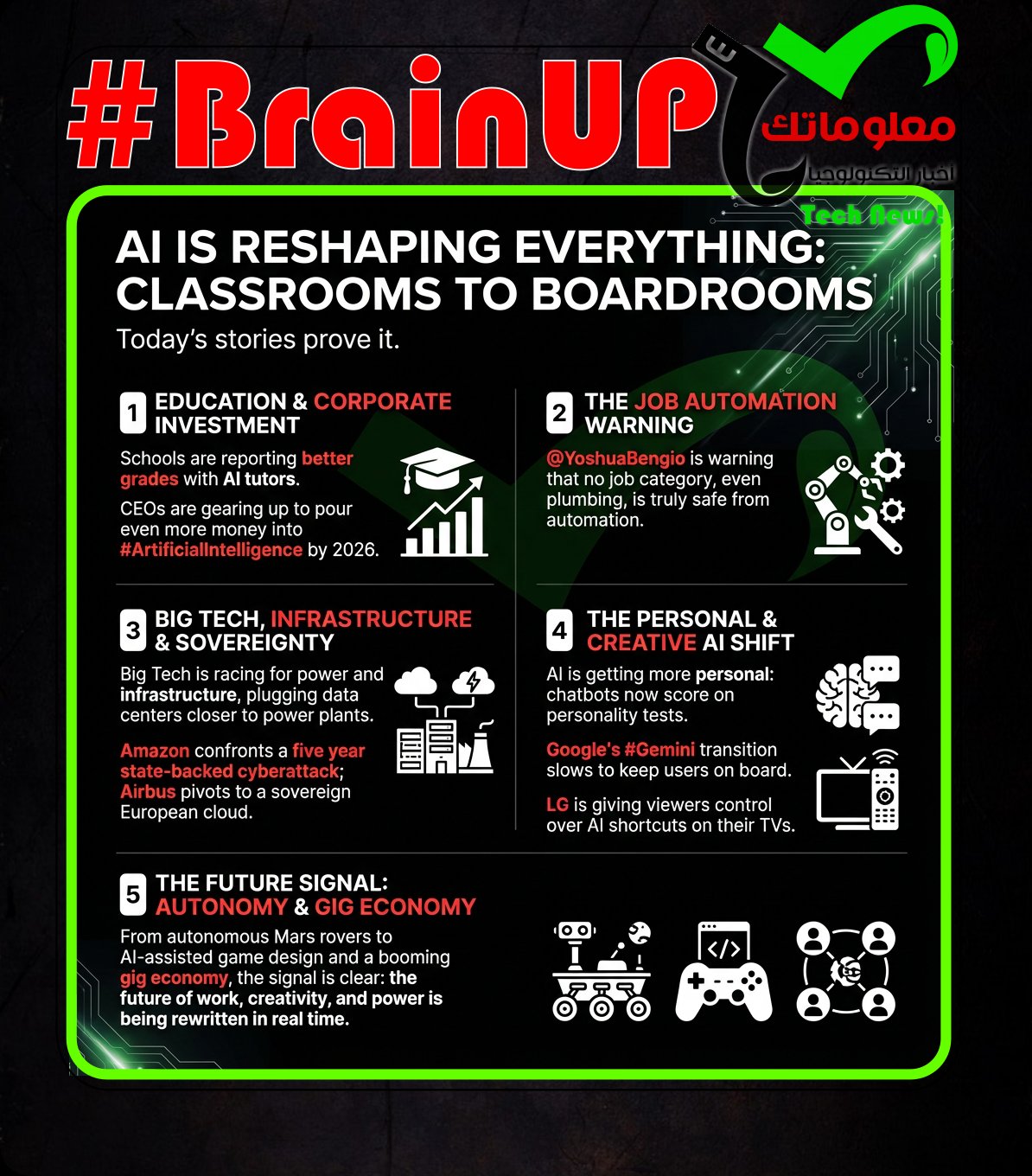
A school reports that students receiving instruction from AI technology achieve better grades compared to traditional teacher-led classes. The school implemented AI-driven teaching tools which personalize learning experiences and provide real-time feedback, resulting in improved academic performance. This shift to AI instruction highlights the growing role of #ArtificialIntelligence in education, potentially transforming how subjects are taught and learned. The success indicates AI can effectively supplement or even enhance conventional methods, offering individualized support to diverse learners. As educational institutions explore technology integration, this example underscores the potential benefits of embracing AI to foster better student outcomes.
2. Airbus prepares to switch critical systems to a European sovereign cloud
European aerospace and defense giant @AirbusSE is preparing a tender, expected to launch in January 2026, to migrate mission-critical applications like enterprise resource planning, manufacturing execution systems, customer relationship management and product lifecycle management to a European sovereign cloud provider by summer 2026, driven by concerns that US cloud giants do not guarantee data protection from foreign government access. Executive vice president Catherine Jestin has said that certain information is extremely sensitive from European and national security perspectives, and Airbus wants to ensure that this data remains under European control rather than subject to laws such as the US CLOUD Act. The value of the contract is expected to exceed 50 million euros over ten years, but Airbus officials acknowledge that truly sovereign European cloud providers with sufficient capacity may be scarce, making the search challenging.
Definition: European sovereign cloud
A European sovereign cloud refers to a cloud computing platform that is owned, operated and legally governed within Europe, ensuring that data stored and processed there is subject to European data protection laws and cannot be accessed by foreign governments or subjected to extraterritorial legal orders like the US CLOUD Act. The aim is to enhance digital sovereignty by keeping sensitive information under local jurisdiction and reducing dependence on non-European technology providers.
US lawmakers have called on the Pentagon to designate Chinese companies DeepSeek and Xiaomi as entities that allegedly support China’s military modernization. The lawmakers argue that adding these firms to the list would strengthen US national security by restricting their access to American technology and capital. This action highlights growing US concerns over China’s advances in sectors like artificial intelligence and telecommunications, where companies like Xiaomi have significant influence. The move aligns with broader US efforts to counter what officials describe as military-civil fusion strategies by China. Such designations are intended to curb the capabilities of firms believed to be contributing to China’s military strength.
4. Jimmy Wales trusts the process
Jimmy Wales, co-founder of Wikipedia, emphasizes the importance of trusting the collaborative and transparent process behind knowledge creation on the platform rather than focusing solely on individual contributors. He highlights how Wikipedia’s open editing and strict community guidelines ensure accuracy and neutrality over time despite occasional errors. Wales argues that the collective effort and constant review by volunteers form a robust system that counters misinformation effectively. This approach underlines the power of #crowdsourcing and community-driven #knowledge platforms in maintaining reliable information. Therefore, trusting the editorial process is essential for sustaining Wikipedia’s mission of providing free and trustworthy knowledge.
Massive shifts in energy policy would let large #dataCenters plug directly into #powerPlants, as federal regulators move to let tech firms draw power at the source. This policy change, described as enabling data centers to effectively tap generation sites, signals a new approach to powering digital infrastructure. The move could reshape #grid dynamics in a competitive energy landscape, potentially affecting reliability, pricing, and regulatory oversight amid a scramble for energy resources. It underscores how energy policy and technology deployment are increasingly intertwined, with energy access becoming a central factor in the expansion of hyperscale computing.
@YoshuaBengio argues that AI-driven automation is a matter of time away from touching virtually every job, with cognitive desk roles among the first to go and trades like plumbing not immune in the long run, a view he stressed on Steven Bartlett’s Diary of a CEO podcast. He notes Gen Z hires are currently hit hardest as junior positions are easiest to cut or backfill with software, and that firms such as Intel, IBM, and Google have frozen thousands of roles expected to be taken by AI within five years. He warns that as companies deploy more robots and accumulate data, AI will become smarter and capable of doing more of the work people do, broadening displacement and even threatening democracy within two decades. Having regrets about his life’s work, he founded LawZero to build safe, human-aligned AI and urges CEOs to pause, collaborate, and address these risks. #AI #LawZero
7. Elon Musk should get his $55 billion Tesla pay package from 2018, Delaware Supreme Court rules
@Elon_Musk’s 2018 Tesla pay package, valued at about $55.8B, is reinstated by the Delaware Supreme Court, overturning a 2024 ruling that voided the award. The court said voiding the package would be inequitable and that rescission is an extreme remedy only when clearly warranted. The decision preserves Musk’s compensation for his time and efforts over six years, even as shareholders had approved a larger potential award of up to $1T tied to growth goals such as deploying a million #robotaxis for commercial use. The ruling underscores Delaware’s central role in corporate law, while concerns persist about business certainty, with some firms like @AndreessenHorowitz reassessing Delaware incorporation.
8. Another look: Google says the Assistant will linger for a while longer
Google will extend the life of the #Assistant and push its sunset to 2026 to ensure a seamless transition to #Gemini across mobile devices and beyond. In its update, @Google says it is adjusting its previously announced timeline to deliver a seamless transition from #Assistant to #Gemini. The move extends the plan beyond the end of 2025 and acknowledges that 2026 will mark ten years since the Assistant first arrived. Google says the upgrade will span more places than phones, including home devices and watches, as part of the broader migration to #Gemini. The company warns more details will come in the coming months, signaling a slower, more personalized transition rather than an abrupt disappearance.
9. Samsung Investigating Whether Employees Accepted Kickbacks for Memory Orders
Samsung is probing allegations that some employees may have accepted kickbacks related to corporate memory orders. The investigation follows concerns about unethical practices potentially influencing business dealings within the company. If proven accurate, such actions could undermine Samsung’s integrity and impact its reputation in the competitive memory market. This internal inquiry reflects Samsung’s commitment to transparency and upholding ethical standards in its procurement processes. Ensuring clean operations is critical for maintaining trust with clients and partners in the technology sector.
10. Gig Economy Attracting More Workers As Layoffs Increase, Goldman Sachs Report Says
The gig economy is expanding as more workers turn to freelance and contract jobs amid rising layoffs, according to a Goldman Sachs report. Data shows a significant increase in gig work participation, driven by economic uncertainty and changing labor market dynamics. This shift reflects a growing preference for flexible employment options, which offer income stability during periods of job market volatility. The report highlights that gig roles are becoming a critical component of the broader employment landscape, impacting traditional workforce structures. As layoffs continue, the gig economy’s role is expected to strengthen, presenting both opportunities and challenges for workers and employers.
11. Strava puts popular “Year in Sport” recap behind an $80 paywall
Strava’s annual #YearInSport wrap-up is now behind an $80 subscription, the first time the feature has been paywalled since its 2016 debut. One user in India, @ShobhitSrivastava, said he wished others could see their Year in Sport without paying, underscoring the social value of the video. Strava’s spokesperson @ChrisMorris said the relaunch aimed to give users ample notice and to keep core features—uploading activities, finding your community, and giving kudos—accessible, while the paid tier unlocks enhanced statistics. The move comes as Strava’s user base nears 50 million, with a $2.2 billion valuation, and amid ongoing tensions from a previous $60-to-$80 price increase, an earlier foray into AI with #AthleteIntelligence, and a Garmin patent dispute, all shaping investor and user reactions to CEO @MichaelMartin’s strategy to go public.
The creator of Anthropic’s Claude Code, @BorisCherny, says he looks for engineers who are #generalists with ‘cool weekend projects’ such as making kombucha. He notes that many non-engineering roles still code, and he prefers engineers who can both code and contribute to product and design while seeking user feedback. Cherny’s side-quest criterion reflects a broader AI hiring trend toward cross-disciplinary ‘product builders’ as industry leaders like @DylanField acknowledge blurred job titles and expanded expectations. Anthropic’s approach aims to recruit across functions—with project managers coding, data scientists coding, and even user researchers coding a little—mirroring the move toward generalist, hands-on contributors across the industry.
13. VW Calls Off 2026 ID Buzz in US—and It May Never Come Back
@VW has decided not to produce the 2026 @ID_Buzz for the U.S. market, signaling that current #EV market conditions and softened demand make the model financially unviable, with a possible return under MY27. A VW spokesperson said the ID Buzz remains an important halo product for the brand, but the company will focus resources on existing inventory and retail performance in MY25 to support the MY27 transition. Demand has softened in the U.S., with fewer than 5,000 buyers through September 2025, and the vehicle’s Hanover, Germany production coupled with tariffs could raise costs for buyers. The move mirrors broader pressure on pricey EVs in the U.S., with a similar fate for @Ford’s F-150 Lightning, underscoring a trend in how automakers manage halo electrics. Ultimately, VW is conserving resources while keeping the door open for a MY27 revival if demand recovers, highlighting the balancing act between premium pricing, tariffs, and U.S. market appetite.
14. Changes in US Voting Patterns During the COVID-19 Pandemic
The study examines alterations in US voting patterns amid the COVID-19 pandemic, focusing on mail-in voting and election outcomes. Data indicates a substantial increase in mail-in voting during the 2020 elections, largely influenced by public health concerns and evolving voter preferences. This shift impacted election administration and raised debates around election security and accessibility, highlighting the importance of adapting voting methods to pandemic conditions. The findings underscore how health crises can influence political behavior and election logistics. These insights provide valuable guidance for policymakers aiming to ensure safe and effective electoral processes during public health emergencies.
15. AI and Video Game Development: Art, Vibe, Coding with MidJourney
AI technology, especially tools like #MidJourney, is transforming video game development by enhancing art creation and setting immersive vibes. These AI-driven platforms enable developers to generate visuals and designs rapidly, reducing time spent on concept art and allowing more focus on coding and gameplay mechanics. By integrating AI, creators can experiment with styles and atmospheres more freely, which fosters innovation and creative expression within games. This synergy between AI art generation and coding streamlines workflow and contributes to richer, more engaging player experiences. As AI tools evolve, they are becoming indispensable in shaping the future of game development processes and aesthetics.
16. Nexperia’s China unit switches to local firms for wafer supplies – document
Nexperia’s China unit is transitioning its wafer supplies from foreign to local Chinese suppliers, according to a document outlining this strategic shift. This move aligns with China’s broader effort to bolster domestic semiconductor production and reduce reliance on foreign technology amid geopolitical tensions and trade restrictions. The change could impact global semiconductor supply chains by increasing China’s self-sufficiency but may also reflect challenges foreign firms face in the Chinese market. This development underscores the growing #techsovereignty trend and highlights the intricate relationship between international firms and China’s local policies. It signals a significant step in the region’s semiconductor ecosystem evolution, aligning company strategy with national industrial priorities.
17. Mark Zuckerberg’s Philanthropy Cuts Ties With Pro-Immigration Organization FWD.us
Mark Zuckerberg’s philanthropic initiative has severed its association with FWD.us, a pro-immigration group, amid increasing political scrutiny. The decision follows concerns about the organization’s influence and alignment with Zuckerberg’s broader public image. This move reflects a calculated distancing from politically sensitive advocacy to safeguard philanthropic interests. It demonstrates the complex balancing act tech philanthropists face when engaging in contentious social issues. The development underscores the evolving dynamics between technology leaders’ public stances and political advocacy groups.
18. Most CEOs ready to spend even more on AI by 2026
A majority of CEOs are planning to significantly increase their investments in #ArtificialIntelligence by 2026, highlighting AI as a key driver for business growth and competitiveness. According to recent reports, companies are accelerating their AI adoption to improve productivity, innovation, and customer experiences amid a fast-evolving digital landscape. Experts note that this trend reflects a strategic priority where AI integrates deeply into business operations, fostering transformative impacts across industries. This commitment by top executives illustrates the growing recognition of AI’s critical role in shaping future market dynamics and organizational success.
19. Facebook is testing a link-posting limit for professional accounts and pages | TechCrunch
Meta is testing a limit on link posts for professional accounts and Pages on Facebook, allowing only two links unless users subscribe to @MetaVerified, which starts at $14.99 per month. The test, confirmed by Meta to @TechCrunch, targets professional mode and Pages, while affiliate links, comments, and links to @Facebook/@Instagram/@WhatsApp posts remain allowed. Meta says the aim is to see whether a higher volume of linked posts adds value for @MetaVerified subscribers and to evaluate potential benefits for creators and brands linking from external sites. Publishers are not included in the test, and links in comments are not affected. A Q3 transparency report shows 98% of feed views come from posts without links and 1.9% from linked posts, mostly from pages followed, with top domains including YouTube, TikTok, and GoFundMe, providing context for the experiment.
20. LG will let you delete the previously unremovable Microsoft Copilot shortcut on its smart TVs
LG will let users delete the previously unremovable Copilot shortcut on its smart TVs, a company representative says. The Copilot icon is a shortcut to launching the AI chatbot in the TV’s web browser, not an app embedded in the TV. This response appears to address user privacy and control concerns by giving viewers a choice over which services appear on their devices, including #Copilot from @Microsoft. LG did not provide a timeline for when the deletion option will be available. The move reflects broader debates about AI features in consumer electronics and privacy tradeoffs in #smartTVs and #privacy.
21. Warning: Amazon Confirms 5-Year Long Russian Cyberattack
Amazon revealed it had been the target of a sustained cyberattack originating from Russia, which persisted undetected for five years. Security researchers identified that the attackers exploited vulnerabilities in Amazon’s cloud infrastructure to infiltrate and maintain covert access. This prolonged intrusion highlights significant challenges in defending complex #cloud computing environments against state-sponsored cyber threats. Amazon’s acknowledgment underlines the importance of continuous security improvements and vigilance to protect sensitive data in the evolving cyber threat landscape. The incident underscores the critical need for heightened cybersecurity measures as enterprises increasingly rely on cloud platforms.
22. Samsung unveils Exynos 2600, industry’s first 2 nm AP
Samsung Electronics has revealed its new Exynos 2600, the world’s first commercially announced 2-nanometer application processor designed for next-generation mobile and AI-focused devices, marking a significant step in South Korea’s semiconductor leadership. The chip integrates advanced process technology with improved power efficiency and performance, aiming to compete with leading global counterparts and support AI workloads, high-speed connectivity and energy-efficient computing. This development builds on Samsung’s broader push to expand its foundry and custom silicon capabilities, while reinforcing its presence in the high-end chip market that has been dominated by competitors like @Nvidia and @TSMC. Industry analysts see the launch as a renewal of South Korea’s commitment to cutting-edge #semiconductor innovation, helping it retain strategic relevance amid intensifying global competition for advanced AI chips and sophisticated system-on-chip designs.
Definition: 2-nanometer process technology
The 2-nanometer (2 nm) process refers to a semiconductor manufacturing node where critical components on a chip are structured at scales of approximately 2 nanometers, enabling superior power efficiency, higher transistor density and improved performance compared to larger process nodes. This advancement allows chips to deliver greater computational power for tasks such as AI inference and mobile computing while consuming less energy, making it a key competitive edge in next-generation semiconductors.
23. ‘Personality test’ shows how AI chatbots mimic human traits – and how they can be manipulated
Researchers have developed the first scientifically validated #personalitytest framework for popular AI chatbots, showing they not only mimic human personality traits but that their ‘personality’ can be reliably tested and precisely shaped, with models like @ChatGPT among those evaluated. The study tested 18 large language models and found that larger, instruction-tuned models such as @GPT-4o most accurately emulated human traits, and these traits could be manipulated through prompts, altering how the AI completes tasks. The findings raise concerns about manipulation and #AIpsychosis, underscoring the urgent need for #regulation and transparency in AI systems to prevent misuse. The authors note that the dataset and code behind the testing tool are publicly available to audit and test advanced models before release, offering a practical path for #auditing and responsible deployment.
24. NASA’s Mars Rover Will Start Driving Autonomously Tomorrow
NASA’s Mars rover is poised to begin driving autonomously, enhancing its capability to explore the Martian surface more efficiently. The rover uses advanced software that allows it to make real-time decisions about navigation and obstacle avoidance without direct input from mission control. This autonomy reduces the delay caused by the distance between Mars and Earth, enabling quicker and safer traverses over the terrain. NASA’s implementation of this technology marks a significant step forward in robotic exploration, as it allows more ground to be covered in less time while increasing mission productivity. The advancement aligns with NASA’s broader goal of developing smart, independent systems that can operate reliably in space environments.
That’s all for today’s digest for 2025/12/20! We picked, and processed 24 Articles. Stay tuned for tomorrow’s collection of insights and discoveries.
Thanks, Patricia Zougheib and Dr Badawi, for curating the links
See you in the next one! 🚀
