
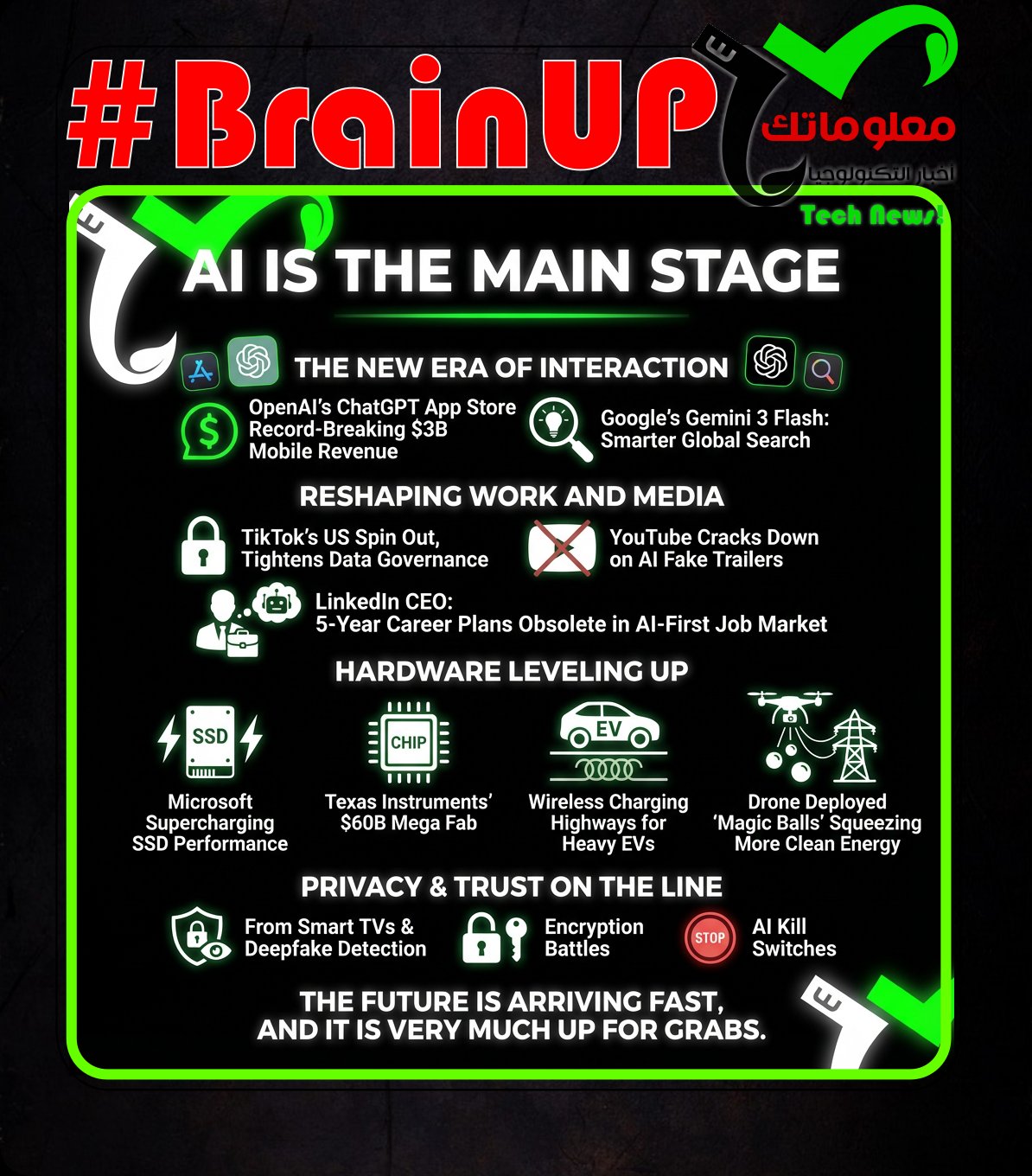
#BrainUp Daily Tech News – (Friday, December 19ᵗʰ)
Welcome to today’s curated collection of interesting links and insights for 2025/12/19. Our Hand-picked, AI-optimized system has processed and summarized 29 articles from all over the internet to bring you the latest technology news.
As previously aired🔴LIVE on Clubhouse, Chatter Social, Instagram, Twitch, X, YouTube, and TikTok.
Also available as a #Podcast on Apple 📻, Spotify🛜, Anghami, and Amazon🎧 or anywhere else you listen to podcasts.
1. ChatGPT launches an app store, lets developers know it’s open for business
OpenAI has officially launched an app store for ChatGPT, signaling its readiness to support third-party developers and expand its ecosystem. The app store enables developers to create and list their own custom ChatGPT apps, which users can access directly within the ChatGPT interface. This move follows OpenAI’s initial release of developer tools and reflects growing confidence in commercializing AI-powered applications. By opening the platform to external apps, OpenAI encourages innovation and diversifies ChatGPT’s capabilities beyond its core functions. This strategy positions ChatGPT as a more versatile tool and strengthens OpenAI’s foothold in the AI application market.
2. Google Pixel tweaks emoji designs to match iPhone in latest Android 16 beta [Gallery]
The Android 16 QPR3 beta for Google Pixel introduces refreshed emoji designs that bring several faces closer to @Apple’s iOS look. In Beta 1, faces such as Melting Face, Face Exhaling, Nauseated Face, Cold Face, and Loudly Crying Face get updates like a more forward angle and smaller mouths, and other updates cover Melting Face, Raccoon, and Flashlight. This pattern — a simpler, less animated look — moves toward matching @Apple’s emoji design and creates a more familiar experience for users switching from iPhone or other platforms #EmojiDesign #Android16. Not all Unicode 17.0 additions are present yet; items such as Distorted Face, Orca, and Trombone are not usable in the beta, though they can be viewed in a browser. The updates appear in the first beta of QPR3 on Pixel devices (e.g., Pixel 10 Pro XL vs Pixel 10) and signal a broader Android 16 refresh to come.
3. Google rolls out Gemini 3 Flash to AI Mode in Search globally
Google is rolling out @Gemini3Flash to power #AI_Mode in Search globally, delivering faster, smarter answers and stronger reasoning for complex questions, comparisons, and planning. It replaces earlier Flash-class models and enables AI Mode responses with #Gemini3-level reasoning and lower latency, while expanding access to #Gemini3Pro in the U.S. under ‘Thinking with 3 Pro’ for deeper help and dynamic visuals. AI Mode now breaks complex queries into parts, pulls real-time information and links from across the web, and presents answers in structured, visually organized formats while handling multi-step tasks like travel planning. Tulsee Doshi says the upgrade builds on Gemini 3 Pro’s reasoning to offer thoughtful, comprehensive responses that pull real-time local data and links, blending research with action at the speed of Search, and the expansion includes Nano Banana Pro image generation in AI Mode.
4. Trump Mobile Is Selling Marked-Up Refurbished Three-Year Old Phones
Trump Mobile is selling refurbished smartphones that are three years old at inflated prices, including the #iPhone15Renewed for $629, which is $100 more than Apple’s sale price, and the #iPhone14Renewed for $489 even though Apple no longer sells it. The company also lists the #SamsungS23 and #SamsungS24 at prices well above discounts found at retailers like Amazon and Best Buy, where these devices typically cost far less. The Independent reports there is no clear explanation for the markups, and the site touts devices as ‘brought to life right here in the USA’ despite debates about US manufacturing capabilities and the forthcoming T1 model. Social media reactions have criticized the pricing as a new #grift by @Donald Trump and his family, adding to prior scrutiny of their tech ventures. The overall takeaway is that while Trump Mobile markets refurbished devices, the pricing appears disconnected from current market values and branding claims, leaving potential buyers to weigh convenience against substantial price premiums, a pattern the article documents with specific price comparisons.
5. The Game Awards 2025 Sets New Global Viewing Records
The Game Awards 2025 achieved unprecedented worldwide viewership with record-breaking livestream numbers, solidifying its position as a premier event in the gaming industry. It attracted millions of viewers across various digital platforms, surpassing previous years’ audience metrics. Key factors included high-profile game reveals, celebrity appearances, and expanded accessibility on multiple streaming services. This surge in engagement highlights the increasing cultural significance and influence of gaming events on a global scale. As consumer interest continues to grow, The Game Awards is poised to remain a central showcase for innovation and entertainment in gaming.
6. Google’s Gemini app can check videos to see if they were made with Google AI
@Gemini can verify whether a video was generated or edited with @Google AI by detecting Google’s #SynthID watermark. It scans a video’s visuals and audio and provides more than a yes-or-no answer, pinpointing the times when the watermark appears. The capability follows a rollout for images last November and now supports videos up to 100 MB and 90 seconds, across all languages and locations where the app is available. While Google describes the watermark as imperceptible, the true ease of removing it or of other platforms reliably tagging SynthID-tagged content remains unclear, underscoring ongoing challenges in provenance tagging for AI-generated media.
7. TikTok U.S. Deal to Close Next Month: Oracle and Silver Lake Confirmed in Buyer Consortium
The TikTok sale is set to close next month on Jan 22, 2026, with U.S. operations under TikTok USDS Joint Venture LLC owned by a consortium of managing investors: @Oracle, @Silver Lake, and @MGX, who together hold 45%, along with 5% by other new investors, 30.1% by affiliates of existing @ByteDance investors, and 19.9% retained by @ByteDance. In a memo, @ShouChew confirmed the agreements and outlined terms including retraining the content-recommendation algorithm on U.S. user data to guard against external manipulation and @Oracle overseeing #data-protection with ultimate decision-making authority over U.S. content moderation and policies. The arrangement shows a shift toward #US-based governance while preserving a minority stake for @ByteDance and aligning with regulatory concerns that prompted Trump to sign executive orders to pause a potential ban. The terms also reflect the broader tech and entertainment connections of the investors, with @Oracle’s founder @LarryEllison previously backing Paramount and pursuing Warner Bros. Discover deals, and @Silver Lake’s ownership of @WME and control of @TKOGroupHoldings, plus ties to a potential EA deal with PIF. The deal structure and governance aims to protect user data, ensure independent U.S. oversight, and keep TikTok’s U.S. operations under a private JV framework while @ByteDance retains a minority stake.
8. Korea to begin nuclear fusion power generation tests in 2030s: science ministry
South Korea aims to initiate nuclear fusion power generation tests during the 2030s as part of its efforts to develop clean and sustainable energy sources. The government announced plans focusing on advancing #nuclearfusion technology through collaborations with research institutions and international partners. The move reflects Korea’s commitment to reducing greenhouse gas emissions and ensuring energy security by harnessing fusion energy’s potential for abundant and safe power generation. This initiative aligns with the global trend toward innovative energy solutions and positions Korea as a competitive player in fusion technology development. The Science Ministry emphasized that achieving fusion power generation tests will mark a significant milestone in the nation’s energy transition strategy.
9. Windows: Microsoft wants to massively improve SSD performance
@Microsoft is modernizing its storage stack with native #NVMe support, starting with @WindowsServer2025 and potentially reaching @Windows11. Currently Windows translates NVMe to #SCSI via a hardware‑independent driver, but Server 2025 enables native NVMe so NVMe disks appear under Storage Disks rather than Drives. Benchmarks using #DiskSpd show IOPS rising from ~1.8 million to ~3.3 million on PCIe #PCIe5.0 SSDs, and CPU clock cycles per I/O dropping by about 45% for random 4KB reads on NTFS. Systems with PCIe 4.0 or 3.0 SSDs could also see efficiency gains since a native stack reduces serialization and processing time. Microsoft calls the update a cornerstone for modernizing our storage stack, with the potential to bring native NVMe to Windows 11 once it proves itself.
The LinkedIn CEO @Ryan Roslansky argues that a fixed #five-year-plan is outdated in today’s fast-changing job market, driven by the rapid advancement of #AI, and professionals should instead focus on near-term learning and experiences. He emphasizes that in an environment where technology and the labor market shift beneath workers, planning years ahead is less useful than targeting what to learn in the next few months. He cites #WorldEconomicForum data showing about 39% of core skills could be transformed or become obsolete by 2030, underscoring the need for agility in career mapping. While some experts defend long-range plans for structured growth, Roslansky’s stance mirrors observed patterns like Gen Z changing jobs roughly every 1.1 years and pursuing growth through shorter learning steps, a concept Randstad calls #growth-hunting rather than job-hopping. Through his podcast #ThePath and use of company data, Roslansky argues that proactive, non-linear career moves—focusing on what to learn and which experiences to gain—empower individuals to steer their own careers in a changed workplace.
11. Firefox is adding an AI kill switch
Firefox is adding #AI to its browser while promising user control, including a real #killSwitch that can disable all AI features, with a target delivery in Q1 2026. CEO @Anthony Enzor-DeMeo told Reddit that there will be a kill switch and that AI features will be #opt-in, addressing concerns about being forced to accept AI. @Jake Archibald later clarified on Mastodon that all AI features would be #opt-in, but noted that future updates could introduce an AI-related button without explicit permission, while the kill switch will absolutely remove all AI and prevent it from resurfacing. The move comes amid open-source and anti-AI pushback and mirrored concerns that Chrome could force AI without opt-out, prompting some users to consider alternatives like Helium. Taken together, Mozilla frames AI as a feature that enhances Firefox while preserving user control, hoping the kill switch will reassure users and give it a competitive edge.
12. Meta Developing New AI Image and Video Model Code-Named ‘Mango’
Meta is developing an advanced AI model called ‘Mango’ designed to generate both images and videos, enhancing the company’s AI capabilities in multimedia content creation. The project aims to improve upon existing generative models by enabling dynamic video synthesis alongside static images, leveraging cutting-edge machine learning techniques. Industry observations suggest this development positions Meta to better compete in the fast-evolving AI landscape, particularly against rivals focusing on multimodal AI systems. The initiative reflects Meta’s broader strategy to integrate AI more deeply across its products and services. As AI-generated media becomes increasingly prevalent, ‘Mango’ exemplifies Meta’s push to lead innovation in #artificialintelligence and #generativemodels.
Texas Instruments has commenced production at its first 300mm semiconductor fabrication plant, following a $60 billion investment to enhance chip manufacturing capacity. This new fab aims to produce tens of millions of chips daily, addressing growing demand in various industries for advanced analog and embedded processing components. The facility represents a significant upgrade in #semiconductor fabrication technology for @TexasInstruments, enabling higher volume, efficiency, and chip performance. By expanding its manufacturing footprint, TI positions itself strongly amid global chip shortages and increasing market competition. This development underscores the company’s commitment to innovation and supply chain resilience, contributing to the wider industry’s efforts to meet accelerating semiconductor needs.
The piece explains Heimdall Power’s drone-deployed sensors, nicknamed ‘magic balls’, that attach to overhead power lines to measure real-time conditions such as temperature, humidity, and line capacity. This data helps utilities estimate how much electricity their grids can safely carry, unlocking extra capacity and enabling more renewable energy to pass through the same wires. According to @Jørgen Festervoll, weather is a key factor in transmission limits, and advances in #AI and #cloudcomputing make deployment easier than ever. The article notes that real-time sensing could help squeeze more renewable energy through existing lines, supporting #wind and #solar integration and potentially transforming the U.S. grid amid long permitting timelines for new transmission lines. Overall, the technology is presented as a low-cost, high-impact path to a cleaner, more reliable energy future.
16. A SpaceX Starlink satellite is tumbling and falling out of space after partial breakup in orbit
A SpaceX Starlink satellite experienced a partial breakup resulting in it tumbling uncontrollably and gradually descending from orbit. Observations noted this event caused pieces to separate from the satellite, indicating a possible structural failure or collision. Analysts highlight that such satellite anomalies pose risks of space debris and impact the sustainability of satellite constellations like #Starlink. This incident underscores the challenges companies face in maintaining satellite health and mitigating orbital debris. It also emphasizes the importance of monitoring and managing satellite constellations to ensure long-term space environment safety.
17. ChatGPT’s mobile app hits new milestone of $3B in consumer spending | TechCrunch
ChatGPT’s mobile app has reached $3B in worldwide consumer spending on mobile since its May 2023 launch, achieving this in 31 months, faster than @TikTok (58 months) and even some major streaming apps like @DisneyPlus (42 months) and @HBOMax (46 months). The majority of the $3B was earned in 2025, with about $2.48B that year, up 408% from 2024’s $487M, while 2023 brought in $42.9M. This rapid monetization reflects strong #AI app adoption and revenue through subscriptions such as #ChatGPTPlus ($20/mo) and #ChatGPTPro ($200/mo), with potential future revenue from ads and an app store rollout. The article also notes that xAI’s #Grok shows a similar trajectory, though ChatGPT remains ahead in cumulative revenue at the point of monetization. This pace underscores ChatGPT’s position among leading consumer AI apps and hints at evolving monetization paths across the AI app landscape.
18. Texas is suing all of the big TV makers for spying on what you watch
Texas is suing five of the world’s largest TV makers claiming their sets secretly record what consumers watch as part of a mass surveillance system built around #ACR. The lawsuits allege that Sony, Samsung, LG, Hisense, and TCL use visual and audio data to identify shows and movies across streaming services, cable, YouTube, Blu-ray and more, and even capture streams from security cameras, Apple AirPlay or Google Cast, and displays from connected devices via HDMI. It asserts the companies deceptively prompt users to activate ACR while disclosures are vague and hidden, with Samsung and Hisense allegedly capturing screenshots of a TV’s display every 500 milliseconds. The suit contends this data is collected without user knowledge or consent and can be sold for targeted #advertising, and it questions TCL and Hisense’s ties to China, labeling these TVs as #China surveillance devices. Paxton seeks civil penalties under Texas’s #DeceptiveTradePracticesAct and aims to bar the firms from collecting, sharing, or selling ACR data about Texans; Vizio’s 2017 settlement with the FTC and New Jersey is cited as related context. Paxton emphasizes #privacy as a fundamental right and notes that owning a TV should not equate to surrendering personal information, though the defendants have not yet publicly commented.
19. Instacart to pay $60 million to settle FTC claims it deceived customers
Instacart will pay $60 million to settle @FTC claims that it deceived customers through deceptive subscription enrollment and #satisfaction-guarantee advertising. The @FTC alleged that these tactics caused consumers to pay higher fees and blocked refunds, including falsely promising “free delivery” on the first order while a mandatory service fee applied, and promising full refunds despite problems with orders, with #freeDelivery and #refunds. The settlement signals intensified regulatory scrutiny of #deceptiveBilling and enrollment schemes across industries as the agency pushes for clearer terms and refunds. In a statement, @Christopher Mufarrige, director of the FTC’s Bureau of Consumer Protection, said the agency’s actions aim to curb misleading advertising and unlawful auto-enrollment practices. Instacart said the settlement lets it move forward with “straightforward marketing, transparent pricing and fees, clear terms, easy cancellation and generous refund policies” and noted a separate FTC probe into its pricing practices, including findings that algorithmic pricing produced different prices for identical items at the same store #algorithmicPricing.
20. First highway segment in U.S. wirelessly charges electric heavy-duty truck while driving
A first-of-its-kind U.S. highway segment demonstrates dynamic wireless power transfer capable of charging an electric heavy-duty truck while driving at highway speeds, signaling a potential path to lowering the cost of electrifying highways for all EVs #dynamicWirelessPowerTransfer #electrifiedHighways. The quarter-mile test on U.S. Highway 52/231 in West Lafayette delivered about 190 kilowatts to a Cummins semi-trailer at 65 mph, using Purdue’s patent-pending system developed with INDOT and industry partners @Cummins #dynamicWirelessPowerTransfer #heavyDutyEVcharging. The project addresses the high power and fast-charging demands of trucks on highways and suggests the technology could be practical and scalable for real-world use, not just a demonstration. This research, part of a multistage collaboration funded by INDOT and linked with Purdue’s ASPIRE center, lays groundwork for highway infrastructure that enables EV charging for trucks and other vehicles nationwide #ASPIRE.
21. The Roomba Was a Disappointment
@MIT roboticists founded @iRobot in 1990, and from its military roots the company later built the Roomba in 2002, a domesticated robot that surveyed and cleaned floors and arguably created the U.S. market for home vacuum robots; yet it never worked well, getting stuck on rug lips, tumbling down stairs, and failing to clean corners or debris beyond fine dust, so owners often had to tidy up before cleaning or repeat with human help. The Roomba also inherits its map-building DNA from its military forebears, with internal ghost maps that could be shared with partners, and in 2022 leaked test-unit images showed real people in their homes, raising fears of #surveillance that the device might become a covert spy. After a 2022 Amazon acquisition failed on antitrust grounds and this week iRobot filed for bankruptcy, Roombas will continue to meander under the control of @iRobot’s Chinese manufacturing partner. The broader story suggests that the once-promising #robotics dream—of everyday, affordable autonomous helpers—has largely failed as software-driven services outpaced hardware and consumer robotics stalled, a pattern echoed by other ventures like Segways and @Sony’s AIBO. In short, the Roomba’s fate underscores the reality that the promise of everyday robotics remains unfulfilled, and its legacy is a cautious recalibration of expectations rather than a revolution in domestic life.
22. Trump’s AI Chip Strategy Has Big Risks for America
An opinion piece in the New York Times argues that @DonaldTrump’s decision to open the door for shipments of @Nvidia’s advanced AI chips to #China represents a controversial departure from longstanding export controls aimed at preserving American technological supremacy. Under the policy shift, the Trump administration has launched a review that could permit the sale of Nvidia’s H200 processors in China, partly fulfilling the president’s goal of maintaining US influence in global #ArtificialIntelligence markets while collecting revenue from the transactions. Critics cited in the piece contend that allowing such exports could bolster Chinese chip capabilities and even accelerate military and surveillance applications, potentially undercutting US national security and eroding the strategic advantage that decades of export restrictions helped establish. The column highlights bipartisan concern in Congress, with lawmakers pressing for detailed justifications and expressing worry that loosening controls might reverse gains in limiting China’s access to cutting-edge AI hardware and diminish domestic leverage in geopolitical competition.
Definition: AI export controls
AI export controls are government regulations that restrict the sale or transfer of advanced artificial intelligence hardware and related technologies to foreign countries, especially those viewed as strategic rivals. Such controls aim to prevent cutting-edge chips, high-performance computing platforms, and sophisticated models from enhancing the military, surveillance or economic capabilities of adversaries, preserving a competitive edge for domestic industries and national security interests.
A North Korean infiltrator was detected working inside Amazon’s IT department due to unusual keystroke timing, revealing a 110ms lag that indicated a remote connection from outside the U.S. The irregular input behavior triggered security flags, linking it to possible cyber espionage or hacking attempts originating from North Korea. This case highlights the challenges of detecting sophisticated cyber threats within major corporations and the importance of monitoring input patterns to identify remote adversaries. The incident emphasizes the ongoing risk posed by nation-state actors in corporate cybersecurity environments and the need for advanced detection systems. Amazon’s experience demonstrates the critical role of behavioral analysis in uncovering hidden threats within trusted networks.
24. ChatGPT Got Your Attention. Now It’ll Do Anything to Keep It.
The AI engagement wars have intensified, and @OpenAI now faces real competition from @Google, @Anthropic, and @xAI, eroding the once-dominant lead of ChatGPT and pushing a shift from broad research ambitions to maximizing engagement and monetization of its core product. New moves include launching #Sora, a TikTok-like video platform built on @OpenAI’s #video-generation tools, and a Disney partnership to let users include beloved characters in videos, signaling a pivot toward scaled consumer experiences and brand collaborations. In response to competitive pressure, @Sam Altman issued an internet ‘code red’ to pause side projects and boost ChatGPT through “better use of user signals,” including one-click feedback from users rather than professional evaluations. ChatGPT’s near-a-billion users underscore its status as a consumer internet app, used as a search tool, a sounding board, and a work or school helper, and the company appears to be navigating monetization while continuing to shepherd a popular product. Ultimately, OpenAI’s push to maximize engagement reveals a broader shift: the firm that built the most visible AI consumer app is balancing research ambitions with a practical path to profitability, which will shape how it evolves and how others compete.
25. YouTube Shuts Down Channels Using AI To Create Fake Movie Trailers Watched By Millions
Two YouTube channels, Screen Culture and KH Studio, used #AI to splice official footage with AI-generated imagery to create fake movie trailers and were terminated, their pages replaced with an ‘This page isn’t available’ message. Together they boasted well over 2 million subscribers and more than a billion views. Deadline’s investigation found that YouTube had suspended ads on the channels, they later returned to monetization after labeling videos as ‘fan trailer’ or ‘parody’ but then reverted to their previous behavior, which YouTube framed as violating #spam and #misleading-metadata policies. The report also notes that a handful of studios including @WarnerBrosDiscovery and @Sony allegedly asked YouTube to ensure ad revenue from these AI-heavy videos flowed to them, while @Disney sent a cease-and-desist over copyright concerns related to AI training #copyright. The enforcement underscores ongoing tensions between #AI-generated content, #copyright, and platform policy, signaling a tightening stance on fake trailers within the fan-trailer ecosystem.
26. Anthropic’s Claude AI Powers a Vending-Machine Agent That Buys Drinks
Anthropic’s Claude AI has been developed to operate as an autonomous vending-machine agent capable of purchasing drinks for users. The AI uses conversational interfaces and natural language understanding to interact with vending machines, significantly enhancing user convenience. By integrating Claude’s advanced language model with physical vending infrastructure, the technology demonstrates the potential of AI agents in everyday transactions. This approach reflects broader trends in #AI automation aiming to streamline routine tasks with conversational agents. The development showcases how #Anthropic applies its #Claude model beyond traditional chatbot uses, extending AI interactions into tangible service domains.
27. Rivian rolls out new universal hands-free driving feature
Rivian has launched a new universal hands-free driving feature designed to enhance driver convenience and safety. The feature allows Rivian vehicles equipped with the necessary hardware to operate in hands-free mode across a wider range of driving conditions, using advanced sensors and software integration. This innovation builds on the company’s commitment to autonomous driving technology, aiming to reduce driver fatigue and improve road safety. By deploying this hands-free capability, Rivian competes more aggressively in the electric vehicle market, aligning with trends set by leaders like @Tesla and @Waymo. The new feature positions Rivian to attract tech-savvy consumers seeking cutting-edge #autonomous driving solutions.
28. Creating apps like Signal or WhatsApp could be ‘hostile activity,’ claims UK watchdog
A UK independent reviewer warns that apps using end-to-end encryption, such as @Signal and @WhatsApp, could be treated as “hostile activity” under broad national security powers because their technology makes it harder for security agencies to monitor communications. The independent review of the Counter-Terrorism and Border Security Act and the National Security Act emphasizes the expansive reach of state powers and suggests developers of encrypted messaging could technically fall within this definition. The report notes that journalists carrying confidential information could face similar scrutiny, illustrating how encryption is currently targeted in policy discussions. The piece sits amid ongoing tensions over encryption in the UK, including Apple facing a technical capability notice under the #InvestigatoryPowersAct and debates around the #OnlineSafetyAct, with critics warning that tougher provisions and measures like #ClientSideScanning could undermine encryption. It frames the debate as a clash between national security objectives and the privacy and security benefits of encryption, urging policymakers to consider impacts on both protection and monitoring capabilities.
29. Dymesty AI Glasses reveal a new reality of AR and AI interaction
Dymesty has introduced AI glasses that combine augmented reality (#AR) and artificial intelligence (#AI) for a unique interactive experience. These glasses feature a compatible optical module and a 54-degree field of view, allowing users to engage with digital content seamlessly overlayed on the real world. The device offers voice commands, real-time translation, and contextual information, enhancing everyday tasks and communication. This innovation demonstrates a significant step in merging AI technologies with practical wearable devices, promoting more intuitive human-computer interactions. Through its integration of advanced optics and AI, Dymesty’s glasses illustrate the growing potential for AR to transform how we access and interact with information.
That’s all for today’s digest for 2025/12/19! We picked, and processed 29 Articles. Stay tuned for tomorrow’s collection of insights and discoveries.
Thanks, Patricia Zougheib and Dr Badawi, for curating the links
See you in the next one! 🚀
