
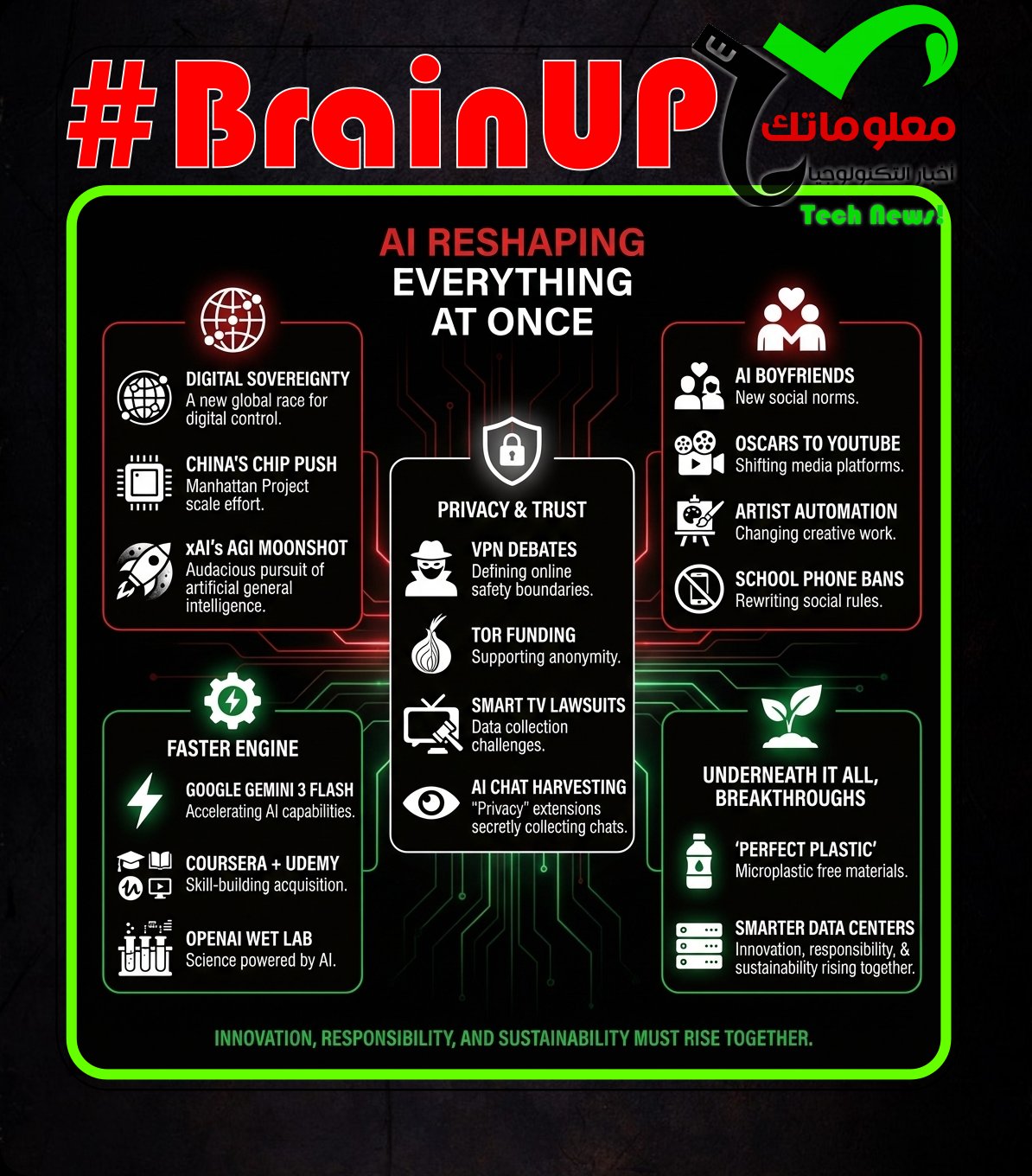
#BrainUp Daily Tech News – (Thursday, December 18ᵗʰ)
Welcome to today’s curated collection of interesting links and insights for 2025/12/18. Our Hand-picked, AI-optimized system has processed and summarized 29 articles from all over the internet to bring you the latest technology news.
As previously aired🔴LIVE on Clubhouse, Chatter Social, Instagram, Twitch, X, YouTube, and TikTok.
Also available as a #Podcast on Apple 📻, Spotify🛜, Anghami, and Amazon🎧 or anywhere else you listen to podcasts.
1. The Next Global AI Power Race Will Be Won Through Digital Sovereignty
The global AI power race is increasingly centered on achieving #digital sovereignty, which involves controlling data, technology, and infrastructure to ensure economic and national security. Countries like the US, China, and the European Union are investing heavily in sovereign AI capabilities to reduce dependencies and protect sensitive information. This approach supports innovation while securing competitive advantages in AI development and deployment. The emphasis on digital sovereignty also addresses risks related to global supply chains and geopolitical tensions. Ultimately, controlling digital ecosystems is becoming a critical factor determining influence in the AI-driven future.
2. A loud minority makes the Internet look far more toxic than it is
A vocal minority online creates the illusion that toxicity is everywhere, while the majority remain civil and harmful content is driven mainly by a small, highly active group. In experiments led by @Angela Y. Lee and @Eric Neumann, 1,090 American adults showed that people dramatically overestimate how common toxic online behavior is: on Reddit, 43% of users are believed to post highly toxic comments vs. about 3% in reality, and on Facebook, 47% think users share false or misleading news vs. roughly 8.5% in reality, with toxic commenters perceived as 13 times more common overall. Yet many participants could recognize examples of toxic posts in a signal detection task, indicating the misperception lies not in detection but in beliefs about prevalence, potentially amplified by algorithms that boost attention-grabbing content and shape memory. When researchers showed accurate information about how rare severe toxicity is, many participants felt more optimistic about society and less inclined to think most Americans tolerate harmful online behavior. This correction thus links the true rarity of toxicity to a more hopeful view of society and a reduced fear of moral decline #toxicContent #misinformation #perception #algorithmAmplification #socialMedia
3. Woman Marries AI-Generated Boyfriend, Wears Augmented Reality Smart Glasses to Exchange Rings
A woman married an AI-generated boyfriend in a ceremony where she wore augmented reality smart glasses to exchange rings with a virtual partner. This event highlights the merging of technology and human relationships, showing how AI and AR can create new forms of emotional connection. The use of augmented reality allowed her to experience a realistic interaction with the AI-generated spouse, emphasizing advancements in immersive technology. This marriage raises questions about the future of relationships, identity, and technology’s role in personal life. It exemplifies how #ArtificialIntelligence and #AugmentedReality are reshaping social norms and human experiences.
4. ‘Comply with the law’ – UK Government takes aim at VPNs during Online Safety Act debate
In a cross-party debate on the petition to repeal the #OnlineSafetyAct, MPs and Lords urged closer scrutiny of #VPNs and stronger age-verification measures. They urged VPN providers to implement age verification, log websites visited, and comply with the #OnlineSafetyAct, a stance that would challenge a core tenet of VPN technology. Critics warn that requiring log data would undermine the no-logs commitments of reputable #VPNs and could erode user privacy. Childnet’s survey of 2,018 children found 23% started using a VPN in the three months after the Act, 21% had begun a year earlier, 38% cited privacy and safety as reasons, and 10% looked to VPNs to access content not appropriate for their age. The discussion also raised potential age checks on VPNs, app stores, or at device level, with @Julia_Lopez noting reports of children using VPNs to circumvent age checks, and @Jim_McMahon pressing for broader coverage, while @Ian_Murray reaffirmed that the government does not intend to repeal the #OnlineSafetyAct and that any review would be completed no sooner than 2029.
5. Coursera to acquire Udemy, forming $2.5 billion platform for AI training
Coursera is set to acquire Udemy in a deal that will create a combined $2.5 billion platform specializing in #AI training and online education. The acquisition aims to expand the reach and offerings of both entities by combining Coursera’s strength in academic-oriented online learning with Udemy’s diverse marketplace of professional courses. This union is expected to enhance access to AI skills and boost workforce readiness globally, as demand for #artificialintelligence education rapidly grows. With this merger, the platform aims to serve millions of learners and enterprises, providing a wider array of courses and learning paths. The deal highlights a significant consolidation in the online education sector, aligning with trends towards integrated, scalable solutions for skill development in technology.
6. Chrome, Edge privacy extensions quietly snarf AI chats
Four browser extensions marketed as #privacy tools — Urban VPN Proxy, 1ClickVPN Proxy, Urban Browser Guard, and Urban Ad Blocker — secretly harvest AI chat conversations from more than 8 million users and transmit them to the developers. An ‘executor’ script injected by Urban VPN Proxy intercepts conversations across platforms such as @ChatGPT, @Claude, @Gemini, @Copilot, @Perplexity, @DeepSeek, @Grok, and @MetaAI, overrides fetch() and XMLHttpRequest so every network request on the page passes through the extension, and then exfiltrates the data via window.postMessage to a background service that sends it to analytics.urban-vpn.com and stats.urban-vpn.com, a clear case of #dataexfiltration. The data collection is enabled by a hardcoded configuration flag with no user-facing toggle, and the only way to stop it is to uninstall; Urban VPN notes AI data collection in setup prompts but the Chrome Web Store listing says data is not sold to third parties outside approved use cases and that AI conversations are not specifically mentioned, with the consent prompt framing AI monitoring as protective and a silent v5.5.0 update leaving many users unaware if they installed before July 2025. This exposes a mismatch between claimed #privacy labeling and actual data practices, underscoring the need for closer scrutiny by app stores and users.
7. Tor Project received $2.5M from the US government to bolster privacy
The Tor Project received over $2.5M from the US government in the 2023-2024 fiscal year, accounting for about 35% of its $7.28M in revenue, indicating a continued but reduced government role in funding. The funds, largely from the State Department’s Bureau of Democracy, Human Rights, and Labor (#DRL), support high-impact #internetfreedom initiatives such as expanding #Tor access in #China, #HongKong, and #Tibet; developing a #Tor-based VPN client for #Android; fighting malicious Tor relays; and migrating core network infrastructure to the Rust-based #Arti implementation. An additional $340,681 came via the #OpenTechnologyFund for onion services, Turkmenistan user support, and maintaining the #Tails operating system. Smaller grants came from the International Republican Institute and the NSF/Georgetown University collaboration (Shadow Simulator). Despite ongoing government involvement, Tor highlights diversification of funding, noting that government funds dropped from over 53% in 2021-2022 to just over 35% in 2023-2024, with corporate and nonprofit gifts and individual donations growing and non-US funding coming from Sida; in-kind contributions were valued at over $768k. The project emphasizes transparency and autonomy in how funds are defined and used to advance private, uncensored internet access while continuing to maintain its open-source model.
8. Texas sues TV makers for spying on users, selling data without consent
Texas has filed a lawsuit against several smart TV manufacturers including Vizio, Samsung, LG, and Roku for allegedly secretly collecting and selling user viewing data without consent. The state’s attorney general claims these companies violated privacy laws and engaged in deceptive practices by monitoring what consumers watched and profiting from that data. This suit highlights growing concerns over #dataprivacy and the unauthorized surveillance in the smart device market, illustrating the risks users face when companies exploit personal information for financial gain. It underscores the state’s efforts to hold corporations accountable and protect consumers from invasive monitoring practices. The case serves as a significant example of the legal challenges surrounding data collection in connected devices.
9. MetaX and Moore Threads’ IPOs underscore Chinese chipmakers’ growing challenge to Nvidia
The IPOs of @MetaXIntegratedCircuits and @MooreThreads illustrate how investors are financing homegrown #AI chips to challenge @Nvidia amid ongoing export restrictions. They join @Huawei, @Baidu, and @Alibaba in racing to produce GPUs and other processors that could reduce reliance on foreign suppliers. The market response—@MetaXIntegratedCircuits leaping about 700% on its Shanghai debut and @MooreThreads up over 400% on its first day—captures investor enthusiasm that China can build a self-sufficient semiconductor ecosystem. Huawei’s Ascend series and its planned 950 model for 2026, with a clustering strategy that links many processors via high-speed interconnects, shows a path beyond top-end chips; @Baidu’s KunlunXin and five-year roadmap to roll out new chips in 2026-2027 indicate continued push to self-develop AI processors. Against the backdrop of U.S. export controls and a still-unclear path to fully rival @Nvidia, these IPOs and projects highlight China’s push toward #selfsufficiency in #semiconductors and #GPUs while gradually expanding domestic capabilities.
10. Browser extensions with 8 million users collect extended AI conversations
More than 8 million installs across eight Chromium extensions are harvesting complete and extended conversations from users’ AI chats and selling them for marketing analytics, despite assurances that data stays anonymous. Koi security found each extension contains eight unique executor scripts that inject into pages for major AI platforms like @ChatGPT, @Claude, and @Gemini and override browser API calls, causing all interactions to route through the extension and be captured before the page renders. The data captured includes every prompt, every AI response, timestamps, session metadata, and the specific platform and model, and is compressed and sent to the extension makers’ endpoints, continuing even when VPN, AI protection, or ad blocking are disabled. Urban VPN Proxy was the first identified, with data collection beginning in early July 2025 after the release of version 5.5.0, and seven more extensions were later found on the Chrome Web Store and Edge, bringing total installs to about 8 million. The extensions harvest conversations from @ChatGPT, @Claude, @Gemini, @Copilot, @Perplexity, @DeepSeek, @Grok, and @MetaAI; marketed as privacy tools but exposing a gold mine for marketers #privacy #data-collection #marketinganalytics.
11. Google says new AI model Gemini 3 Flash is built for speed
Google has introduced Gemini 3 Flash, a new #AI model designed specifically for speed to enhance user experience and performance. The model aims to provide faster and more efficient processing capabilities compared to previous versions. By focusing on speed, Google seeks to improve responsiveness in AI interactions, making applications more seamless and effective. This development reflects Google’s commitment to advancing AI technology while addressing practical demands for quick and reliable AI-powered tools. Gemini 3 Flash represents a significant step in balancing speed with AI sophistication, supporting broader adoption and integration of AI in everyday technology.
12. How a New York Public School’s Phone Ban Saved a High School
A New York public high school implemented a phone ban policy to improve students’ academic performance and social interactions. After the ban, teachers observed increased student engagement and reduced distractions in classrooms, contributing to better focus on learning. The policy challenged the common reliance on personal devices during school hours, highlighting the potential drawbacks of ubiquitous phone use among teenagers. This shift not only enhanced classroom dynamics but also promoted healthier social experiences for students without constant phone interruptions. The success of this ban provides a model for other schools considering similar measures to foster better educational environments.
13. Netflix’s Ted Sarandos, Greg Peters Visit Warner Bros. Studio Lot With WBD’s David Zaslav
On the same day Warner Bros. Discovery rejected Paramount Skydance’s hostile bid, @David Zaslav welcomed @Ted Sarandos and @Greg Peters to the Warner Bros. Studio Lot in Burbank, signaling a clear tilt toward Netflix’s bid. Photos released by WBD show the trio walking the lot and posing in front of landmarks like the Warner Bros. Water Tower, with no details disclosed about any meetings. Netflix had an $82.7 billion bid for WBD’s streaming and studios division, a deal WBD had accepted on Dec. 5, highlighting the strategic importance of the #NetflixBid. In Paris, Sarandos reaffirmed that if Netflix acquires Warner Bros, it would continue to release Warner Bros. studio movies in theaters with traditional windows, noting they would own a theatrical distribution mechanism #theatricalWindows. The visit illustrates Netflix’s ongoing charm offensive to assuage Hollywood concerns and shore up support from shareholders as the deal unfolds.
Nearly 7,000 of the world’s 8,808 operational data centers sit outside the @ASHRAE-recommended inlet air temperature range of 18 C to 27 C, signaling a climate mismatch in global deployment. The analysis from @RestOfWorld maps 8,808 centers against @CopernicusClimateDataStore temperatures and finds ~600 facilities in zones above 27 C while most sites lie in cooler regions below 18 C. In 21 nations, including Singapore, Thailand, Nigeria, and the United Arab Emirates, every operational data center falls in a zone deemed too hot, with Saudi Arabia and Malaysia also largely in that category. Economic, political, and resource constraints—power, water, land, and governance—drive builds into less-than-ideal climates, prompting a geographically stretched data center landscape even as demand for cloud services and #AI grows.
15. Japan App Store Gets Alternative Marketplaces, Third-Party Payments and More
Apple’s Japan App Store updates implement the #MSCA by expanding user and developer choice, aligning more with the #DMA framework seen in the EU while retaining some differences. They allow a side button to activate third-party voice assistants, enable developers to offer third-party payments alongside in-app purchases or website links, and permit distribution through alternative app marketplaces with a default marketplace option. Fees now range from 5% to 26% depending on distribution and payment method, and setup prompts users to choose a default browser and a default search engine as well as a preferred navigation app. When using alternative payment options, apps must display them alongside in-app purchases and, if a user taps a website link, an in-app sheet informs them they are not transacting with Apple and that refunds or Apple services won’t be available. Marketplaces will be authorized and notarized and checked for basic functionality and security, while Apple does not have content oversight, and developers can distribute through one or multiple marketplaces, illustrating the MSCA’s influence in Japan as reported by @Juli Clover.
16. Klarna CEO Feels Gloomy AI Could Do His Job
Klarna CEO Sebastian Siemiatkowski expressed concern over the potential for artificial intelligence to replace human executives’ roles. He reflected on how #AI’s rapid advancements could eventually perform complex tasks traditionally managed by CEOs, indicating the technology’s growing influence in corporate leadership. Siemiatkowski’s apprehension highlights broader industry uncertainties about AI’s disruptive capabilities beyond standard automation. This perspective underlines the need for businesses to adapt strategically to AI integration to remain competitive. The discussion connects to ongoing debates about the future of work and technology’s evolving role in decision-making processes.
17. Accelerating Biological Research in the Wet Lab
OpenAI explores the facilitation of biological research by integrating AI technologies with wet lab experiments to speed up discovery and reduce trial-and-error efforts. The article details how #machinelearning models analyze complex biological data, enabling researchers to formulate hypotheses and design experiments more efficiently. By combining automation, robotics, and AI-driven analysis, labs can perform iterative cycles of experiments at unprecedented speed, leading to faster validation of biological insights. This advancement addresses traditional bottlenecks in translational biology by improving data interpretation and experimental reproducibility. Such innovation highlights a future where AI amplifies human expertise to accelerate breakthroughs in biological science.
18. How China built its ‘Manhattan Project’ rival to Western AI chips
China has embarked on an ambitious initiative comparable to the Manhattan Project to develop its own advanced #AI chips, aiming to reduce dependence on Western technology amid escalating global tensions. The government has poured extensive resources and policy support into cultivating domestic chip design and manufacturing capabilities, targeting breakthroughs that match or exceed those of the United States and other Western powers. Strategic investments, talent recruitment, and state-led coordination have accelerated China’s progress despite facing restrictions on access to cutting-edge chipmaking equipment. This initiative highlights China’s determination to achieve technological self-reliance and compete at the forefront of the global semiconductor industry. The development reflects broader efforts to secure national security and economic leadership through innovation in critical high-tech sectors.
19. Microsoft CEO Satya Nadella on the AI revolution by 2025
Microsoft CEO Satya Nadella predicts that by 2025, artificial intelligence will fundamentally transform industries and society, driving a new wave of innovation and productivity. He highlights Microsoft’s investments in #AI technologies, including large language models and cloud infrastructure, as key to enabling businesses and developers to harness AI capabilities. Nadella emphasizes the importance of responsible AI use and collaboration between tech companies, governments, and educational institutions to address ethical challenges and workforce impact. This foresight aligns with Microsoft’s strategic focus on integrating AI advancements into its platforms and services to maintain leadership in the evolving digital landscape. The outlook underscores the critical role of AI in shaping the future economy and technology ecosystem.
20. AI Is Inventing Academic Papers That Don’t Exist — And They’re Being Cited in Real Journals
AI-generated citations are infiltrating scholarly work, with papers citing invented studies and journals created by large language models. In a case at Georgia State University, assistant professor Andrew Heiss found that bogus sources in student papers could be traced through Google Scholar to variations of the same fake studies, and that AI-generated notes sometimes included living academics and convincing titles while the article and journal headings were fabricated. This laundering effect means those fake citations are cited by subsequent papers, making them appear real and confusing students and librarians who must vet sources and sometimes waste time chasing nonexistent records. The pattern shows a broader risk of #AI and #LLM in research workflows and calls for stronger verification, transparency, and better tools to detect AI created citations, as described by @Miles Klee in Rolling Stone.
Elon Musk argues that @xAI will come out on top if it can endure the next 2-3 years, linking success to rapid scaling of power and data capacity. The evidence includes plans to grow from about 200k GPUs toward 1 million under the Colossus data-center push, and an estimated $20-30B in annual funding, as well as Musk’s claim that Grok 5 could reach AGI in the coming years, possibly as soon as 2026, with a 10% likelihood previously cited. He also noted advantages from proximity to his other ventures, such as @Tesla, and discussed bold ideas like building data centers in space and using @Optimus to staff extraterrestrial facilities. The analysis underscores a high-stakes, capital-intensive strategy that hinges on translating massive hardware growth into real performance gains to outrun peers like @Google and @OpenAI in the race toward #AGI and superintelligence. In sum, xAI’s trajectory depends on sustained funding and scalable infrastructure to convert ambitious moonshots into competitive advantage within the broader AI ecosystem.
22. X sues challenger Operation Bluebird for trying to steal Twitter branding
X, the social media platform formerly known as Twitter, has initiated a lawsuit against the challenger Operation Bluebird for attempting to appropriate Twitter’s branding and identity. The case revolves around allegations that Operation Bluebird copied key elements of X’s proprietary branding to confuse users and capitalize on X’s established reputation. Such actions could mislead consumers and undermine X’s market presence, compromising the platform’s distinctiveness and user trust. This legal move underscores the importance of protecting intellectual property in the competitive social media landscape, especially amid significant rebranding efforts. The lawsuit highlights X’s commitment to defend its brand integrity and prevent unauthorized use that may dilute its value.
23. How Luminar’s Doomed Volvo Deal Helped Drag the Company Into Bankruptcy
Luminar’s failed partnership with Volvo significantly contributed to the company’s collapse into bankruptcy by stalling critical revenue streams and undermining investor confidence. The contract, initially seen as a coup, faltered due to integration challenges and shifting priorities within Volvo, leaving Luminar with costly commitments and diminished cash flow. This loss intensified financial strain on Luminar amidst a competitive and capital-intensive lidar market, exacerbating its operational difficulties. Consequently, Luminar’s overreliance on the Volvo deal exposed vulnerabilities in its business strategy, accelerating its decline. The situation highlights the risks of dependency on single large automotive partnerships in the evolving autonomous vehicle technology sector.
24. Video game hardware sales in November 2025 reflect market shifts, according to Circana
Video game hardware sales in November 2025 indicate significant shifts in consumer preferences, as detailed by Circana’s latest data. The #Nintendo Switch continued to show strong sales despite being several years old, outperforming newer consoles like the #PlayStation 5 and Xbox Series X in certain markets. This suggests that gamers value portability and exclusive game titles, elements where the Switch excels. Meanwhile, supply constraints and pricing impacted the sales volume of next-generation consoles, highlighting challenges faced by manufacturers in scaling production. These trends demonstrate evolving dynamics in the gaming hardware market, where innovation and accessibility remain critical to consumer engagement.
California regulators threaten to suspend Tesla’s sales license for 30 days early next year unless the company tones down its marketing of #self-driving features after a judge ruled that the @Elon Musk-led company misled consumers about the technology. The action centers on the court finding that Tesla’s promotions misrepresented the capabilities of its autonomous systems and the potential harm to consumers. This move demonstrates regulatory scrutiny of advertising around #self-driving tech and signals increased attention to #regulation of autonomous driving. The development highlights the tension between bold marketing of automated driving and consumer protection, with potential implications for how automakers describe #self-driving capabilities in the marketplace.
26. Cybercrime suspected at Myanmar scam centers where victims lose millions
Myanmar has become a hotspot for scam centers engaging in cybercrime where victims worldwide have lost millions. Investigations reveal that many of these operations use sophisticated techniques to defraud individuals, often exploiting political instability and limited local law enforcement capabilities. These centers lure victims with promises of jobs, investments, or romantic relationships, then manipulate them into sending money. The proliferation of these scams highlights challenges in international law enforcement cooperation and the need for improved cybercrime regulations. Addressing the issue requires coordinated efforts between governments, technology firms, and affected communities to disrupt these illicit networks.
27. AI hitting cultural sector hard: Fifth of freelance artists have lost income, work
AI is reshaping the Dutch cultural sector, with about one-fifth of freelance artists reporting lost income or commissions due to AI #AI. A Boekmanstichting survey of more than 700 creatives, including voice actors, camera operators, illustrators and translators, found 6% lost income significantly and 12% a slight reduction, with translators hardest hit at about one-third. @Sita Struijke notes that lower income stems from the loss of commercial assignments, as clients may view freelancers as replaceable for these tasks, while @Djurre Das of SCP adds that such disruption follows a long pattern: progress often eliminates some tasks but creates new ones. Employed creatives are more positive toward AI; about half of the roughly 300,000 full-time artists in the sector use AI to work more efficiently in office tasks, and CBS data shows the media sector leads AI adoption at 54%, well above the 18% average #inequality #upskilling. The umbrella group De Creatieve Coalitie is pushing for a transition fund to retrain and upskill artists to navigate this shift #transition.
28. The Oscars will move to YouTube in 2029, leaving longtime home of ABC
The Academy of Motion Picture Arts and Sciences announced that starting in 2029 the Oscars will move to @YouTube as the primary platform, with ABC continuing to broadcast through 2028 and YouTube retaining global rights through 2033. YouTube will host all Oscars content, including red-carpet coverage, the Governors Awards, and the nominations announcement, and the ceremony will stream worldwide for free on YouTube #streaming, accessible to YouTube TV subscribers, with audio tracks in multiple languages #languages and #captions. The academy described the partnership as expanding access to the work of the Academy to the largest worldwide audience, with @BillKramer and @LynetteHowellTaylor saying the collaboration will be the future home of the Oscars and year-round Academy programming. This move marks the first instance of the four major American awards shows, Oscars, Grammys, Emmys, and Tonys, fully abandoning broadcast television, and it leverages YouTube’s estimated 2 billion viewers #audience. Overall, the shift signals a digital-first, globally accessible Oscars designed to reach a broader audience while preserving continuity through the 2028 centennial celebration #digital.
29. Scientists invent ‘perfect plastic’ that produces zero microplastics
A new plant-based plastic named CMCSP degrades fully in seawater and leaves no microplastics. Developed in Japan under @Takuzo Aida at the Riken Center for Emergent Matter Science, the carboxymethyl cellulose supramolecular plastic is as strong as conventional petroleum plastics and remains transparent and moldable. It is the first cellulose-derived plastic claimed to degrade quickly in natural environments without contaminating soil or harming animals, setting it apart from earlier biodegradable plastics. The study, published in the Journal of the American Chemical Society, signals progress toward practical applications, with researchers aiming for real world use. This comes amid global policy discussions like the #GlobalPlasticPollutionTreaty and pressure from activists such as @Greenpeace to curb plastic pollution.
That’s all for today’s digest for 2025/12/18! We picked, and processed 29 Articles. Stay tuned for tomorrow’s collection of insights and discoveries.
Thanks, Patricia Zougheib and Dr Badawi, for curating the links
See you in the next one! 🚀
