
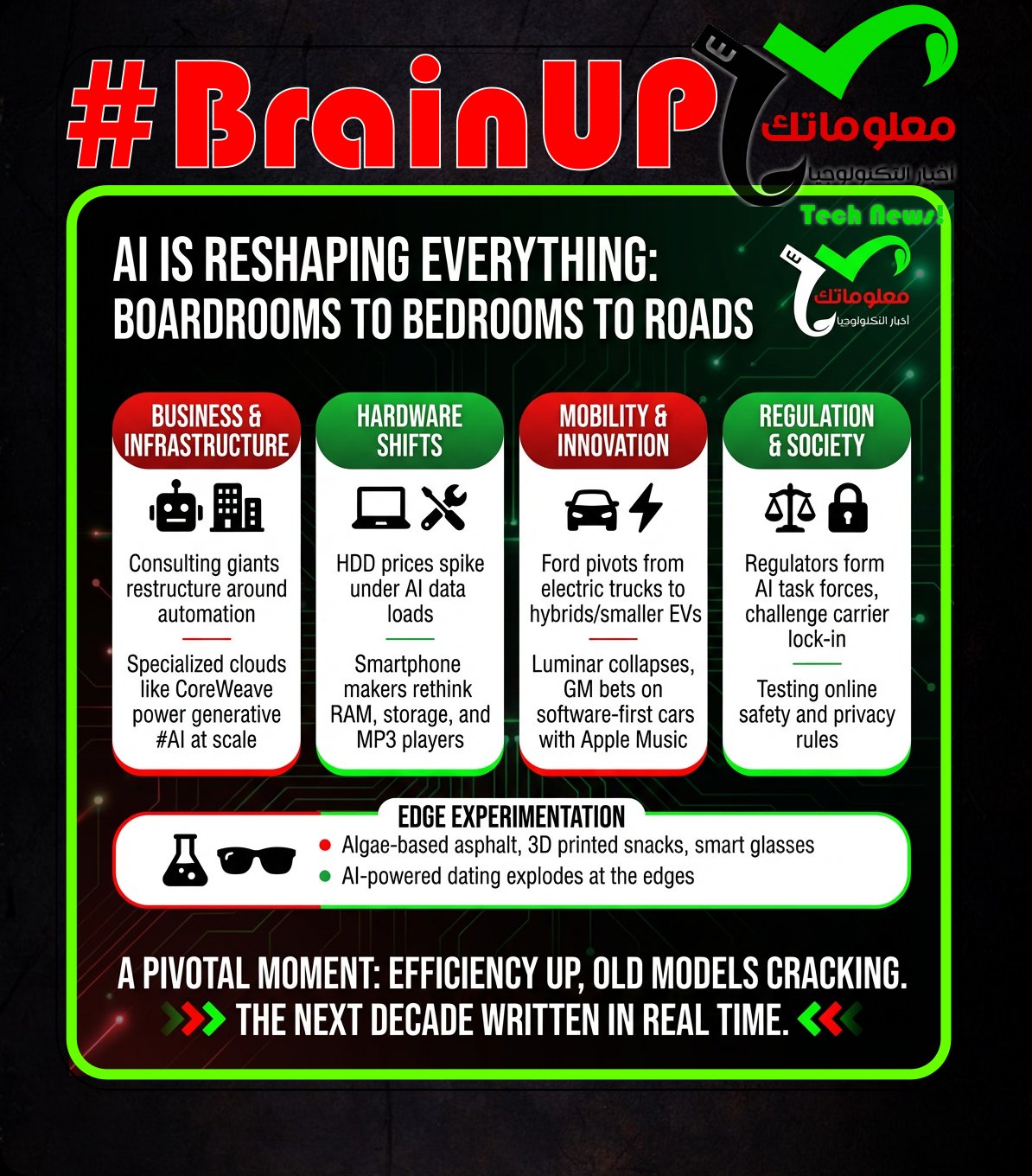
#BrainUp Daily Tech News – (Tuesday, December 16ᵗʰ)
Welcome to today’s curated collection of interesting links and insights for 2025/12/16. Our Hand-picked, AI-optimized system has processed and summarized 29 articles from all over the internet to bring you the latest technology news.
As previously aired🔴LIVE on Clubhouse, Chatter Social, Instagram, Twitch, X, YouTube, and TikTok.
Also available as a #Podcast on Apple 📻, Spotify🛜, Anghami, and Amazon🎧 or anywhere else you listen to podcasts.
1. McKinsey to make thousands of layoffs as AI advances
McKinsey, a leading consulting firm, plans to lay off thousands of employees as advancements in #ArtificialIntelligence reduce the need for traditional consulting tasks. The firm faces significant pressure to adapt its workforce amid growing competition from AI-driven services that can automate data analysis and recommendations. This shift highlights a broader trend in the consulting industry, where companies must balance human expertise with technological efficiency to remain competitive. McKinsey’s decision reflects the transformative impact of AI on employment and business models in professional services. Such moves underscore the necessity for firms to rethink talent strategies in an AI-dominant landscape.
2. Microsoft 365 Price Increase: What You Need to Know
Microsoft announced a price increase for its #Microsoft365 subscription plans, marking the first significant change in nearly a decade. The new pricing reflects enhancements in productivity and collaboration tools, including the integration of AI-powered features from @OpenAI, aimed at increasing user efficiency. This adjustment responds to evolving market demands and the need to support ongoing innovation and infrastructure investments. While the price hike may impact budget-conscious customers, it underscores Microsoft’s commitment to delivering advanced capabilities and value. Users should evaluate the benefits of the updated features against the cost increase to determine the best fit for their needs.
3. Google to Retire Dark Web Report Tool That Scanned for Leaked User Data
Google announced it will retire its Dark Web Report tool on April 30, 2024, which scanned for leaked user data across the dark web and notified users of potential compromises. The tool, part of Google’s suite of proactive security measures, aimed to help users identify and respond to breaches before attackers could exploit their information extensively. However, Google has decided to discontinue it, citing a shift in focus toward integrating similar protections directly into its broader security infrastructure rather than maintaining a standalone service. Users are encouraged to continue protecting their accounts with established security features such as two-factor authentication and password managers. This move reflects Google’s ongoing adaptation to evolving cybersecurity challenges while emphasizing consolidated, user-friendly safety mechanisms.
4. Payments firm PayPal files for bank charter in lending push
PayPal has filed for a bank charter with U.S. regulators to expand its lending services. The move aims to give PayPal greater control over the financing it provides to customers and merchants, rather than relying on third-party banks. With a bank charter, PayPal can offer loans, deposit accounts, and other financial products directly, enhancing its competitiveness against traditional banks and fintech firms. This strategy supports PayPal’s broader goal to grow its lending business and diversify revenue streams amid a shifting payments landscape. The filing aligns with a trend of fintech companies seeking bank charters to integrate more deeply into the financial system.
Hard disk drives are rising in price as #AI infrastructure expansion and China’s PC push collide, marking the biggest price increase in eight quarters. HDD contract prices jumped roughly 4% quarter over quarter in Q4 2025, according to Digitimes Asia citing @Nikkei, with nearline HDDs showing a similar uptick #nearline. The two main demand drivers are a renewed push in China’s PC market driven by government procurement policies that favor domestically produced CPUs and operating systems, boosting local PC production and HDD adoption amid concerns about long-term data retention in SSDs due to NAND bit rot, and the U.S. data center sector’s growing need for high-capacity nearline HDDs as #AI workloads generate and move more data. This pressure comes against a backdrop of tight supply, with HDD manufacturing constrained by specialized components like read/write heads and precision media, and elevated DRAM prices limiting cost control, suggesting the trend may persist even as HDDs remain cheaper per GB than SSDs and #AICapEx continues to drive demand.
6. UK to encourage Apple and Google to put nudity blocking systems on phones
The UK government plans to urge @Apple and @Google to implement nudity blocking systems on smartphones to better protect children from harmful content. This proposal is part of broader efforts including the #OnlineSafetyBill to make tech companies more accountable for online harms. By equipping phones with built-in detection and filtering technology, the government aims to prevent the sharing and viewing of non-consensual or exploitative nude images. Experts argue such measures could reduce child exploitation and provide parents more control over digital safety. This strategy aligns with the UK’s commitment to safeguarding children in digital spaces by leveraging technology alongside legislation.
7. Lidar-maker Luminar files for bankruptcy
Luminar, once a leading #lidar supplier that courted automakers like Volvo and Mercedes-Benz, has filed for bankruptcy and is seeking to sell its lidar and semiconductor units as part of a court process. The company has undergone layoffs and was embroiled in a legal fight with its founder @Austin Russell, who was ousted after an ethics inquiry, with its semiconductor unit already lined up for sale to Quantum Computing for $110 million. It will continue to operate during the bankruptcy to minimize disruptions and deliver its hardware and software, but Luminar will cease to exist once the process is complete, per statements from CEO @PaulRicci. The move follows Volvo’s decision to drop Luminar from its 2026 models due to limited supply, underscoring market pressures for #autonomousvehicles and the fragility of even well-funded startups in this space, alongside deals with @Mercedes-Benz, Volvo, #Audi, Toyota Research Institute, Caterpillar, and Tesla. The bankruptcy highlights how market dynamics and leadership turmoil can reshape the #lidar landscape and shrink competition among sensor suppliers.
8. In 2025, tech giants decided smart glasses are the next big thing
As 2025 draws to a close, major players are banking on #smartglasses as the next big thing, with devices from @Lenovo, @Rokid, and @EvenRealities underscoring the push. VR headsets remain niche due to high prices and a lack of compelling content, while smart glasses for mixed reality offer a more practical path by blending digital cues with the real world. The key difference is that smart glasses provide a mobile-first heads up display that overlays information while you stay aware of your surroundings rather than fully replacing reality with a digital environment, and they are not typically tethered to a PC. Google plans to support both smart glasses and headsets with Android XR, but heavier devices like Galaxy XR illustrate how size and weight can limit all-day use. Overall, the article suggests smart glasses could become mainstream if a broader ecosystem of content and affordable hardware emerges, moving beyond mere novelty toward everyday augmentation.
9. Verizon refused to unlock man’s iPhone, so he sued the carrier and won
A man sued Verizon after the carrier refused to unlock his iPhone, citing their policy restricting unlocking. The court ruled in favor of the man, finding Verizon’s refusal violated #FCC rules requiring carriers to unlock devices upon contract completion or full payment. This legal decision reinforces consumers’ rights to unlock their smartphones for use with other carriers or resale. The case highlights the ongoing tension between carriers’ control over devices and regulatory efforts to empower consumers. Ultimately, the ruling sets a precedent that carriers must comply with unlocking requests under federal guidelines.
10. It’s Time to Give MP3 Players a Second Chance
MP3 players, once a revolutionary technology for portable music, have been largely overshadowed by smartphones, but revisiting them reveals unique benefits. They offer focused music listening without distractions from calls, notifications, or apps, which can improve the experience during activities like running or commuting. Devices like the iPod Classic, with extensive storage and long battery life, serve niches where smartphones may fall short, such as in simple usability and offline music access. The resurgence of interest in dedicated #musicdevices underscores the value of specialized gadgets amid multifunctional devices. Embracing MP3 players again allows users to enjoy music more intentionally, preserving the joy of music without the interruptions typical of smartphones.
11. CoreWeave Is a Cloud-Computing Bet on Generative AI
CoreWeave has positioned itself as a specialized cloud-computing provider focusing on generative AI workloads, attracting investor interest amid a rising market for AI infrastructure. The company operates GPU data centers tailored to meet the high demand for graphics processing units crucial for AI tasks, differentiating itself from mainstream cloud providers like Amazon and Microsoft. CoreWeave’s growth narrative is tied to the expanding adoption of generative AI technologies which require substantial computational power, especially in industries developing AI models and applications. However, the stock’s performance reflects broader market skepticism about the sustainability of AI-driven valuations, cautioning investors about the risks of an AI bubble. CoreWeave’s emergence underscores the shift towards niche cloud services catering to #AI and highlights the evolving landscape of the cloud computing market amid rapid AI advancements.
In response to Rockstar’s firing of 31 GTA 6 staff, UK Prime Minister @SirKeirStarmer called the move deeply concerning and pledged that ministers will investigate, reaffirming that every worker has the right to join a union. MP Chris Murray raised the matter in Parliament, citing the @IWGB union’s allegations of union busting and questioning whether Rockstar is following UK employment law. Take-Two Interactive has described the firings as the result of gross misconduct after employees were found distributing and discussing confidential information in a public forum. Bloomberg and People Make Games have reported that the workers were on a private Discord server where union organization was discussed, and that a Slack policy change was shared, which is part of the broader controversy. The statements suggest a broader government focus on strengthening #employmentlaw and #workersrights in the UK, with ministers intending to monitor the case and provide updates to the MP.
13. Judge blocks Louisiana’s social media age verification law
A judge blocked Louisiana’s 2023 law that would have required social media platforms to verify users’ ages and provide parental controls. The Secure Online Child Interaction and Age Limitation law would have affected @Meta, @Reddit, @Snap, @YouTube, @Discord and others and was set to take effect this summer. In his ruling, Judge @JohnW.deGravelles said the age verification and parental-consent requirements are both over- and under-inclusive, and that the law’s definition of ‘social media platform’ is nebulous. NetChoice argued the measure is unconstitutional and would pose a massive privacy risk, not just chill speech, with @PaulTaske calling it a privacy risk seen in countries without a #First Amendment. The ruling reflects ongoing debates over age verification and online safety and suggests more legal battles over safety, privacy and speech are ahead.
14. SoundCloud Confirms Breach After Member Data Stolen, VPN Access Disrupted
SoundCloud recently confirmed a cybersecurity breach that resulted in the theft of member data and disruption of VPN access. The breach was discovered after unusual activity was detected, prompting an investigation that revealed unauthorized access to customer databases. This incident exposed sensitive user information, raising concerns about data security on the platform. The company took immediate steps to mitigate the breach, including disabling affected systems and enhancing security measures to prevent future attacks. SoundCloud’s response highlights the ongoing challenges online services face in protecting user data against sophisticated cyber threats.
15. OpenAI communications chief Hannah Wong to exit
Hannah Wong is departing from her role as the communications chief at OpenAI, effective later this month. Her exit comes amid a pivotal time for OpenAI as it continues to expand and refine its AI technologies, including advancements in #artificialintelligence and #machinelearning. Wong’s leadership had been instrumental in shaping OpenAI’s public messaging and stakeholder engagement. The change signals a possible shift in communications strategy as OpenAI faces increasing scrutiny and competition. This transition may impact how OpenAI presents its innovations and policies in the evolving tech landscape.
16. Denmark takes a Viking swing at VPN-enabled piracy
Denmark’s government has opened a public consultation on amendments to copyright and broadcasting laws that would restrict #VPN use to access certain online content, aiming to curb illegal streaming. The draft stresses tech-neutral language to cover future developments and says the rules should address today’s piracy while updating them to handle evolving technologies, including pirate decoders. It notes that using #VPNs to view geo‑restricted content is rarely illegal, and compares the situation to the UK after the #OnlineSafetyAct, where VPN use surged though officials say a VPN ban is not planned. Experts and privacy activists argue the approach could limit #privacy_preserving_tech rather than stopping piracy, and suggest platforms should verify user location instead. The piece situates Denmark within a broader global debate on balancing enforcement, privacy, and future tech in the fight against online piracy.
17. Algae-based asphalt binder could pave the way for greener roads
Researchers have developed an innovative asphalt binder derived from algae, aiming to create more sustainable and environmentally friendly roads. This new binder utilizes algae biomass as a renewable resource, which can reduce reliance on traditional petroleum-based binders that contribute to pollution. The algae-based binder demonstrates comparable performance in durability and flexibility to conventional materials, suggesting its viability for widespread use in road construction. This development could significantly lower the carbon footprint of road infrastructure while also promoting the use of renewable materials in civil engineering. Integrating algae-based binders into paving practices aligns with global trends toward greener construction technologies and sustainability goals.
18. A startup betting that AI can find your ‘soulmate’ has raised $4 million. Read its pitch deck.
Keeper, a 2022-founded #AI dating startup, says it can identify your #soulmate and will tell you when there isn’t a good match. It disclosed a $4M pre-seed in Oct 2024 led by Lightbank and Lakehouse Ventures, with participation from Goodwater Capital and Champion Hill Ventures, and has drawn over 1.5M sign-ups and about 300k accounts. From its beta data, 10% of dates led to marriage, and Keeper uses layered algorithms and AI models to drive matchmaking, while currently limiting itself to heterosexual couples with plans to add LGBTQ+ options later. Creating a profile requires standard details like age and height plus academic test scores, as it builds its product toward better match quality. Investors view AI as a disruption point in dating with peers like #Sitch and #Amata and incumbents like #Tinder and #Bumble pursuing AI-enhanced experiences, and the founder emphasizes transparency, saying they’ll tell you if a soulmate isn’t found, all within a broader cultural context mentioned in the piece involving @ElonMusk.
19. Ford pulls the plug on the all-electric F-150 Lightning pickup truck
Ford is ending production of the all-electric F-150 Lightning and will shift toward hybrid vehicles and a future line of smaller, cheaper EVs, while keeping the Lightning name for a plug-in hybrid. The move follows customer demand and centers on the reality that the Lightning was a money-loser and would likely remain unprofitable. A plug-in hybrid version with a gasoline generator will let the truck keep moving even if the battery runs out. The all-electric Lightning drew attention for its utility with outlets and power options, won the 2023 MotorTrend Truck of the Year, was KBB’s top pick for electric trucks in 2024, and Ford says it was the best-selling electric truck in America last quarter. The broader EV market faced affordability and range challenges, and production costs did not fall as expected, with policy shifts under @Trump eliminating incentives that pushed #electrification, prompting @Ford to reallocate capital toward higher-return areas and toward smaller, more affordable EVs.
20. Creative Commons Announces Tentative Support for AI Pay-to-Crawl Systems
Creative Commons has tentatively supported the proposal for AI companies to pay website owners for crawling their content, responding to growing concerns about unauthorized data use. The organization highlighted that compensating creators aligns with fair use principles and helps sustain open content ecosystems. This move signals a shift in the balance between AI development and content rights, as pay-to-crawl systems could incentivize fairer data practices. It reflects broader debates on intellectual property in the AI era, emphasizing collaborative solutions between tech firms and content creators. Creative Commons’ stance may influence future policies on AI data sourcing and remuneration frameworks.
21. Microsoft will finally kill obsolete cipher that has wreaked decades of havoc
Microsoft has announced it will disable the outdated #RC4 cipher in its software, ending support for a cryptographic algorithm that has caused significant security vulnerabilities for decades. RC4’s weaknesses have been exploited to decrypt sensitive communications, prompting experts and organizations to urge its discontinuation. Microsoft’s move follows industry trends prioritizing stronger encryption methods to protect data confidentiality and integrity. This change enhances cybersecurity resilience for Microsoft users by eliminating a long-standing attack vector. Ultimately, retiring RC4 aligns with broader efforts to modernize encryption standards across technology platforms.
22. Scientists say printed food could change the way we eat
Italian scientists are pioneering sustainable snacking by 3D-printing sweet treats from lab-grown plant cells and fruit residues under the Nutri3D project led by ENEA, in collaboration with EltHub and Rigoni di Asiago, as Italy balances heritage with UNESCO status #3Dprinting. Prototypes include snack bars and honey pearls designed to retain flavor and nutritional value, with ENEA inks shaped by a 3D printer at EltHub in Abruzzo, and the objective is to grow the plant cells rather than the whole plant #cell-culture. @Silvia Massa notes that shrinking arable land and climate change drive the effort, which uses fruit residues from jam production and other by-products to combine cellular foods with recycled materials #byproducts. The initiative follows similar work in Northern Europe, and the technology could be valuable in space or conflict zones, with @Ermanno Petricca calling the snacks fruit for astronauts; 3D-printed plant-based meats are already on restaurant menus in Rome such as Impact Food #spacefood. ENEA is also testing microgreens and nano-tomatoes for space cultivation, a 59% public survey showing willingness to try such foods, and the prospect of tailored nutrition for dietary needs via 3D-printed foods #nutrition.
23. Microsoft’s recent Windows updates cause WSL networking issues
Microsoft’s latest Windows updates have caused network connectivity problems within the Windows Subsystem for Linux (#WSL). Users report that after installing updates released May 9 and May 10, WSL distributions encounter issues connecting to the internet, affecting development workflows reliant on this subsystem. The problem stems from changes in networking components in these cumulative updates, disrupting DNS resolution and outbound connections in WSL environments. Microsoft is investigating the issue and suggests workarounds such as restarting the LxssManager service or uninstalling specific updates to restore networking functionality. These disruptions highlight the complexity of maintaining compatibility in layered OS components like #WSL and underline the need for careful update testing to avoid development interruptions.
24. GM Bets You’ll Miss CarPlay Less With Built-In Apple Music Support
GM is rolling out a native @Apple Music app in models that don’t offer CarPlay, included at no extra cost through the standard OnStar Basics package for 8 years. The change is standard in all 2025 and newer vehicles and will be delivered via over-the-air updates, though the rollout will be phased and not all models will have it immediately. Cadillac models will additionally gain #SpatialAudio with #DolbyAtmos, reflecting the required hardware and software. This move shifts in-car entertainment away from CarPlay toward built-in streaming via Apple Music as part of GM’s broader software updates, signaling a new approach to how music is accessed in eligible vehicles.
25. Return Of 4GB RAM In Smartphones By 2026 Amidst DRAM Crisis, microSD Slots Make A Comeback
The #smartphone industry is expected to reintroduce 4GB RAM phones by 2026 due to an ongoing #DRAM crisis. Despite modern trends favoring higher memory capacities, supply chain constraints and rising memory prices are pushing manufacturers to optimize costs. Additionally, there is a resurgence of #microSD slots as users seek expandable storage options in response to storage limitations and increased content consumption. This trend suggests a shift in smartphone design priorities driven by economic and supply challenges, impacting both hardware configurations and user experiences. The return of lower RAM tiers and microSD expansion reflects a strategic adjustment to market demands and component availability.
26. Government forms task force to regulate AI advancements
The government has established a new task force to oversee and regulate the rapid advancements in artificial intelligence (#AI) technologies. This move comes amid growing concerns about ethical usage, potential job displacement, and security risks associated with AI deployment. Experts, including @FeiFeiLi and representatives from the Federal Tech Agency, have been appointed to develop guidelines that balance innovation with public safety. The initiative aims to create a collaborative framework among industry leaders, policymakers, and researchers to ensure AI benefits society responsibly. This task force represents a significant regulatory step to address the challenges and opportunities presented by AI growth.
27. Elon Musk’s net worth hits estimated $600bn as SpaceX prepares for IPO
@Elon Musk’s net worth has surged to about $600bn as #SpaceX eyes an IPO that could value the company around $800bn, boosting his wealth significantly. With a ~42% stake in @SpaceX, a flotation valued at over $1tn would lift his wealth by about $168bn to roughly $677bn. His ~12% stake in @Tesla has also buoyed his fortune, as shares rose this year amid expectations of #AI and #robotics expansion, including a robotaxis test and a $1tn pay plan approved by shareholders. Separately, @xAI is in talks to raise about $15bn at a $230bn valuation, underscoring Musk’s broader bets on #AI and programmable technologies. This shows how high-valuation tech ventures and ambitious AI plans are shaping @Elon Musk’s net worth.
28. Payments firm Paypal files bank charter in lending push
Paypal has submitted an application for a national bank charter to the Office of the Comptroller of the Currency, signaling its intention to expand its lending services. The move aims to grant Paypal more control over its financial products and enhance lending capabilities, diverging from reliance on partner banks. This regulatory step supports Paypal’s strategic ambition to become a broader financial services provider, especially in consumer and small business lending. By securing a bank charter, Paypal expects to streamline and potentially reduce costs associated with lending operations, positioning itself competitively in the fintech space. This development marks a significant evolution in Paypal’s business model, integrating more traditional banking functions into its digital payment ecosystem.
29. Scientists discover 12-day disaster warning window for Earth orbit collisions in 2025
Scientists have identified a critical 12-day window in 2025 during which the risk of catastrophic collisions in Earth orbit will be significantly heightened. This discovery is based on detailed simulations and analyses of congested orbital paths involving thousands of satellites and debris. The research highlights the increasing dangers posed by the proliferation of space objects and the necessity for improved monitoring and collision avoidance protocols. The findings underscore the urgency for international cooperation in #space traffic management to prevent potentially disastrous chain reactions in orbit. This enhancement in predictive capability could inform timely interventions to safeguard satellites and infrastructure vital to modern communications and navigation.
That’s all for today’s digest for 2025/12/16! We picked, and processed 29 Articles. Stay tuned for tomorrow’s collection of insights and discoveries.
Thanks, Patricia Zougheib and Dr Badawi, for curating the links
See you in the next one! 🚀
