
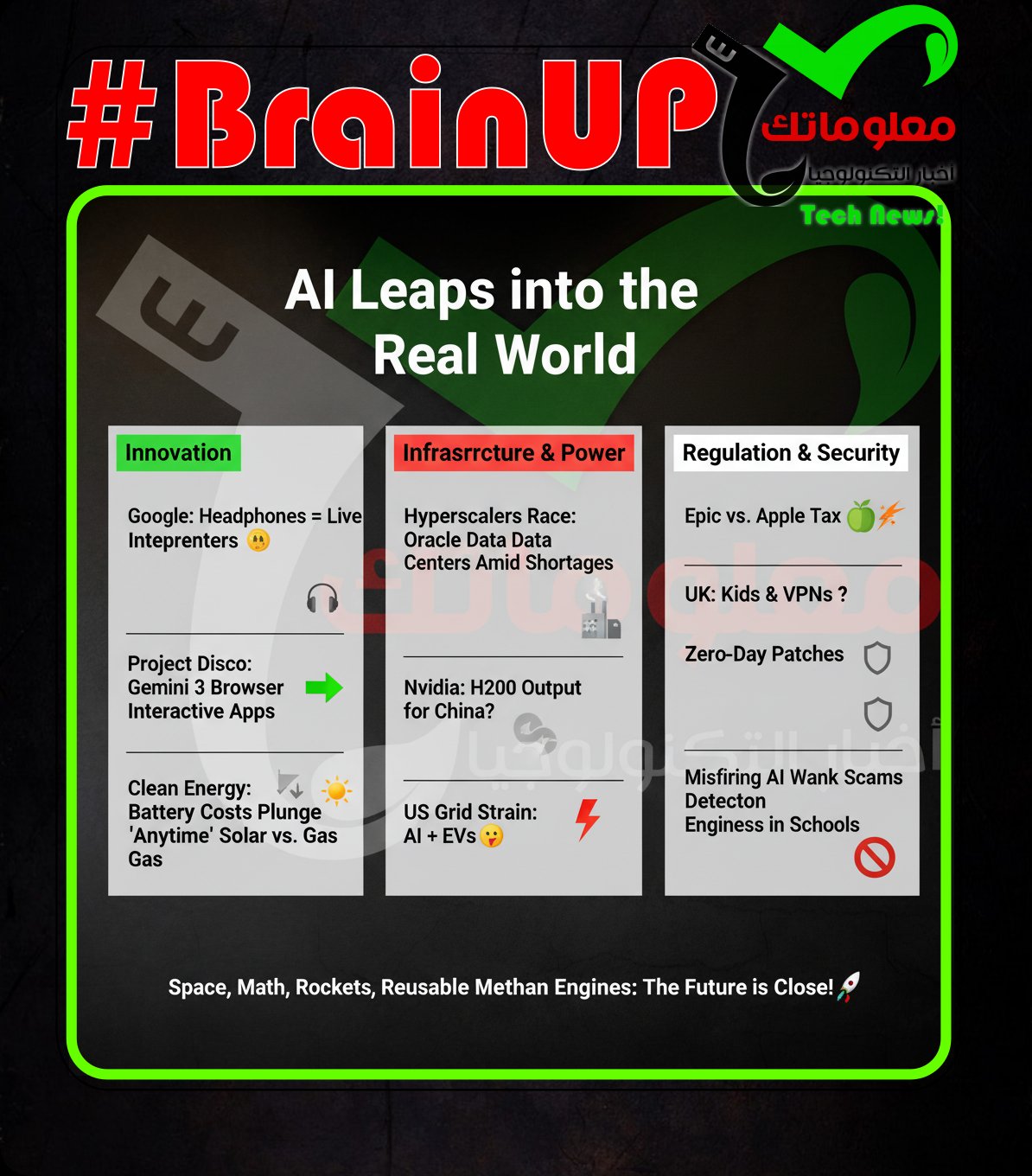
#BrainUp Daily Tech News – (Saturday, December 13ᵗʰ)
Welcome to today’s curated collection of interesting links and insights for 2025/12/13. Our Hand-picked, AI-optimized system has processed and summarized 21 articles from all over the internet to bring you the latest technology news.
As previously aired🔴LIVE on Clubhouse, Chatter Social, Instagram, Twitch, X, YouTube, and TikTok.
Also available as a #Podcast on Apple 📻, Spotify🛜, Anghami, and Amazon🎧 or anywhere else you listen to podcasts.
1. Google turns ordinary headphones into instant language interpreters
Google has introduced a new feature that can transform ordinary headphones into instant language interpreters by using Android Neural Networks API and Google Translate technology. This allows users to have real-time conversations across different languages without needing specialized hardware or devices. The functionality leverages machine learning models running on smartphones to process and translate speech efficiently, enabling more seamless multilingual communication. This advancement highlights Google’s commitment to making technology more accessible and practical for everyday users, enhancing communication across cultural and language barriers. By integrating this feature into commonly used devices like headphones, Google expands the usability of its #AI and translation tools in real-world, on-the-go scenarios.
2. Google and Apple Roll Out Emergency Security Updates After Zero-Day Attacks
Google and Apple urgently released security updates to address active zero-day vulnerabilities targeting their platforms, highlighting the increasing threat of sophisticated cyber attacks. The zero-day exploits, which allow attackers to execute malicious code without prior detection, prompted swift action from both companies to protect users. These emergency patches indicate enhanced collaboration and rapid response capabilities within the tech industry to mitigate risks from emerging security threats. The updates underscore the critical importance of timely vulnerability management and the ongoing battle against cyber adversaries. As these measures are deployed, users are strongly advised to update their devices promptly to ensure optimal protection.
Oracle is delaying several OpenAI data centers, pushing delivery from 2027 to 2028, due to shortages of skilled labor and materials that could add about a year to expansion. The delayed facilities are part of the #Stargate AI infrastructure program announced by @Oracle, @OpenAI, and @SoftBank, and the contract aims to raise Stargate capacity to two million AI accelerators and 5 GW of power. Despite the timetable slip, the overall scope remains unchanged, and the campuses are planned at an unusually aggressive scale that would rank among the world’s largest data centers. @Oracle CEO Clay Magouyurk emphasized that demand for AI capacity remains strong and that Oracle only accepts orders it can fulfill, noting ongoing progress such as the Abilene, Texas SuperCluster with nearly 200,000 Nvidia GPUs, and the delivery of Nvidia Grace Blackwell GB200 and AMD MI355 capacity. The company says bottlenecks are acknowledged but it continues its expansion, balancing growth with a rigorous process to ensure customer success and margins.
5. Epic celebrates the end of the Apple tax after appeals court win in iOS payments case
Epic Games has achieved a significant victory against Apple in an appeals court ruling that challenges the mandatory use of Apple’s in-app payment system and the associated 30% commission fee, often called the ‘Apple tax.’ The court’s decision effectively opens the door for developers to offer alternative payment methods within iOS apps, potentially lowering costs for developers and consumers alike. This ruling undermines Apple’s control over iOS payment infrastructure and could reshape the app economy by increasing competition and reducing Apple’s revenue dominance. The case highlights ongoing tensions between platform holders and developers over platform fees and control, reflecting broader debates about competition and fairness in digital markets. Epic’s win signifies a key moment in efforts to regulate dominant tech platforms and promote more open ecosystems.
6. In 2025, AI and EVs gave the US an insatiable hunger for power
The growing adoption of electric vehicles (#EVs) and artificial intelligence (#AI) technologies in the US has significantly increased national electricity demand by 2025. This surge is driven by the energy-intensive needs of AI systems for data centers and the widespread charging requirements of EVs. Utilities are challenged to meet this insatiable hunger for power while managing grid stability and integrating renewable energy sources. Policy adjustments and infrastructural investments are essential to address the escalating load and maintain a reliable energy supply. The intertwining of AI and EV growth reflects a broader shift toward electrification that requires strategic planning to ensure sustainable power management.
7. Analysis finds “anytime electricity” from solar available as battery costs plummet
According to @Ember, falling battery costs and improved performance are making #dispatchable solar an economically viable, anytime electricity option. Evidence from auctions in Italy, Saudi Arabia, and India shows core #BESS equipment costs fell 40% in 2024 to $165/kWh, with all-in capex outside the U.S. and China around $125/kWh, yielding a #LCOS of about $65 per MWh. Analysis highlights longer lifetimes, higher efficiency (20-year LFP, 90% efficiency), and de-risked revenue models that cut #LCOS by roughly 35% before falling equipment prices; storing 50% of a day’s solar adds about $33 per MWh, bringing total to about $76 per MWh when using the 2024 solar price of $43 per MWh. Linking back, the findings indicate dispatchable solar can displace new gas in LNG-reliant regions, though U.S. costs differ due to tariffs and IRA constraints, with four-hour projects seeing 10–15% cheaper equipment while the U.S. remains a major BESS market behind China.
8. Strategic Investment in Cybersecurity and Risk Management in Organizations
Organizations face increasing cyber threats that necessitate strategic investment in #cybersecurity and #riskmanagement to protect assets and maintain trust. The article provides evidence from recent empirical studies that demonstrate how timely and well-structured cybersecurity investments reduce vulnerability and financial losses due to cyberattacks. It also analyzes the role of organizational factors such as resource allocation, employee training, and governance in enhancing the effectiveness of cybersecurity measures. Implementing proactive cybersecurity strategies aligned with business objectives strengthens resilience and competitive advantage. This research underlines that integrating cybersecurity into overall risk management frameworks is essential for sustaining organizational performance in the evolving digital landscape.
9. Paper proposes a CRASH Clock for satellite collision risk
The @Sam Lawler-led team proposes the #CRASH_Clock (Collision Realization And Significant Harm) as a Key Environmental Indicator to estimate how long it would take before a catastrophic collision occurs if collision avoidance maneuvers cease. It currently stands at 2.8 days, down from 121 days in 2018, reflecting the surge of satellites in low Earth orbit, including the #Starlink megaconstellations. SpaceX reported Gen 1 satellites average 37 maneuvers per year and Gen 2 44 per satellite per year, amounting to a collision-avoidance action roughly every 1.8 minutes across the constellation, with Starlink using a conservative threshold of 3 in 10 million versus the industry standard 1 in 10,000. Lawler warned there is no magic here, it is essentially avoiding collisions by moving a Starlink satellite every couple of minutes, illustrating how crowded orbits could get if avoidance systems fail. The CRASH Clock serves as a sobering reminder of the risk of rapid deterioration in situation awareness and the need to manage orbital congestion and collision-avoidance reliability.
10. Disney to Invest $1 Billion in OpenAI, License Characters for Use in ChatGPT
Disney is set to invest $1 billion in OpenAI and license its iconic characters for integration into ChatGPT, enhancing user interaction through familiar entertainment figures. This move bridges the worlds of artificial intelligence and popular culture, allowing users to engage with Disney characters within AI-powered platforms. By combining OpenAI’s advanced #AI technologies with Disney’s rich character portfolio, the collaboration aims to create innovative content and user experiences. This strategy reflects a growing trend among media companies to merge AI with entertainment to capture and expand audiences. The partnership underscores Disney’s commitment to leveraging cutting-edge technology to strengthen its brand presence in the digital age.
11. UK Lords propose ban on VPNs for children
The UK House of Lords has proposed a ban on the use of VPNs by children to protect them from potentially harmful online content. The proposal aims to address concerns about children’s online safety by restricting access to #VirtualPrivateNetworks that can bypass content filters. Critics argue this could raise privacy issues and limit children’s freedom online, while supporters emphasize the need for stricter controls amid rising digital risks for minors. The debate highlights the tension between digital privacy and child protection policies in the UK. Overall, the proposal reflects increasing governmental attempts to regulate online environments specifically for younger users.
12. Korean Air, Hyundai Rotem to build reusable methane rocket engine – The Korea Times
@Korean Air and @Hyundai Rotem will jointly develop a reusable 35-ton-class #methane rocket engine, a core technology for next generation launch vehicles, by October 2030 under a government-backed 49 billion-won KRIT program. Hyundai Rotem will lead engine planning, evaluate the engine power pack, and manufacture the combustors. @Korean Air will lead development of the turbopump, a core component described as the heart of the propulsion system, aiming for high performance and reliability for methane engines. The project is expected to strengthen Korea’s space industry ecosystem and support military satellite launch capabilities and future national defense needs. About 70 experts and officials attended a kickoff in Daejeon to review development tasks, technical-validation procedures, and risk-management plans. Hyundai Rotem notes that methane engine technologies have been studied since 1994 and that a 2006 combustion test established a technological base for possible commercialization. Linking these efforts, the collaboration aims to bolster Korea’s #NewSpace sector and defense capabilities.
13. Florida School Locked Down After AI Weapon Detector Identifies Clarinet as Gun
A Florida school was locked down following an alert from an AI-powered weapon detection system that mistakenly identified a student’s clarinet as a gun. The incident highlights the increasing use of #AI surveillance technologies in schools intended to enhance safety but raises concerns about their accuracy and the potential for false positives disrupting educational environments. AI misidentifications like this demonstrate the challenges in relying solely on automated systems for critical security decisions, as they may misclassify harmless objects and cause unnecessary panic. This event underscores the importance of combining human judgment with AI tools to balance security measures with practical implications. As schools adopt more sophisticated technologies, careful evaluation is necessary to prevent such errors and maintain trust.
14. Nvidia considers increasing H200 chip output due to robust China demand, sources say
Nvidia is contemplating ramping up production of its H200 chips in response to strong demand from China, according to industry sources. This potential increase reflects the growing appetite in China for advanced AI computing technology, which Nvidia’s H200 chip targets. The move indicates Nvidia’s strategic adjustment to capitalize on the expanding Chinese AI market despite ongoing geopolitical tensions and export controls. By boosting supply, Nvidia aims to strengthen its presence in a key market while addressing supply chain constraints. This situation highlights how #AI chip demand is reshaping global semiconductor production priorities.
15. China Is Rejecting H-200s, Outfoxing U.S. Strategy, Sacks Says
China is actively rejecting the U.S.-developed H-200 drones, effectively countering American military strategy in the region. @Sacks, a security expert, explains that China’s tactics include advanced electronic warfare and anti-drone measures that neutralize the H-200’s operational advantage. This approach undermines U.S. efforts to assert dominance through unmanned aerial systems, forcing a reevaluation of Washington’s technology deployment and strategic assumptions. The Chinese strategy reflects a broader trend of leveraging indigenous innovation and countermeasures to maintain regional power balance. As a result, U.S. military planners must adapt to these evolving challenges to sustain influence in the face of China’s growing technological sophistication.
16. Tech Support Scams Evolve to Target Bank Accounts Directly
Tech support scams have evolved from simple fraud to sophisticated attacks that directly compromise victims’ bank accounts. Scammers impersonate tech company representatives to gain access to personal devices and then install malware or steal credentials, resulting in unauthorized bank transfers and significant financial losses. This shift highlights the increased risk of digital banking and the need for heightened security awareness among consumers. Experts warn that traditional warnings about phone scams are no longer sufficient, as attackers now exploit multiple vectors including social engineering and malware to bypass security measures. Strengthening consumer education and banking security protocols is critical to mitigating this escalating threat.
17. Intel Has Tested Chipmaking Tools Firm With Sanctioned China Unit, Sources Say
Intel has recently tested products from a Chinese chipmaking equipment firm linked to a unit sanctioned by the United States, according to sources. This situation highlights the challenges U.S. companies face in navigating export restrictions imposed on China, particularly in the semiconductor sector. The involvement of a sanctioned unit suggests complexities in supply chains and raises questions about compliance and enforcement of these sanctions. Intel’s actions reflect the tensions between maintaining business operations and adhering to international regulatory frameworks. This case underscores the broader geopolitical and technological contest surrounding #semiconductor supply and #trade_policy between the U.S. and China.
18. Fallout AI Recap: A Promising Start for Amazon Prime Video’s Anime Adaptation
Amazon Prime Video’s anime adaptation of #Fallout combines post-apocalyptic storytelling with AI-centric themes, exploring the survival struggles in a devastated world. The episode introduces key characters grappling with the trauma of nuclear fallout and the intrigue of advanced AI technology, highlighting moments that build emotional depth and tension. The narrative skillfully balances action with character development, setting up complex relationships and moral dilemmas amid technological threats. Visually, the animation captures the bleak yet compelling environment, enhancing viewer immersion in the #Fallout universe. This adaptation offers fans and newcomers alike a fresh perspective on the beloved franchise, blending classic themes with modern AI concerns.
19. Google Weather for Wear OS breaks on original Pixel Watch, Galaxy Watch
The piece reports that @Google Weather for Wear OS is broken on the original Pixel Watch and Galaxy Watch due to a bug, even though Google indicated Weather would continue to work for users who had the app installed before upgrading to Wear OS 6. Opening Google Weather results in a Loading… screen that switches to ‘Can’t download weather data’ with a looping Retry option, and the same problems affect the Forecast, Sun, and UV Index Tiles. This issue appears to affect all Google Weather users on every Wear OS device, including older Pixel Watch models, while Pixel Weather remains on Pixel Watch 2–4. The problem is described as likely a bug rather than a deprecation, with Google possibly needing a server-side update, and workarounds include third-party apps like AccuWeather or Gemini. #WearOS #GoogleWeather
20. Google opens Willow processor to UK scientists
Google has made its novel #Willow_processor accessible to UK scientists to advance research efforts. The #Willow_processor, designed to be highly efficient in handling AI workloads, enables faster and more energy-efficient computations compared to traditional processors. This initiative supports scientific projects that require intense data processing, fostering innovation in fields like healthcare and climate modeling. By granting access to this cutting-edge technology, Google aims to accelerate breakthroughs and enhance the UK’s scientific capabilities. Such collaborations exemplify how technology companies can empower research communities through shared resources and advanced infrastructure.
21. String Theory Inspires a Brilliant, Baffling New Math Proof
String theory has motivated a groundbreaking math proof that connects physics and pure mathematics in unexpected ways. Mathematician @EdwardWitten leveraged concepts from #stringtheory to formulate a novel approach to counting geometric shapes, revealing deep structures in the process. This breakthrough proof not only advances the field of geometry but also illustrates how theoretical physics can inspire profound mathematical insights. The interaction between these disciplines showcases the power of interdisciplinary approaches to solve longstanding problems. Consequently, the work bridges abstract math and theoretical physics, opening new avenues for research.
22. Google announces experimental ‘Disco’ browser with ‘GenTabs’ powered by Gemini 3
Google unveils Disco, an experimental AI browser aimed at shaping the future of web browsing, with its flagship GenTabs feature powered by @Gemini3 and built on #Chromium. GenTabs analyzes your open tabs and chat history to determine the best tool for your prompt, producing interactive web apps such as a trip planner with calendar, timelines, maps, and crowd-management tips in a GenTab that features a Gemini spark instead of a favicon. The system supports background links via a traditional tab strip, and examples include meal and gardening planners and a 3D solar-system model, with explanations that every generative element ties back to the web and sources, and no coding is required—just describe the tool you want. Google frames Disco as a vehicle to learn faster and to collaborate with the community on future browser ideas, noting that compelling concepts may eventually flow into larger products like #Chrome, and it opens a macOS waitlist for early access. By releasing this experiment, Google aims to accelerate development and gather user feedback to shape what the web browser of the future could be.
That’s all for today’s digest for 2025/12/13! We picked, and processed 21 Articles. Stay tuned for tomorrow’s collection of insights and discoveries.
Thanks, Patricia Zougheib and Dr Badawi, for curating the links
See you in the next one! 🚀
