
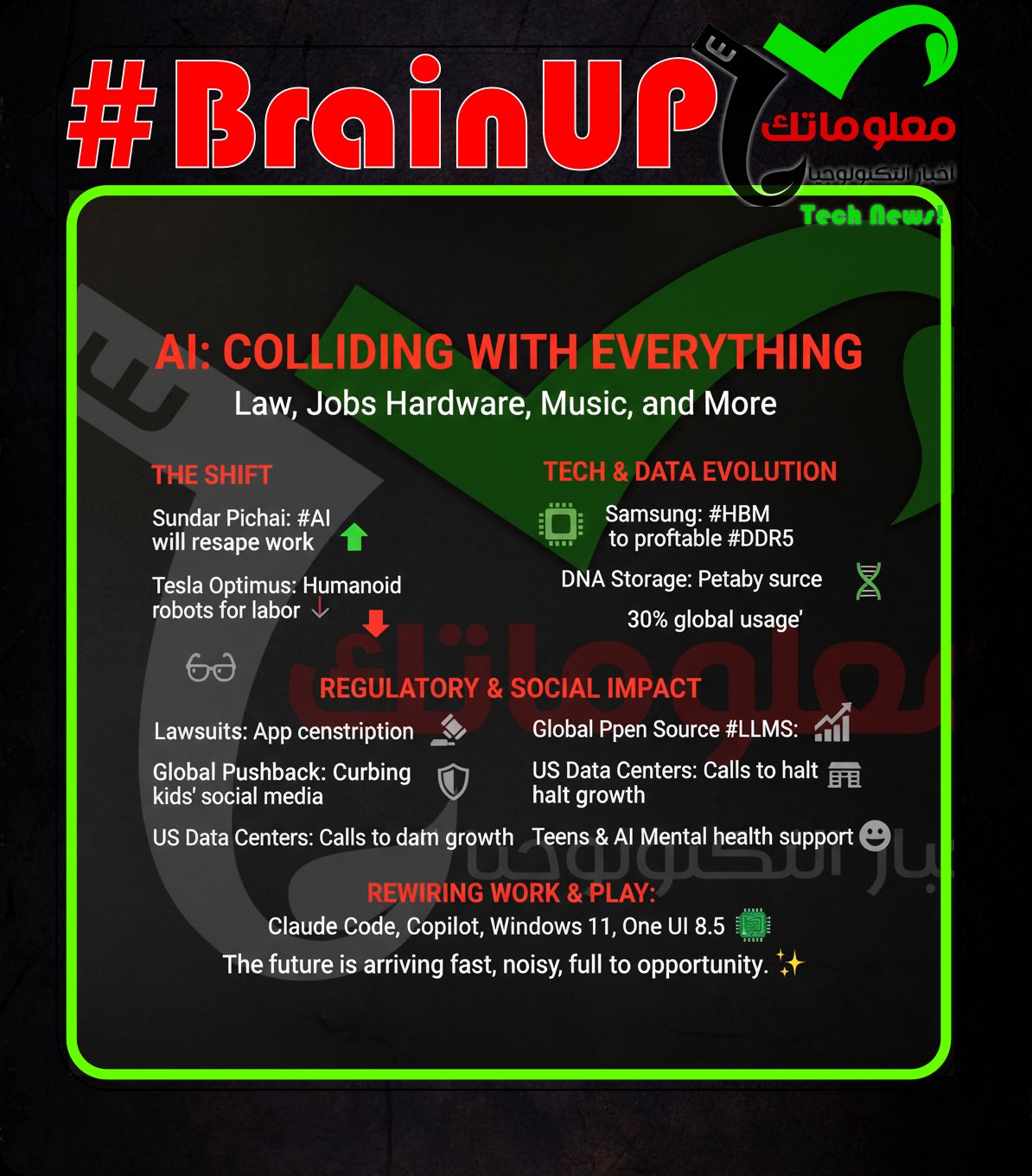
#BrainUp Daily Tech News – (Tuesday, December 9ᵗʰ)
Welcome to today’s curated collection of interesting links and insights for 2025/12/09. Our Hand-picked, AI-optimized system has processed and summarized 21 articles from all over the internet to bring you the latest technology news.
As previously aired🔴LIVE on Clubhouse, Chatter Social, Instagram, Twitch, X, YouTube, and TikTok.
Also available as a #Podcast on Apple 📻, Spotify🛜, Anghami, and Amazon🎧 or anywhere else you listen to podcasts.
1. Bondi, Noem Sued for Pushing Apple to Block Anti-ICE App
@Pamela J. Bondi is accused in a new lawsuit of violating the #FirstAmendment by pressuring Apple to block #ICEBlock, an app that lets the public report locations of ICE agents. The complaint says her actions amount to state censorship and seeks a court order declaring coercion and an injunction to stop Trump officials from pressuring #ICEBlock distributors. Apple approved #ICEBlock for distribution in April 2025, and developer Joshua Aaron created it to alert people to nearby, community-reported sightings of ICE personnel. Statements from officials claiming Aaron acted illegally are seen as threats of adverse government action against entities making the app available. The case, Aaron v. Bondi in the D.D.C., No. 24-cv-4250, seeks relief to shield #ICEBlock and its distributors from government pressure and to curb official interference.
2. Tesla’s Optimus Falls in Miami Demo
Tesla’s humanoid robot, Optimus, experienced a fall during a live demonstration in Miami, highlighting challenges in #robotics stability and mobility. The incident occurred while the robot was performing basic walking tasks, emphasizing the complexity of designing humanoid robots capable of safe and reliable movement. Despite the fall, Tesla continues to develop Optimus with the goal of creating a multi-purpose, bipedal robot for various labor-intensive tasks. This event illustrates the current technological hurdles in #AI and robotics integration for practical applications. Tesla’s efforts in advancing humanoid robotics demonstrate both progress and the need for further refinement before widespread deployment.
3. Samsung Shifts Focus From HBM To DDR5 Modules, DDR5 RAM Results in Far More Profits Than HBM
Samsung is reallocating its efforts from High Bandwidth Memory (#HBM) to DDR5 RAM modules due to the latter generating significantly higher profits. Despite #HBM’s technological advances and use in high-end applications, its market share remains limited, resulting in less financial return for Samsung. DDR5 technology, driven by increased demand in PCs and servers, offers Samsung a larger and more profitable market. The shift illustrates Samsung’s strategic move to prioritize products with better revenue potential and mass-market adoption. This transition reflects broader industry trends where profit margins guide focus towards scalable memory solutions like #DDR5 over niche high-performance memory types.
4. Microsoft has a problem: nobody wants to buy or use its shoddy AI
Microsoft’s AI offerings, including ChatGPT integrations and #Copilot features, struggle with poor user experiences and underwhelming performance, leading to low adoption and mixed reception. Despite the company’s significant investments and partnerships with OpenAI, many users and critics report frustration due to inaccuracy, limited real-world utility, and reliability issues. This undermines Microsoft’s efforts to lead in the #AI market and affects customer trust, contrasting with the hype and high expectations surrounding AI technologies. The gap between Microsoft’s AI ambitions and the actual delivered value highlights challenges in product development and market fit. Consequently, Microsoft’s broader AI strategy faces obstacles, emphasizing the need for meaningful improvements and better user alignment.
5. In 1995, a Netscape employee wrote a hack in 10 days that now runs the Internet
In 1995, @Brendan_Eich hacked together a working internal prototype of #JavaScript during a 10-day sprint at #Netscape, and today the language is the glue that holds the interactive web together. The sprint produced a demo rather than a finished language, with #JavaScript publicly announced in September 1995 and a 1.0 release in March 1996, and it now runs on approximately 98.9% of all websites with client-side code. Its design drew from #Java to please management while borrowing from #Scheme and #Self for a prototype-based object model, leaving quirks that developers still discuss. The naming path moved from #Mocha to #LiveScript to #JavaScript in December 1995 after a license with #Sun, a marketing decision to ride #Java’s buzz. Microsoft responded with #JScript for Internet Explorer, contributing to years of browser incompatibilities, a friction @Bill_Gates reportedly described as changing JS too often, and overall the rapid evolution cemented JavaScript as the defining language of the web.
6. Australia, Europe countries move to curb children’s social media access by 2025
Australia and several European countries are progressing with new policies aimed at restricting children’s access to social media platforms by 2025 to protect their mental health and well-being. Governments are proposing age verification systems and enhanced privacy settings as part of broader regulatory frameworks addressing the risks social media poses to minors. These efforts come amid growing evidence linking children’s social media use to issues like anxiety and depression, prompting calls for greater oversight and responsibility from tech companies. The coordinated move reflects a global trend toward stricter internet safety standards for young users, emphasizing prevention over cure. As governments implement these restrictions, they aim to create safer digital environments for children while balancing technological innovation and user rights.
7. EXCLUSIVE: Google Tells Advertisers It’ll Bring Ads to Gemini in 2026
Google plans to monetize its AI chatbot Gemini by introducing ads with a targeted 2026 rollout. Two agency buyers said Google reps told them ad placements in Gemini are slated for 2026, but details on formats, pricing, and testing remain unclear. The plan is described as separate from ads in AI Mode, and Google has not shared prototypes or technical specifics on how Gemini ads would appear. As @trishlaostwal reports, this early-stage push signals Google’s broader monetization strategy for #Gemini and #AI, with details to come but no prototypes shown yet.
In February, a Slovenian security researcher analyzed Sipeed’s NanoKVM (@Sipeed) and found an undocumented microphone along with a broad set of security weaknesses in the device’s software, including #KVM concerns. The teardown exposed default SSH credentials, open SSH access, a web interface lacking CSRF protection and session invalidation, and a hardcoded encryption key used to protect login passwords across all devices #SSH #CSRF. The device also routed DNS queries to China by default and regularly contacted Sipeed infrastructure to fetch updates and a closed-source binary, with a plain-text key used to verify that component and no firmware integrity checks #DNS #firmware. The underlying Linux image was lean yet included tools like tcpdump and aircrack, and the OS’s ALSA utilities amixer and arecord could activate the microphone, enabling potential audio capture or exfiltration #ALSA. Community forks have emerged to port alternative Linux distributions, reflashing requires opening the case to write a new image to the microSD, and while Sipeed has addressed many concerns, experts still advise flashing a custom Linux distro for homelab use and note that removing the mic is possible but fiddly.
@Sundar Pichai, CEO of Google, acknowledges that #AI technology is causing job displacement but emphasizes the need for individuals and society to adapt to this significant change. He highlights that while automation can eliminate certain types of work, it also creates opportunities for new kinds of jobs and economic growth. Pichai stresses the importance of #education and #skill development to prepare workers for the evolving job market. He advocates for collaborative approaches involving governments, businesses, and communities to manage the societal disruptions posed by AI. This perspective underlines the critical balance between embracing innovation and addressing its human and social impacts.
10. China’s open-source models make up 30% of global AI usage, led by Qwen and DeepSeek
The article reports that #China’s open-source #LLMs account for nearly 30% of global AI usage, led by @Qwen and @DeepSeek, with @MoonshotAI’s Kimi K2 also highlighted. Evidence from an empirical study of 100 trillion tokens by @OpenRouter and @AndreessenHorowitz shows Chinese open-source LLMs rose from a base of 1.2% in late 2024 to almost 30% this year, while Chinese-language prompts comprise roughly 5% of all requests. This surge is attributed to competitive quality, rapid iteration, and dense release cycles, with Alibaba Cloud’s Qwen and DeepSeek enabling users to adapt to higher workloads. The report notes that Chinese-language prompts are now the second most used language globally, behind English, and that China ranks fourth in global LLM token share behind the US, Singapore and Germany. Overall, despite Western models like the @OpenAI GPT family continuing to lead, Chinese open-source models are expanding their global footprint.
11. Donald Trump Praises Ted Sarandos As Netflix, WBD Battle For Market Share
Donald Trump publicly praised @Ted Sarandos for his leadership at #Netflix amid intense competition with Warner Bros. Discovery (#WBD) for streaming market share. Trump highlighted Sarandos’ strategic vision and adaptability in navigating the rapidly evolving entertainment industry. Sarandos’ focus on original content and international expansion has helped solidify Netflix’s position relative to its rivals. The competition between Netflix and WBD exemplifies the dynamic and aggressive nature of the streaming wars, influencing industry trends and consumer options. This recognition underscores the significance of executive leadership in driving success and innovation in digital media platforms.
Paramount Skydance is launching a hostile bid to buy Warner Bros. Discovery, going directly to WBD shareholders with an all-cash $30 per share offer and an enterprise value of about $108.4 billion after losing out to Netflix for the studio and HBO Max assets. The bid is backed by equity financing from @David Ellison’s family and RedBird Capital, plus roughly $54 billion in debt commitments from Bank of America, Citi and Apollo Global Management, with additional funding from Middle Eastern partners including Saudi Arabia’s PIF, Abu Dhabi’s L’imad Holding Company PJSC, and the Qatar Investment Authority, and a portion from @Jared Kushner’s Affinity Partners, who willforgo governance rights. The modifications allow the deal to be outside the jurisdiction of the #CFIUS, signaling a strategy to keep #WBD whole and maximize shareholder value versus Netflix’s deal for WBD’s studio and streaming assets. Shares moved on the news, with Paramount up about 9%, WBD up about 4%, and Netflix down about 3%. Ellison told CNBC he is ‘finish what we started’ and highlighted the cash premium of roughly $17.6 billion versus Netflix, while arguing WBD’s linear assets are worth $1 per share (versus WBD’s privately stated value closer to $3 per share), and noting he texted @David Zaslav about the bid when it was raised.
13. Scientists create a “cassette tape” made of DNA that can store every song ever written
A team led by @Xingyu Jiang at the Southern University of Science and Technology in Shenzhen has built a DNA-based #cassette tape that stores data on a thin plastic film, with a single prototype holding about 36 petabytes. Data are encoded as the DNA bases A, T, C, and G and arranged into blocks on the tape where white spaces absorb DNA solution and black stripes coated with water-repelling ink prevent spread, yielding roughly 550,000 file slots on a tape a little over half a mile long. A small optical scanner reads the partitions at about 1,570 positions per second as the tape moves, and reading uses DNA sequencing to determine the base order while the original strand on the tape serves as a template to rebuild the double-stranded DNA after each read. To erase data, an enzyme cuts the attached DNA so the strand detaches and can be replaced with a new sequence, enabling rewriting and multiple recoveries of the same file. DNA storage offers enormous density, about 455 exabytes per gram, and long-term stability (a half-life around 521 years in buried samples), suggesting a path to energy-efficient archival storage that can work with standard DNA-writing instruments and sequencing tools to aid future data growth.
14. ‘I feel it’s a friend’: quarter of teenagers turn to AI chatbots for mental health support
AI chatbots are meeting a substantial, unmet demand for teen mental health support as waiting lists persist in conventional services. In England and Wales, around 40% of 13- to 17-year-olds affected by youth violence turn to AI chatbots for help, and about one in four teens overall used an AI chatbot for mental health support in the past year, with black children twice as likely as white children to do so. The Youth Endowment Fund’s study of more than 11,000 young people also notes that victims and perpetrators of violence are more likely to use AI for support, partly because chatbots are accessible 24/7 and can be more private than talking to a school counsellor. Shan, who turned to ChatGPT after friends were killed, says it feels like a friend, offering nonjudgmental, private conversations that can be accessed anytime, unlike NHS and charity services. Critics warn that children at risk still need human help and that AI cannot replace professional care, while supporters argue AI can bridge gaps while safeguarding and better equity are addressed. The findings highlight a tension between immediate access and the importance of safeguarding, suggesting that AI tools like @ChatGPT and @Snapchat can complement but not substitute for qualified mental health support in #youthcare #privacy #waitinglists.
15. More than 200 environmental groups demand halt to new US datacenters
A coalition of more than 230 environmental groups is calling for a national moratorium on new US datacenters to curb the energy appetite fueling the #AI and #crypto boom. They say datacenters drive planet-heating emissions, consume vast amounts of water for cooling, and push electricity bills higher, urging Congress to pause approvals until new regulations are in place #climate #water #electricity. The letter notes support from organizations such as Greenpeace, Friends of the Earth, and Food & Water Watch and points to projects that have been blocked or delayed due to local opposition to rising costs. Politically, the push ties to electoral wins in Virginia, New Jersey, and Georgia as candidates campaign on lowering power bills and curbing #datacenters, while @Donald Trump champions AI growth yet calls himself the affordability president. It also acknowledges complexities like aging transmission lines and extreme weather, suggesting that policy must balance AI-driven computing with economic, environmental, and water security.
16. Microsoft sends a harsh message to millions of customers
Microsoft is enforcing stricter security and licensing controls on its cloud customers, signaling significant changes in how users manage and access its products. This includes tightening requirements around multi-factor authentication (MFA) and restricting license transfers, aiming to reduce fraud and unauthorized usage. Customers are pushed to adopt enhanced security protocols, reflecting Microsoft’s commitment to safeguarding data and ensuring compliance in a cloud-centric world. These measures emphasize Microsoft’s strategy to balance user convenience with robust security and control, affecting millions globally. As a result, organizations must adapt to these updated policies, which reinforce #cybersecurity and #cloudcomputing best practices.
17. Google to launch first of its AI glasses in 2026
Google says it will launch the first of its AI-powered glasses in 2026, including audio-only glasses integrated with @Gemini and glasses with an in-lens display on top of @AndroidXR, as it races to compete with @Meta in a growing #AI wearables market. The hardware is being designed with @Samsung, @Gentle Monster and @Warby Parker, with @Warby Parker committing $150 million to the effort, and the first styles expected to arrive in 2026 though specific models were not named. This move signals a renewed push into AI wearables aimed at providing hands-free, context-aware assistance without distracting users, building on Google’s earlier smart-glasses efforts and focusing on supply-chain readiness. By tying AI glasses to @Gemini and partnering with major eyewear brands, Google aims to challenge #Meta in the consumer AI-device space and expand its #AndroidXR ecosystem.
18. Claude Code is coming to Slack and that’s a bigger deal than it sounds
Anthropic’s AI assistant Claude Code is launching on Slack, integrating powerful generative AI directly into a widely used communication platform. This move follows the growing trend of embedding advanced AI tools into workplace productivity apps to enhance collaboration and efficiency. By enabling users to interact with Claude Code through Slack, workers can automate tasks, generate content, and access AI-driven insights without leaving their workflow. The integration highlights how AI is becoming more accessible and functional in everyday business environments, reflecting a shift towards smarter, AI-augmented communication. This development exemplifies how #AI and #collaboration tools are converging to reshape professional communications and productivity.
19. 16 New Features Coming in Windows 11’s Huge December Update
Windows 11 is rolling out a significant December update that introduces 16 new features aimed at enhancing user productivity and system functionality. Among these are improvements to the Snap Layouts feature, allowing more flexible window organization, a Focus Sessions timer integrated with Spotify for better concentration, and added support for Android apps via the Windows Subsystem for Android. The update also brings enhancements to File Explorer with tabs and updated context menus, along with security improvements and energy-saving adjustments. These additions demonstrate Microsoft’s ongoing commitment to refining the Windows 11 experience by integrating user-centric features and expanding compatibility, reinforcing Windows as a versatile and modern operating system.
20. Here’s everything new in Samsung’s One UI 8.5 update [Gallery]
One UI 8.5 arrives in beta with a wider rollout planned for 2026, introducing a fully customizable Quick Panel, a refreshed design language with 3D-like icons and Liquid Glass-inspired UI elements influenced by @Apple #LiquidGlass. The Quick Panel is fully customizable, with adjustable toggle and slider layouts and a refreshed interface for adding controls; the My Files app gains Storage Share to access nearby Samsung devices’ storage after a prompt on the target device #StorageShare #QuickPanel. Other additions include weather backgrounds for alarms and Audio broadcasts built on #Auracast support, accessible via the Quick Panel, while Photo Assist gains AI image generation with a history to review and pick favorites. This signals a push toward deeper personalization and cross-device collaboration from @Samsung, and for users it means quicker controls, richer visuals, and easier sharing across devices.
21. Exynos 2600 Launch Rumor From Tipster Earlier Than Expected
The Exynos 2600 chipset, reportedly codenamed ‘S5E262A’, is rumored to launch earlier than expected, potentially in the first quarter of 2023, based on information from tipster @FrontTron. This SoC is positioned as an entry-level 5G chipset succeeding the Exynos 850 and will power the upcoming Galaxy A14 LTE and 5G models. Early launch could offer Samsung a competitive edge in the budget smartphone segment by delivering improved 5G capabilities and performance. The anticipation around Exynos 2600’s rollout highlights Samsung’s efforts to strengthen its mid-tier lineup promptly. These developments suggest Samsung is accelerating its chipset release cadence to better serve evolving market demands.
That’s all for today’s digest for 2025/12/09! We picked, and processed 21 Articles. Stay tuned for tomorrow’s collection of insights and discoveries.
Thanks, Patricia Zougheib and Dr Badawi, for curating the links
See you in the next one! 🚀
