
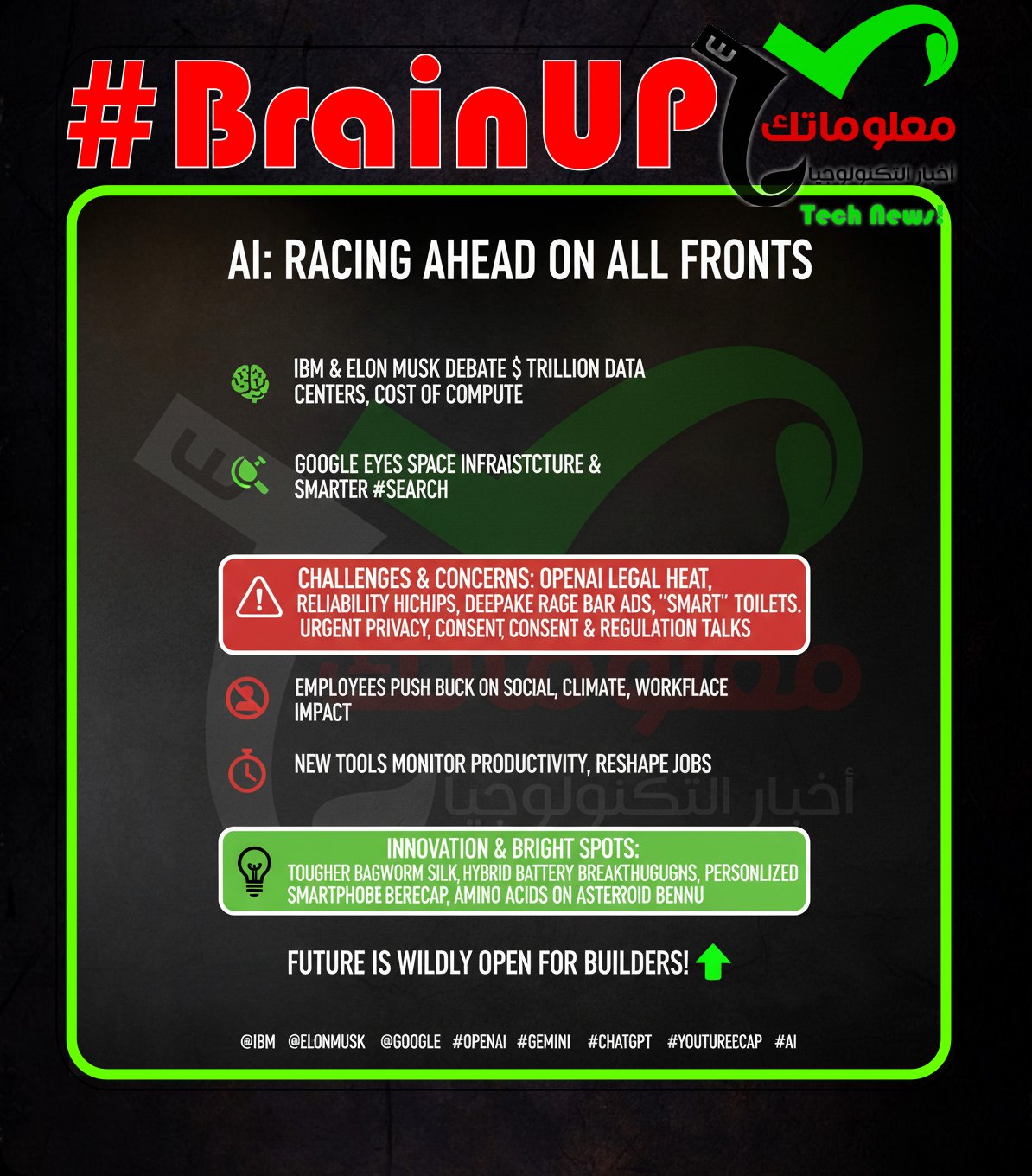
#BrainUp Daily Tech News – (Wednesday, December 3ʳᵈ)
Welcome to today’s curated collection of interesting links and insights for 2025/12/03. Our Hand-picked, AI-optimized system has processed and summarized 21 articles from all over the internet to bring you the latest technology news.
As previously aired🔴LIVE on Clubhouse, Chatter Social, Instagram, Twitch, X, YouTube, and TikTok.
Also available as a #Podcast on Apple 📻, Spotify🛜, Anghami, and Amazon🎧 or anywhere else you listen to podcasts.
IBM @Arvind Krishna questions whether trillions in #capex for #AI data centers will pay off at today’s costs, saying there’s ‘no way’ to turn a profit. He lays out napkin math: a 1 GW data center costs about $80B, so 20-30 GW would imply roughly $1.5T of capex and about $800B in profit just to cover interest. He also notes that AI chips depreciate quickly, needing replacement in about five years, which further erodes potential returns. Krishna contrasts this view with other leaders’ bets, such as @Sam Altman urging 100 gigawatts of capacity annually, a belief he characterizes as speculative, while OpenAI has reportedly pursued about $1.4T in deals. Overall, the piece frames a tension between ambitious AI infrastructure builds and the economics of realizing returns, suggesting the current cost landscape makes profitability uncertain.
2. ChatGPT is down worldwide, conversations disappeared for users
ChatGPT experienced a worldwide outage that resulted in users losing access to their conversations. The disruption affected the ability to interact with the AI, leaving many users unable to use the service temporarily. OpenAI, the company behind ChatGPT, acknowledged the issue and worked to resolve it as quickly as possible. This incident highlights the challenges of maintaining uninterrupted service for popular AI platforms in a global context. It underscores the importance of robust infrastructure and prompt communication to manage user expectations during downtime.
More than 1,000 Amazon employees sign an open letter to @AndyJassy and the company’s leadership warning that the warp-speed rollout of #AI will do staggering damage to democracy, our jobs, and the earth. Signatories, from Whole Foods cashiers to IT staff, argue the move casts aside climate goals to build #AI and to create a more militarized surveillance state with fewer protections for ordinary people, while pressuring workers to produce more in less time. Amazon says the claims are false, highlighting its climate commitments, including two advanced nuclear energy agreements and more than 600 renewable projects, while noting emissions rose 6% last year due to rapid data-center expansion. The company plans to invest up to $50 billion to expand AI and supercomputing infrastructure for U.S. government customers starting in 2026, and to spend roughly $150 billion on data centers over the next 15 years, per company statements. In October, Amazon announced around 14,000 corporate job cuts—about 4% of the 350,000 corporate workforce—with potential total reductions up to 30,000 as part of an AI-driven restructuring, a backdrop the letter says highlights the tension between AI investments and workers’ careers.
4. AT&T ends DEI commitments under FCC pressure
AT&T confirmed to the FCC that it will end all diversity equity and inclusion programs as part of its effort to secure approval for purchasing wireless spectrum from U.S. Cellular. The company stated it will remove DEI job roles training and internal policies while aligning with new regulatory expectations under @BrendanCarr. The shift mirrors moves by T-Mobile and Verizon which also halted DEI programs during major transaction reviews. The situation highlights how regulatory scrutiny is influencing corporate behavior across telecom with #DEI now treated as a potential risk factor in high value deals. AT&T’s compliance underscores a broader trend in which companies reshape internal culture policies for strategic approval advantages.
6. Toyota Doubles Down on Hybrids in the U.S. with $1.4 Billion Battery Push
Toyota is intensifying its commitment to #hybrid vehicles in the U.S. by investing $1.4 billion to build a new battery factory in North Carolina, aiming to support production of more affordable hybrid electric vehicles. This investment supports Toyota’s strategy to expand hybrid offerings while navigating supply chain challenges and shifting consumer preferences amid rising enthusiasm for #electricvehicles. The new facility will supply lithium-ion batteries essential for hybrid models, differentiating Toyota’s approach from competitors focusing predominantly on battery-electric vehicles. Toyota’s focus on hybrids reflects a belief in their immediate practicality and potential to reduce emissions efficiently compared to conventional gas engines. This move highlights Toyota’s distinct path in the #automotive industry, reinforcing its hybrid leadership and adapting to the evolving energy and regulatory environment.
7. Cosmonaut removed from SpaceX’s Crew 12 mission for violating national security rules: report
Oleg Artemyev, a @Roscosmos cosmonaut, has been removed from SpaceX’s Crew 12 to the ISS over alleged #ITAR violations, according to The Insider, which says he photographed SpaceX documentation and used his phone to export classified information. Roscosmos officials confirmed Artemyev’s transfer to another job, while The Insider cites launch analyst @GregoryTrishkin as the source of the violation claim and says an interdepartmental investigation is underway. The timing—two and a half months before launch—with no clear explanation is described as indicative of a security concern by observers cited in The Insider. Fedyaev has replaced Artemyev on Crew 12, which is scheduled to launch no earlier than Feb 15 and carry ESA’s @SophieAdenot along with two as-yet-unnamed astronauts for a roughly six-month stay. SpaceX and NASA have not publicly commented, and the article notes Artemyev’s long spaceflight history and prior wartime-era photo ops that drew condemnation from @NASA and @ESA.
8. The rise of deepfake pornography in schools: ‘One girl was so horrified she vomited’
The use of #nudify apps and #AI-enabled deepfake technology is spreading in schools, with hundreds of teachers reporting pupils creating sexually explicit images of peers. A headteacher recounted a teen on a bus using a #nudify app to alter a girl’s photo, an incident that led to police involvement and to the decision not to inform the target girl due to stigma. International cases show the scale: in Extremadura, Spain, 15 boys received probation for making fake naked images of female classmates affecting about 20 girls, youngest 11; in Australia, about 50 students at Bacchus Marsh grammar had their images faked and distributed; in the US, more than 30 girls at Westfield High School found deepfake porn shared on Snapchat. In the UK, a Teacher Tapp poll of 4,300 secondary teachers found about 1 in 10 aware of students creating deepfake sexually explicit videos in the last academic year, mostly involving 14-year-olds or younger, including 11-year-olds. The piece argues this reflects a culture where consent and personal boundaries are undermined, and stigma around image-based abuse can prevent victims from being told or supported.
9. White House Launches “Worthless And Whiny” Taxpayer-Funded Media Bias Tracker
The White House has introduced a taxpayer-funded media bias tracker aimed at monitoring alleged inaccuracies and bias in news reporting. This initiative, criticized for its ineffectiveness and perceived whininess, seeks to hold media outlets accountable but raises concerns about government overreach and the chilling effect on free press. Critics argue that the tracker lacks clear standards and may be used to intimidate journalists rather than improve media integrity. The project reflects ongoing tensions between the administration and the press, highlighting challenges in balancing accountability with freedom of expression. Ultimately, this media bias tracker exemplifies the complexities of addressing #media bias while ensuring #press freedom.
10. OpenAI Loses Key Discovery Battle as It Cedes Ground to Authors in AI Lawsuits
OpenAI, whose CEO is @Sam Altman, suffers a setback in its AI copyright battles as a U.S. district judge orders disclosure of internal communications tied to deleting two massive pirated-book datasets, a move that could amplify authors’ leverage. The ruling pushes OpenAI to hand over Slack messages in channels such as project-clear and excise-libgen, and finds OpenAI has waived privilege by shifting its rationale for deletion. The material could illuminate whether OpenAI engaged in willful infringement and, if evidence destruction was contemplated for litigation, could drive higher damages and sway juries in later trials #willful-infringement #discovery #attorney-client-privilege. The decision echoes broader tensions in the #shadow-library dispute landscape, recalling related cases like Anthropic’s $1.5 billion settlement and signaling a tougher environment for OpenAI as authors push theories of piracy #copyright #AI.
11. Sundar Pichai says Google will start building data centers in space, powered by the sun, in 2027
Google plans to start building data centers in space powered by the sun, with initial steps as early as 2027, per @SundarPichai. In #ProjectSuncatcher, Google would send tiny racks of machines to satellites to test the concept and scale from there. Supporters say space-based centers could harness the sun’s vast energy and reduce the environmental footprint of #AI, though the UN Environment Programme cautions about unknowns and tradeoffs. Google frames it as a long-term moonshot and suggests extraterrestrial data centers could become normal within a decade, aligning with the goal of shifting infrastructure off Earth.
Kohler’s Dekota toilet camera is marketed as end-to-end encryption, yet the company can access the data and may use it to train AI models. Data is described as encrypted at rest on devices and on Kohler systems, and data in transit is encrypted to Kohler’s servers where it is decrypted and processed, with safeguards intended to keep identifiable images from Kohler Health employees. The company clarifies that the true end of the encryption is Kohler itself, and that the setup resembles HTTPS between the app and servers rather than true client-side encryption, highlighting a mismatch between marketing terms and actual protection. This raises privacy concerns for users of health-tracking devices that collect images and sensitive data, underscoring the importance of clear encryption definitions and the potential for data use beyond direct service delivery. For consumers, it matters to scrutinize such claims and consider how data could be accessed or used, especially in contexts where AI models might be trained, as discussed in comparisons to #EndToEndEncryption in messaging apps like @WhatsApp, @iMessage, and @Signal and explained by @EFF.
13. Bagworm Silk: Forging a Path to the Future of Fibers | The Government of Japan – JapanGov –
Bagworm silk, a natural protein fiber developed in Japan, offers a sustainable alternative to petroleum-based fibers and their microplastic pollution while demonstrating notable strength. Joint research by @NARO and @Kowa, published in #NatureCommunications, found bagworm silk to have about 2.3 times greater toughness and 1.8 times higher tensile strength than spider silk. To commercialize it, Kowa established the Kowa Research Laboratories for Advanced Science and began indoor breeding with a system for continuous silk collection, noting bagworms spin silk throughout their larval stage after birth. They create ultra-thin, nonwoven fabric-like MINOLON sheets from bagworm silk, and the silk’s highly ordered protein structure underpins its mechanical performance. The work outlines a pathway for industrial-scale, natural fiber production and a potential replacement for conventional fibers, aligning with #bagwormSilk and #biofibers as future materials.
14. This Is When Microsoft Starts Telling Your Boss If You’re Not At Work
Microsoft is implementing new AI-driven monitoring tools within its productivity software to inform managers when employees are not actively working, reflecting a shift towards increased workplace surveillance. This initiative uses data from Microsoft 365 apps to analyze user activity, such as email, document editing, and meeting participation, to gauge engagement levels. Critics argue this raises concerns about privacy and autonomy, potentially impacting employee trust and company culture negatively. However, proponents claim it can enhance productivity and accountability in hybrid work environments by providing managers with clearer insights. The development highlights ongoing tensions between technological capabilities in #workplace monitoring and the need for balance with worker rights.
15. Subaru Owners Are Ticked About In-Car Pop-Up Ads for SiriusXM
Subaru owners are ticked about in-car pop-up ads for SiriusXM that appear on infotainment screens, prompting complaints to @NHTSA. A 2024 Crosstrek owner reported the pop-up overtook the screen during Apple CarPlay use, and Reddit threads dating back to 2023 show ongoing complaints including near-miss incidents where a driver almost wrecked due to the screen changing while driving. The Autopian covered the egregious push notifications, and @TheDrive says Subaru notes the messages occur only twice a year around Memorial Day and Thanksgiving, lasting about two weeks as a safety alert that all channels are available. The piece cautions that large screens demand drivers’ attention and that car makers’ data access may enable more in-car advertising, hinting this could worsen as marketing links expand #inCarAds #infotainment.
16. OpenAI declares ‘code red’ as Google catches up in AI race
@Sam Altman reportedly declared a “code red” at OpenAI, urging a sharper focus on ChatGPT as #Google and others close the gap in the AI race. In a memo reported by the Wall Street Journal and The Information, OpenAI will delay initiatives like #ads, #shopping, #health agents, and the #Pulse personal assistant to concentrate on core improvements such as faster speed, greater reliability, better personalization, and the ability to answer more questions. There will be a daily call for those tasked with improving the chatbot, and Altman encouraged temporary transfers to speed up development. The move signals an inflection point as OpenAI spends hundreds of billions to fund growth while pursuing profitability, while Google’s code red and the strength of #Gemini3 and the #NanoBanana image model illustrate intensifying competition. The Verge frames the moment as a pivotal point in the AI race, with Google’s momentum and its tools pressuring OpenAI to accelerate.
17. The rage-bait era – how AI is twisting our emotions without us even realising it
The rage-bait era is portrayed as a global problem in which AI-generated videos twist emotions to provoke outrage and drive engagement by passing fake clips off as real. The piece points to concrete examples, including a grainy CCTV-style clip of children reciting a Muslim prayer circulated by right‑wing accounts, and a flood of AI-created ‘fake protesters’ and man-on-the-street segments that feed immigration debates, with Oxford University Press naming ‘rage bait’ the word/phrase of the year. The Times exposed a trainer named Geeth Sooriyapura who teaches others to seed outrage for clicks and ad revenue, claiming to have earned hundreds of thousands. AI-generated videos have spread across platforms and audiences, with clips featuring @DonaldTrump and @ZohranMamdani used to amplify messages and videos about SNAP delays circulating on TikTok, Instagram and Facebook. The article notes that tools like OpenAI’s latest Sora can produce convincing clips rapidly, fueling a monetized ecosystem where engagement and revenue trump truth, underscoring the need for media literacy and vigilance in the #ragebait era #AI #OpenAI #Sora #SNAP.
18. A massive Samsung Galaxy S26 leak just revealed all the key specs
A leak from @Ice Universe reveals detailed specs for three Galaxy S26 models, S26, S26 Plus, and S26 Ultra, while there is no mention of an S26 Edge yet. The S26 vanilla features a 6.3-inch FHD+ display with 2,600 nits brightness and 1-120 Hz, a chipset upgrade (Snapdragon 8 Elite Gen 5 / Exynos 2600) with 12GB RAM, 256/512GB storage, a 50MP main camera, 12MP ultrawide, 10MP telephoto, a 4,300mAh battery and 25W charging. The S26 Plus keeps the same display tech, memory options and cameras but bumps to a 4,900mAh battery with 45W charging. The S26 Ultra is the strongest performer, with a 6.9-inch QHD display, 2,600 nits, a Gen 5 chipset, 12/16GB RAM, up to 1TB storage, a 200MP main camera, 50MP ultrawide, 10MP and 5x telephoto lenses, a 5,000mAh battery and 60W charging. Color hints from wallpaper leaks posted by @wr3cckl3ss and launch timing chatter from @theonecid suggest a possible January debut.
19. Google experiments with combining AI summaries and AI Mode for enhanced user experience
Google is testing a new feature that merges its AI-generated overviews with AI Mode to improve the quality and relevance of search results. This integration allows users to receive more concise and contextually rich summaries powered by advanced language models. By consolidating #AI overviews with interactive AI features, Google aims to reduce information overload and streamline the retrieval process. The approach reflects the company’s ongoing efforts to leverage #AI and #machinelearning to enhance search usability and precision. These developments highlight Google’s commitment to innovating in the #searchengine space by blending AI advancements with user-friendly designs.
20. YouTube Launches ‘Recap’ Personalized Year-End Reels, Unveils 2025 Top-Trending Lists
@YouTube unveiled its 2025 end-of-year trending lists and launched YouTube Recap, a personalized, shareable highlight reel of a user’s watch history for the year. Recap offers up to 12 cards highlighting top channels, interests, and how viewing habits evolved, and it assigns personality types such as Sunshiner, Wonder Seeker, and Connector. Recap debuted in New Zealand last month and begins rolling out in North America on Dec. 2, with a worldwide rollout to follow over the week, accessible from the home page or under the You tab on mobile and desktop. Music remains part of Recap, showing top artists and songs for listeners and offering deeper dives into genres, podcasts, and international music via the YouTube Music app. The feature follows the end of YouTube Rewind in 2021 and reflects extensive testing, aiming to capture viewer personas rather than just data. In addition to Recap, YouTube released year-end trending lists for the U.S. across culture, creators, songs, and podcasts, with Netflix’s KPop Demon Hunters and Squid Game among the top topics. Overall, YouTube is expanding year-in-review formats to a broader, shareable experience that echoes #SpotifyWrapped, #YouTubeRecap, and #TrendingLists.
21. Elon Musk lists his three most important ingredients for AI development
Elon Musk emphasizes three essential components for advancing #AI: massive computational power, large-scale datasets, and sophisticated algorithms. He highlights how these ingredients drive the capabilities and improvements in AI technologies. Musk’s perspective aligns with the broader tech belief that scaling computational resources and data quality accelerates AI development. His emphasis informs ongoing investments and strategies in the AI sector. Understanding these core elements helps clarify the roadmap for future AI innovation and deployment.
22. NASA’s OSIRIS-REx Finds Tryptophan on Asteroid Bennu
NASA’s OSIRIS-REx mission discovered the amino acid tryptophan on asteroid Bennu, marking a significant breakthrough in understanding the origins of life. The presence of tryptophan, a complex organic molecule vital for life, suggests that asteroids may have delivered key ingredients to early Earth. Analysis of the Bennu sample revealed these molecules embedded within the asteroid’s carbon-rich material, supporting theories about prebiotic chemistry in space. This finding advances knowledge about the potential for life-building blocks in the solar system and emphasizes the importance of sample-return missions. It underlines the role of celestial bodies in shaping the chemical pathways necessary for life on Earth.
That’s all for today’s digest for 2025/12/03! We picked, and processed 21 Articles. Stay tuned for tomorrow’s collection of insights and discoveries.
Thanks, Patricia Zougheib and Dr Badawi, for curating the links
See you in the next one! 🚀
