
#BrainUp Daily Tech News – (Tuesday, December 2ⁿᵈ)
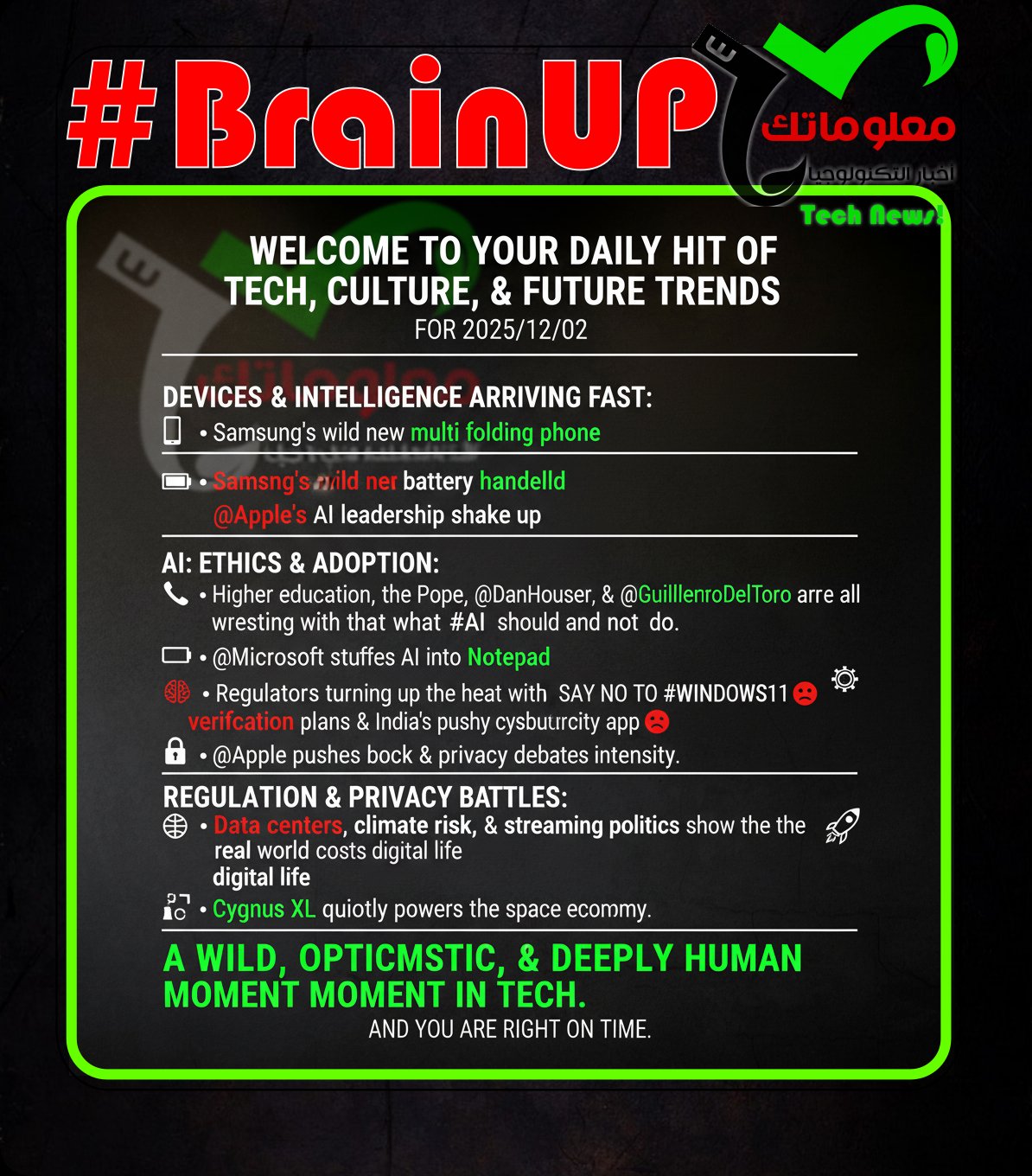
Welcome to today’s curated collection of interesting links and insights for 2025/12/02. Our Hand-picked, AI-optimized system has processed and summarized 19 articles from all over the internet to bring you the latest technology news.
As previously aired🔴LIVE on Clubhouse, Chatter Social, Instagram, Twitch, X, YouTube, and TikTok.
Also available as a #Podcast on Apple 📻, Spotify🛜, Anghami, and Amazon🎧 or anywhere else you listen to podcasts.
1. Samsung unveils first multi-folding phone, competition set to heat up
Samsung has introduced its first multi-folding phone, marking a significant advancement in #mobiletechnology and intensifying competition in the smartphone market. The device features multiple folding screens, allowing greater versatility and portability compared to traditional foldable phones. This innovation demonstrates Samsung’s commitment to pushing #mobileinnovation boundaries against competitors like @Apple and Huawei, who are also exploring foldable tech. The launch is poised to influence consumer preferences and elevate standards for future smartphones. Samsung’s multi-folding phone sets a new benchmark in the evolving landscape of foldable devices, highlighting the escalating race in the industry.
2. AyaNeo Next 2 Gets New Release With Huge 115Wh Battery
The AyaNeo Next 2 handheld gaming PC has received an upgraded version featuring a significantly larger 115Wh battery, enhancing its gaming endurance. This increase in battery capacity compared to previous models allows for extended playtime, addressing a common limitation in portable gaming devices. The new release maintains the device’s powerful hardware, combining performance with improved battery life to satisfy users seeking both strength and longevity. By boosting battery size, AyaNeo demonstrates commitment to user experience, making the Next 2 more competitive in the handheld gaming market. This update is likely to appeal to gamers who prioritize extended mobile gaming sessions without frequent recharging.
3. AI didn’t break college — it exposed a broken system, a professor says
@Steven Mintz argues that AI didn’t ruin college, it revealed a system that long devalued real learning through #industrializededucation of mass lectures and rubric-driven grading. When he opened 400 student essays and found identical sentences, structure, and conclusions, he framed it as a pedagogy crisis rather than a cheating scandal. He notes that AI can already do what many assignments require, so the problem lies with the #takehomeessay and the assignment itself, prompting a shift toward in-class writing, oral presentations without detailed notes, and student-led discussions with assessment based only on observable activities. He envisions #masterylearning handled by AI to take care of basic facts and chronology, freeing students for #inquirylearning that asks questions and builds complex arguments, while continuing to stress timeless literacies like #research, #writing, #numeracy, and #criticalreading in ways that foster creativity and independent thought. If universities persist with business as usual, public trust in higher education could erode.
4. Netflix kills casting from phones
@Netflix has removed the ability to cast shows and movies from phones to TVs for most devices. The company now directs users to navigate @Netflix with the TV remote, and casting remains possible only on older #Chromecast devices or TVs that support #GoogleCast. However, this casting is limited to subscribers on pricier #adfree plans, starting at $17.99 per month, while ad-supported subscribers at $7.99 cannot cast even with legacy #Chromecast devices. Netflix has not explained the reasons, echoing a 2019 move to remove #AirPlay in pursuit of a certain viewing quality. For users with legacy #Chromecast devices, casting may still work on higher‑tier plans, but the broader policy reduces mobile casting for most subscribers.
5. Apple names former Microsoft, Google exec to succeed retiring AI chief
Apple named @Amar Subramanya, a former Microsoft AI researcher who also worked with @DeepMind, to succeed retiring AI chief @John Giannandrea, who will stay on as an advisor through spring. Subramanya will be Apple’s VP of AI and report to @Craig Federighi, leading teams focused on Apple’s foundation models, research and #AI safety. The change follows concerns that Apple lags behind peers in AI investment, despite increasing overall AI spending, and shows Apple pursuing on-device AI over cloud infrastructure while striking a deal with @OpenAI to integrate #ChatGPT into some products. Earlier this year, Siri’s major upgrade was delayed to 2026, underscoring development challenges within the #AppleIntelligence suite launched in 2024. Analysts say this leadership shift could recalibrate Apple’s AI strategy toward stronger on-device capabilities and safer, more personalized experiences in line with Apple’s device-centric approach.
6. Security Disaster: 500 Million Microsoft Users Say No To Windows 11
Half a billion Microsoft users are refusing to upgrade to #Windows11, citing security and privacy concerns as the primary reasons. Many users criticize mandatory features like #TPM 2.0 and stringent hardware requirements that can lead to reduced system performance or incompatibility. This widespread rejection highlights dissatisfaction with Microsoft’s direction and raises questions about the balance between enhanced security and user freedom. The mass resistance reflects broader tensions in the tech community regarding #OS updates and corporate control. Microsoft’s challenge now is to address these concerns while maintaining security standards and user trust.
@Dan Houser, Rockstar co-founder, questions the promised benefits of #AI, suggesting it may not deliver the sunlit future tech visionaries promise. He argues that AI will ‘eat itself’ because models rely on internet-sourced information, which will increasingly be generated by the models themselves, a comparison he likens to feeding cows with cows and producing #Mad_Cow_Disease. He notes that AI will excel at some tasks but not all, urging caution about hype and overreliance on automation. On Virgin Radio UK, speaking with @Chris Evans, he also criticized the executives steering AI development as not being ‘fully-rounded humans’ and questioned their moral authority to define humanity or creativity. This skeptical stance contrasts with the broader AI hype and adds a grounded, human-centered perspective on how AI should fit into labor and creativity.
8. Read Instagram chief Adam Mosseri’s memo ordering staff to the office five days a week in 2026
Instagram chief @Adam Mosseri orders most US staff with desks to return to the office five days a week in 2026, starting February 2, as part of a plan to make Instagram more nimble and creative amid rising competition #backtooffice #creativity. In the memo ‘Building a Winning Culture in 2026,’ the changes include fewer recurring meetings (canceled every six months unless absolutely necessary) and a push to protect focus time by encouraging employees to decline meetings that interfere with deep work #focus. Mosseri also calls for more product prototypes than slide decks to establish proofs of concept and better gauge social dynamics, with a goal of faster decision-making. The policy notes that 2026 will be tough but should move Instagram forward with creativity, boldness, and craft as competition from rivals like Alphabet, Apple, and Microsoft intensifies #prototyping.
9. Spotify stands by ICE recruitment ads despite artist backlash
Spotify stands by ICE recruitment ads amid a backlash from artists and labels, set against a broader climate where tech platforms align with @Donald Trump and #ICE. The ads urge listeners to ‘join the mission to protect America’ and ‘fulfill your mission’ by applying to become an ICE agent, and Spotify says the commercials do not violate its advertising policies and users can thumbs down to manage their own preferences. Epitaph and ANTI-, along with the band Thursday, have posted messages calling for Spotify to stop running the ads. The backlash could foreshadow a larger reckoning for Spotify within the music industry as more artists boycott over founder @Daniel Ek’s investment in the German military AI company Helsing. NoMusicForGenocide’s geo-blocking campaign adds another layer of tension as politics and business intersect in streaming.
10. Amazon Data Centers Linked to Rare Cancers and Miscarriages in Oregon
Residents near Amazon data centers in Oregon have reported higher incidences of rare cancers and miscarriages, prompting concerns about environmental and health impacts from the facilities. Investigations revealed elevated levels of toxic chemicals, including volatile organic compounds (VOCs), possibly released by the data centers or related industrial activities. Health experts suggest these pollutants may contribute to adverse health outcomes among the local population, emphasizing the need for stricter environmental monitoring and regulation. The situation underscores the tension between advancing technological infrastructure and protecting community health in regions hosting large-scale data operations. Addressing these risks is crucial to ensure sustainable growth and safeguard public well-being.
11. A nationwide internet age verification plan is sweeping Congress
A nationwide push to require app-store level age verification is advancing in Congress with the #ASA, which would force stores to verify users’ ages and send that data to apps at download, making app stores the center for youth safety. The federal approach follows state models led by Utah, and it has gained new support from @Pinterest, which argues it would give parents peace of mind, alongside backing from others like @Meta, @Snap, and @X. The package featuring #ASA sits alongside #KOSA and will be debated in a House committee, while Texas faces a legal challenge to a similar law and critics, including @CCIA, contend it could violate the First Amendment. The UK’s Online Safety Act has already mandated age verification and sparked privacy concerns, illustrating the tension between safety goals and data risks, which experts say cannot be fully avoided by moving verification to the store. Supporters frame it as a straightforward, commonsense measure to hold Big Tech to the same safety standard as local stores, while opponents warn it could restrict speech and impose new compliance burdens as the policy potential moves through legal battles and court scrutiny.
12. Zillow drops climate risk scores after agents complained of lost sales
Zillow recently removed its climate risk scores from home listings following feedback from real estate agents who argued the scores negatively impacted their sales. The climate risk scores were designed to inform buyers about potential environmental risks like flooding or wildfires, aiming to increase awareness around #climatechange impacts on real estate. However, some agents reported the scores created fear among buyers, leading to reduced interest and dropping sales figures. Zillow’s decision reflects the tension between transparency regarding climate risks and practical concerns of property market dynamics. This change highlights ongoing challenges in integrating climate data in real estate without inadvertently harming transactions.
Guillermo del Toro used his Gotham Awards Vanguard Tribute for Frankenstein to condemn #AI in filmmaking, bluntly declaring ‘Fuck AI’ and praising the human artistry that shines on every single frame of the film, which was willfully made by humans. He thanked the designers, builders, makeup, wardrobe, cinematographers, composers, and editors, saying the tribute belongs to all of them. On stage with @JacobElordi and @OscarIsaac, del Toro spoke about Mary Shelley’s tale and the privilege of returning to it with artists as extraordinary as @JacobElordi and @OscarIsaac by his side, forming a family around the project. Frankenstein premiered at Venice to a 13-minute standing ovation, streams on Netflix starting Oct 17, and is expected to contend in nine Oscar categories, including Best Picture, Best Supporting Actor for Elordi, Best Adapted Screenplay, and Best Production Design.
During a virtual appearance at the National Catholic Youth Conference in Indianapolis, @Pope Leo XIV warned young people about #AI, saying machines can process information quickly but cannot replace human wisdom or discernment. He told attendees not to ask #AI to do their homework, noting it cannot offer real wisdom, judge between right and wrong, or stand in authentic wonder before the beauty of God’s creation. He called #AI one of the defining features of our time and said safety is built through education and personal responsibility, since filters and guidelines cannot make choices for you. He urged students to use AI in ways that help them grow and to avoid distractions that undermine their dignity or call to holiness, aiming to deepen friendship with God and become more like Him. If AI vanished tomorrow, he argued, you should still know how to think, create, and act on your own, because AI cannot replace the unique gift you bring to the world.
Microsoft is enhancing Windows 11’s Notepad by integrating AI features that allow users to watch AI-generated text appear in real-time, turning the app into an interactive AI toy. This update introduces a streaming experience that visually demonstrates AI text being typed live, showcasing advancements in user engagement with AI-powered tools. The feature is part of Microsoft’s ongoing effort to embed intelligent capabilities directly into native Windows applications, improving productivity and creativity. By offering this interactive AI streaming in Notepad, Microsoft is blending simplicity with cutting-edge technology to enhance the user’s experience. This innovation reflects broader trends in AI integration within operating systems, highlighting Microsoft’s commitment to advancing AI accessibility.
16. India will require a state-owned cybersecurity app to be installed on all smartphones
India plans to mandate the installation of a state-owned cybersecurity app on all smartphones. This move aims to enhance national cyber defenses by monitoring security threats and collecting data to thwart attacks. Critics raise concerns over privacy and surveillance implications, arguing it could lead to misuse of personal information. The government maintains the app will protect citizens and is part of broader efforts to strengthen cyber infrastructure in a rapidly digitizing nation. This policy highlights the balance India seeks between security priorities and individual privacy rights.
17. Apple resists India order to preload state-run app as political outcry builds
Apple is resisting an Indian government directive to preload its state-run app on iPhones sold in the country, prompting a political controversy. Indian officials argue the app is essential for public use and compliance with local regulations. Apple contends that preloading this app undermines user choice and platform policies, fostering debate over digital sovereignty and corporate control. The tension highlights broader challenges in balancing regulatory demands with global tech companies’ operational philosophies. The dispute underscores the clashing priorities in #digitalgovernance and the future of #appdistribution in India.
18. Cygnus XL brings cargo to the ISS for 1st time | Space photo of the day for Dec. 1, 2025
Cygnus XL’s first cargo delivery to the ISS carried 11,000 pounds of supplies, marking a milestone for @NorthropGrumman’s upgraded cargo spacecraft #CygnusXL #ISS. The spacecraft is the largest cargo vehicle to date for Northrop Grumman, reconfigured with increased payload capacity, a larger pressurized cargo volume, and structural upgrades for heavier loads, though a thruster issue caused a one-day delay in arrival. Since 2013, Cygnus missions have delivered experiments, spare parts, and daily necessities to astronauts aboard the ISS under @NASA’s #CRS program. As the ISS ages and plans for commercial space stations in the 2030s accelerate, demand for larger, more capable cargo vehicles continues to grow, a trend this mission helps illustrate #payload #spacecraft. The docking and unloading demonstrate the ongoing logistics pipeline that enables long-duration spaceflight and underscores private industry’s role in supporting the ISS and future space infrastructure.
19. MKBHD’s wallpaper app Panels is shutting down | TechCrunch
@MKBHD’s wallpaper app Panels is shutting down, with Brownlee saying it was a niche product and he couldn’t turn it into the vision he had. Launched in September 2024, Panels offered artist-curated, high-resolution wallpapers at $50 per year or $12 per month and briefly topped the #1 spot in photos apps on iOS and Google Play. It logged around 900k lifetime downloads and about $95k in consumer spending, but last month saw only 3,000 downloads and $500 in revenue, falling short of sustaining the project. Panels will shut down on December 31, 2025, refund active annual subscribers, delete user data after shutdown, and open-source the app code for others. The situation highlights the challenge of monetizing paid wallpaper content and the impact of development-team changes on product execution, even for a high-profile creator #wallpapers #open-source
That’s all for today’s digest for 2025/12/02! We picked, and processed 19 Articles. Stay tuned for tomorrow’s collection of insights and discoveries.
Thanks, Patricia Zougheib and Dr Badawi, for curating the links
See you in the next one! 🚀
